
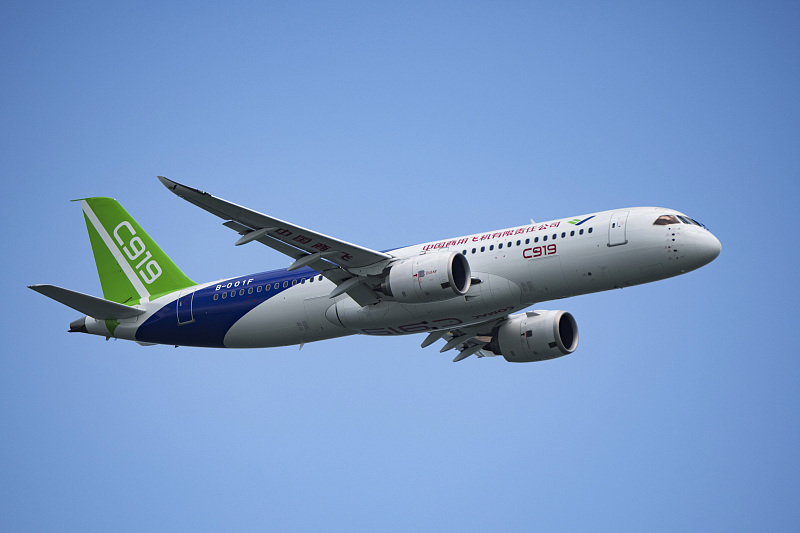
A new aviation and aerospace policy debate is emerging in Washington, where a bipartisan U.S. congressional committee has recommended restricting the certification of Chinese-manufactured aircraft and tightening controls on Western companies maintaining commercial and investment relationships with China's aerospace industry.
The recommendations are contained in a 65-page report titled China's Wingmen: How Western Government Policy Enabled China's Rise in the Skies, released on November 19, 2026, by the U.S. House Select Committee on the Chinese Communist Party following a year-long investigation.
The report calls on the Federal Aviation Administration (FAA) not to certify aircraft manufactured in China, including the COMAC C919, and urges the U.S. government to reconsider federal contracts awarded to aerospace and defence companies that maintain relationships with Chinese military-linked organisations.
These are congressional recommendations, not enacted U.S. policy. The FAA has not introduced a new certification ban, and no immediate prohibition on Chinese aircraft has been announced.
The proposed restrictions could have significant implications for China's Commercial Aircraft Corporation (COMAC), particularly its C919 narrowbody passenger aircraft and C909 regional jet.
The C919 entered commercial service in May 2023 with China Eastern Airlines and is positioned as a domestic competitor to the Airbus A320neo and Boeing 737 MAX families.
However, the aircraft has not received FAA or European Union Aviation Safety Agency (EASA) type certification. The European regulator has been undertaking the C919 certification process, while COMAC's international expansion remains heavily dependent on obtaining acceptance from overseas aviation authorities.
The congressional committee argues that the FAA should not certify Chinese-manufactured aircraft, citing concerns about China's state subsidies, the close relationship between civilian aerospace companies and the military-industrial sector, and aviation safety transparency.
One of the report's cited concerns is China's failure to publish a final investigation report into the fatal China Eastern Airlines Boeing 737-800 crash in March 2022.
The committee argues that insufficient access to safety information raises questions about whether the regulatory environment provides the transparency required for FAA certification.
It is important to distinguish these political and regulatory concerns from a technical finding: the report does not establish that the C919 itself has failed FAA safety requirements. The aircraft has not undergone FAA type certification.
One of the most consequential aspects of the report concerns Airbus, whose extensive manufacturing and industrial partnerships in China have attracted particular attention from U.S. lawmakers.
Airbus opened its first A320-family final assembly line in Tianjin in 2008 and inaugurated a second facility in October 2025. The facilities are part of the manufacturer's global production network, supporting its strategy to serve China's expanding aviation market. More than 800 A320-family aircraft have been assembled in Tianjin, according to industry reporting.
The congressional report argues that Airbus's commercial relationships with Chinese aerospace organisations have contributed to the development of China's wider aerospace manufacturing capabilities.
Particular attention has been directed towards Aviation Industry Corporation of China (AVIC) and its affiliated companies.
One example highlighted by the committee is Xi'an Aircraft Industry Group (XAC), which manufactures wing structures for Airbus A320-family aircraft while also participating in the production of Chinese military aircraft, including the Y-20 strategic transport aircraft and H-6 bomber.
The report also highlights Airbus's historical investment in AviChina, the listed arm of AVIC. Airbus sold its entire 5% shareholding in April 2025, but its operational partnerships and component-supply relationships in China continue.
The committee argues that manufacturing cooperation, engineering expertise and supplier development can create industrial capabilities with potential dual-use applications in civilian and military aviation.
The committee's recommendations go beyond restricting Chinese aircraft certification.
It wants the U.S. government to reconsider the allocation of taxpayer-funded contracts to defence and aerospace companies that simultaneously support China's aerospace industrial base.
Airbus is specifically highlighted because it has commercial and industrial operations in China while also participating in U.S. government and defence programmes.
The report proposes that companies receiving U.S. government funding should disclose their Chinese aerospace relationships and that restrictions should be considered where those relationships support entities linked to China's military capabilities.
It also recommends that the U.S. Treasury Department restrict outbound investments in China's aerospace sector and encourage allied countries to adopt similar measures.
This could create complications for European manufacturers, particularly Airbus and French aerospace companies, whose industrial relationships with China are deeply integrated into global supply chains.
However, these measures would require decisions by the relevant U.S. government authorities and potentially further legislation. They are not currently automatic restrictions on Airbus's U.S. contracts.
The congressional investigation also examined the activities of major American aerospace suppliers, including:
GE Aerospace: Its joint venture with AVIC-related partners, Aviage Systems, supplies avionics technology for COMAC aircraft, including the C919.
Honeywell Aerospace: Its commercial aerospace partnerships in China were examined for technology-transfer and military end-user risks.
Collins Aerospace: Its Chinese commercial partnerships and licensed technology transfers were also scrutinised.
The committee argues that some technologies supplied through commercial programmes could have broader military applications.
However, the companies have defended their activities.
Honeywell said its projects were fully licensed and approved by the U.S. government. GE Aerospace said it takes national security, regulatory compliance and intellectual property protection seriously. RTX, the parent company of Collins Aerospace, also said it complies with applicable U.S. laws and regulations.
The report itself acknowledges that several of the technology transfers were licensed. It does not establish that the commercial partnerships under investigation were necessarily illegal.
The proposed measures could have consequences extending well beyond the COMAC C919.
China's commercial aviation industry continues to depend on international suppliers for important aircraft systems and components. The C919, for example, uses the LEAP-1C engine supplied by CFM International, the joint venture between GE Aerospace and Safran.
This illustrates the complexity of restricting China's aerospace industry: Western manufacturers are simultaneously suppliers to, competitors of and industrial partners with Chinese aerospace companies.
The congressional report also acknowledges this challenge through what it calls the Backfill Problem. If American companies withdraw from Chinese commercial aerospace programmes, European or other international manufacturers could potentially replace them, leaving China with continued access to important technologies while American companies lose commercial opportunities.
The committee therefore advocates coordinated action with U.S. allies rather than relying exclusively on unilateral restrictions.
China's embassy in Washington criticised the recommendations, arguing that national-security concerns should not be used to politicise trade and technology issues.
The report does not immediately change FAA certification policy, aircraft procurement arrangements or existing commercial contracts.
The FAA has confirmed that it has not certified any Chinese-manufactured aircraft. The C919 therefore remains outside the U.S. certification system, and the proposed recommendation would formalise a more restrictive policy towards future applications.
The next steps would involve consideration by the FAA, Treasury Department, export-control authorities and federal procurement agencies, alongside possible legislative action by Congress.
For COMAC, the debate introduces another potential obstacle to international market expansion. For Airbus and other Western aerospace manufacturers, it raises questions about how to balance access to China's large aviation market with U.S. national-security and government-contracting requirements.
Ultimately, the issue is no longer limited to competition between the Airbus A320neo, Boeing 737 MAX and COMAC C919. It increasingly concerns the intersection of commercial aircraft manufacturing, international supply chains, technology transfer and national security.
The central question for the global aviation industry is whether Western aerospace companies can continue manufacturing and cooperating in China while maintaining access to U.S. government contracts and markets under increasingly restrictive national-security policies.
|
Issue |
Development |
|---|---|
|
Congressional report |
China's Wingmen, November 19, 2026 |
|
Issuing body |
U.S. House Select Committee on China |
|
FAA recommendation |
Do not certify aircraft manufactured in China |
|
Aircraft in focus |
COMAC C919 and C909 |
|
Airbus exposure |
Two A320-family assembly lines in Tianjin |
|
Airbus historical production |
More than 800 aircraft assembled in Tianjin |
|
U.S. suppliers scrutinised |
GE Aerospace, Honeywell and Collins Aerospace |
|
Investment proposal |
Restrict U.S. outbound investment in Chinese aerospace |
|
Government contracts |
Reconsider awards to companies supporting China's aerospace industrial base |
|
Current legal status |
Recommendations only; not enacted restrictions |
You may like to read......