
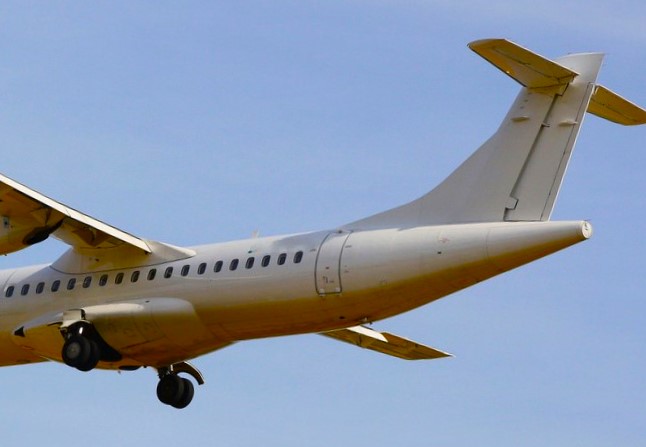
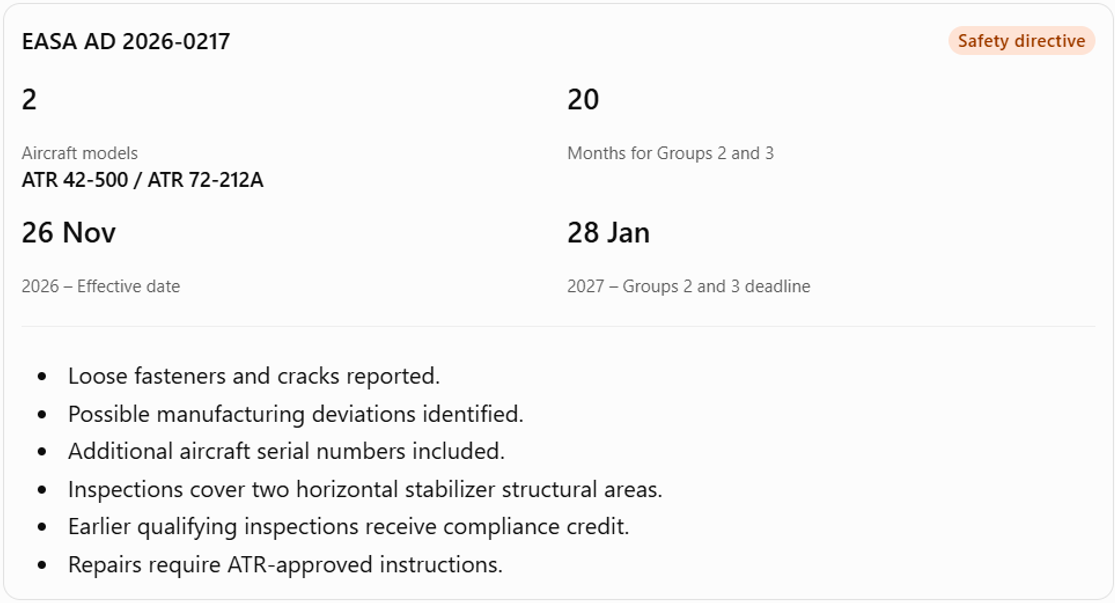
The European Union Aviation Safety Agency (EASA) has issued a new airworthiness directive (AD 2026-0217), requiring additional attention to the horizontal stabilizer structures of certain ATR 42-500 and ATR 72-212A turboprop aircraft.
The directive follows reports of loose fasteners and structural cracks discovered during inspections of aircraft already in service. Subsequent investigations identified possible manufacturing deviations that could affect additional horizontal tailplanes (HTPs).
EASA warns that, if these defects remain undetected and uncorrected, they could compromise the aircraft's structural integrity.
Importantly, this is not a new fleet-wide grounding order. It applies to specific aircraft identified by manufacturer serial number (MSN) in the relevant ATR service bulletins.
The latest directive is the third major regulatory step in a continuing investigation into the ATR horizontal stabilizer.
22 June 2023 – EASA AD 2023-0125
The initial directive followed reports of loose fasteners and cracks in the horizontal stabilizer. It required a one-time detailed inspection of the leading-edge lateral ribs, intermediate box, centre-box upper panel and forward backup fitting.
The compliance deadline was 24 months from 6 July 2023.
14 May 2025 – EASA AD 2025-0110
Further investigation identified additional potentially affected aircraft. The inspection programme was expanded to include the horizontal stabilizer's front spar web and internal centre-box area.
The directive also expanded aircraft applicability and introduced additional ATR service bulletins. It became effective on 28 May 2025.
12 November 2026 – EASA AD 2026-0217
Further engineering analysis concluded that Groups 2 and 3 required a shorter inspection compliance period. The new directive retains the previous inspection requirements but reduces the deadline from the original 24-month period to 20 months for these groups.
It supersedes AD 2025-0110 and becomes effective on 26 November 2026.
The directive identifies two groups of affected structural areas:
Affected Area 1: Left- and right-hand horizontal stabilizer leading-edge lateral ribs, the intermediate box, centre-box upper panel and forward backup fitting.
Affected Area 2: Horizontal stabilizer front spar web and internal centre-box area.
The inspections are detailed one-time inspections (DET), conducted in accordance with the applicable ATR service bulletins:
|
Aircraft |
Service bulletin |
|---|---|
|
ATR 42-500 |
ATR42-55-0020 Rev. 04 |
|
ATR 72-212A |
ATR72-55-1013 Rev. 04 |
|
ATR 42-500 |
ATR42-55-0025 Rev. 01 |
|
ATR 72-212A |
ATR72-55-1018 Rev. 01 |
|
Aircraft group |
Inspection deadline |
|---|---|
|
Group 1 |
Within 24 months of 6 July 2023 |
|
Group 2 |
Within 20 months of 28 May 2025 |
|
Group 3 |
Within 20 months of 28 May 2025 |
If an inspection identifies a discrepancy, operators must contact ATR for approved repair instructions before the next flight. The repair must then be completed within the time specified by ATR, or before the next flight if no compliance period is specified.
There is also an important provision for operators who have already completed inspections. EASA accepts qualifying earlier inspections of Area 1 conducted under the original service bulletins and revisions 01–03, and Area 2 inspections under the original SBs. These inspections do not have to be repeated solely because the directive has been superseded.
The issue has also attracted attention from the US Federal Aviation Administration (FAA).
In December 2023, the FAA issued AD 2023-21-10 covering certain ATR 42-500 and ATR 72-212A aircraft. It addressed loose, missing or incorrectly installed fasteners, composite delamination and cracks in the horizontal stabilizer.
Following EASA's expanded requirements in 2025, the FAA published a further proposed airworthiness directive on 4 May 2026 (Docket FAA-2026-3878). The proposal sought to replace its earlier directive and address the expanded inspection requirements. The comment deadline was 18 June 2026.
This regulatory history demonstrates that the concern is not limited to an isolated inspection finding. Investigations have progressively identified additional potentially affected aircraft and structural areas.
The horizontal stabilizer is a critical part of an aircraft's empennage. It contributes to longitudinal stability and carries aerodynamic loads throughout flight.
Loose fasteners, cracks or composite delamination in its structural components can potentially affect load transfer and structural integrity.
For airlines operating ATR turboprops, the latest directive means:
Reviewing aircraft serial numbers against the updated ATR service bulletins.
Verifying compliance with previous inspection requirements.
Planning inspections within the revised deadlines.
Coordinating with ATR if any structural discrepancies are identified.
Maintaining appropriate airworthiness records.
One important distinction: EASA has not announced a blanket grounding of ATR 42 or ATR 72 aircraft. The directive applies to specifically identified serial numbers, and it does not establish that every affected aircraft has structural damage.
The latest EASA directive reinforces the importance of manufacturing quality, structural inspections and continuing airworthiness monitoring.
What began as reports of loose fasteners and cracks in 2023 has evolved into a broader inspection programme covering additional aircraft serial numbers and internal horizontal stabilizer structures.
With the revised January 2027 deadline approaching for Groups 2 and 3, ATR operators will need to ensure that the required inspections are completed on time.
The key concern is not simply the discovery of cracks, but the possibility that similar manufacturing deviations may exist across additional aircraft structures that have yet to be inspected.
FL360aero note: EASA's directive does not publish a total affected-fleet figure or establish that additional serious incidents have occurred. The findings should therefore be described as a potential unsafe condition rather than evidence of widespread structural failures.