
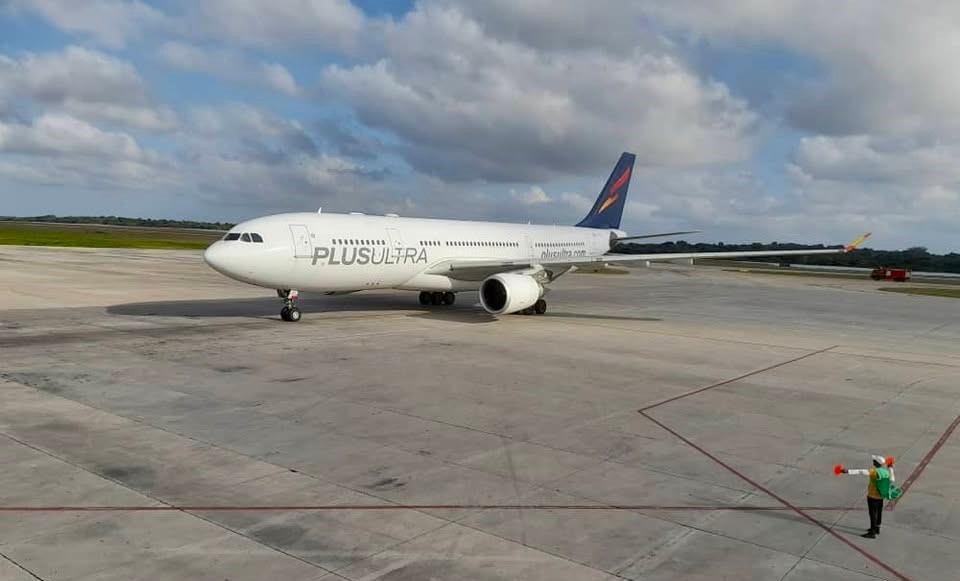
Spanish long-haul carrier Plus Ultra Líneas Aéreas is undergoing a major financial and operational restructuring, with mounting liquidity pressures forcing the airline to suspend key international routes, reduce its flying programme and consider significant workforce adjustments.
The latest development came on November 17, 2026, when the airline suspended its scheduled services between Madrid and Lima, Peru, and Madrid and Buenos Aires, Argentina. The move represents a substantial contraction of its international network and follows the earlier suspension of services to Colombia in June 2026.
However, the two suspended routes have different timelines: Lima has been suspended until further notice, while Buenos Aires services were initially suspended through December 15. The airline has not established a confirmed resumption date for either route.
Plus Ultra attributes the latest operational cuts to the challenging aviation environment, particularly the sharp increase in operating expenses, including aviation fuel costs.
The airline says its restructuring measures are intended to strengthen its financial position and safeguard the company's long-term viability.
According to reports published by Europa Press on November 17 and 18, the carrier has initiated negotiations with creditors under a pre-insolvency restructuring framework to address its financial difficulties and liquidity constraints.
The company has also appointed Spanish law firm Summa Iuris to advise on the restructuring process. The negotiations could extend for an initial three-month period, with a possible additional three-month extension if required.
This is an important distinction: entering a pre-insolvency restructuring process does not mean the airline has already declared bankruptcy or ceased operations. Rather, it provides an opportunity to negotiate with creditors and attempt to avoid formal insolvency proceedings.
The latest restructuring measures are extensive. Plus Ultra has indicated that it intends to reduce its fleet and eliminate a significant portion of its scheduled flying programme.
The company's remaining scheduled international operations are concentrated on Venezuela, with services connecting Caracas to Madrid and Tenerife. Its ACMI and charter division, which provides aircraft, crew, maintenance and insurance services to other airlines, has reportedly continued operating normally.
The company had previously operated a broader network across Latin America, including destinations in Peru, Argentina, Colombia, Uruguay and Venezuela.
The scale of the proposed adjustment is significant:
Scheduled commercial flight hours are expected to be reduced by more than 61%.
The airline has announced its intention to initiate a collective redundancy process (ERE) covering its Madrid workforce.
The affected employment centres include its Madrid headquarters and operational base at Adolfo Suárez Madrid-Barajas Airport.
The workforce involved comprises 679 employees, including 668 active employees and 11 on leave of absence.
The final number of job losses has not yet been established.
The financial figures reported by the airline underline the severity of the situation. Its projected 2026 fuel expenditure reached €104.83 million, compared with an original budget of €69.13 million, representing an increase of approximately 51.6%.
Furthermore, the airline reported an operating loss of €31.08 million between February and August 2026. These pressures, combined with limited liquidity and unsuccessful progress in attracting potential investors, have accelerated its restructuring programme.
The reduction in scheduled operations and the planned fleet downsizing have also raised questions about aircraft utilisation at Madrid-Barajas.
With several long-haul routes suspended and the scheduled network substantially reduced, some aircraft are reportedly remaining on the ground rather than being deployed on regular passenger services.
The fleet reduction is part of the wider restructuring strategy, although the precise number of aircraft currently parked, their individual registrations and their future disposition have not been independently established.
The airline's continued ACMI and charter activities provide an alternative source of utilisation for some of its aircraft while it works to stabilise its scheduled operations.
The financial crisis at Plus Ultra has also triggered a wider debate about passenger protection in the European aviation market.
Spanish consumer-rights organisation FACUA – Consumers in Action issued a statement on November 19, criticising the European Union for failing to introduce a dedicated financial guarantee mechanism to protect airline passengers in the event of carrier insolvency.
FACUA argues that airlines should be required either to maintain specific insurance coverage or contribute to a common guarantee fund. Such a mechanism would help passengers recover the cost of unused tickets and potentially cover alternative travel arrangements if an airline ceased operations because of financial failure.
The organisation had proposed this protection during discussions surrounding the reform of European Regulation EC 261/2004, which governs compensation and assistance for passengers affected by denied boarding, cancellations and lengthy delays.
However, the proposed airline insolvency guarantee mechanism was not incorporated into the revised legislation adopted in 2026.
The revised European passenger-rights framework addresses matters including cancellation and delay compensation, assistance during disruptions, hand baggage and passenger rerouting. However, these protections do not amount to a dedicated fund guaranteeing repayment when an insolvent airline lacks the financial resources to meet its obligations.
FACUA considers the Plus Ultra situation an example of the financial risks faced by passengers who purchase airline tickets weeks or months before departure, only to find that the carrier may subsequently be unable to operate the promised service.
The situation raises important questions about the financial protection available to passengers whose flights are cancelled because an airline is experiencing financial difficulties.
Under the existing EU passenger-rights framework, travellers whose flights are cancelled generally have the right to choose between:
A refund of the unused ticket.
Rerouting to their final destination at the earliest opportunity.
Rerouting at a later date, subject to availability and applicable conditions.
However, the legal entitlement to a refund does not necessarily guarantee that passengers will recover their money if the airline becomes insolvent and cannot meet its financial obligations.
FACUA has highlighted several possible avenues for affected passengers:
The immediate future of Plus Ultra will depend on its ability to negotiate an acceptable restructuring agreement with creditors, restore liquidity and establish a commercially sustainable operating model.
The revised European Regulation (EU) 2026/2202 is scheduled to apply from October 23, 2027. Although it updates the air passenger-rights framework, it does not establish the dedicated airline insolvency guarantee fund sought by FACUA.
For Plus Ultra, the challenge is now much broader than simply restoring cancelled routes. The airline must address its financial obligations, resize its fleet, manage potential redundancies and rebuild confidence among passengers, employees, suppliers and commercial partners.
Its ongoing Caracas services and ACMI/charter operations could provide a foundation for continued business activity. Nevertheless, the outcome of creditor negotiations will be decisive in determining whether the carrier can preserve its long-term position in the European–Latin American aviation market.
|
Area |
Current situation |
|---|---|
|
Financial position |
Serious liquidity and operating-loss pressures |
|
Restructuring |
Creditor negotiations initiated |
|
Lima |
Suspended until further notice |
|
Buenos Aires |
Suspended through December 15 initially |
|
Colombia |
Services suspended since June 2026 |
|
Venezuela |
Caracas services retained from Madrid and Tenerife |
|
ACMI/charter |
Reportedly continuing normally |
|
Fleet |
Reduction planned |
|
Workforce |
Collective redundancy process announced |
|
Employees affected by proposed process |
679 |
|
Fuel expenditure |
€104.83 million projected for 2026 |
|
Operating loss |
€31.08 million, February–August 2026 |
|
Passenger protection |
No dedicated EU airline insolvency guarantee fund |
FL360aero assessment:
This is not yet the story of an airline that has formally gone bankrupt. It is the story of a carrier attempting to avoid insolvency through creditor negotiations, drastic capacity reductions and a restructuring of its business model. The distinction is essential for accurate aviation reporting.
Europa Press – Plus Ultra opens creditor negotiations and prepares collective redundancies
Europa Press – Plus Ultra appoints Summa Iuris for restructuring
El País – Plus Ultra's financial crisis, fleet reduction and planned job cuts
FACUA – Airline insolvency guarantee fund and passenger protection