
Key highlights
1. Dassault abandons hydrogen research: CEO Éric Trappier confirmed on 15 November 2026 that the company has stopped investigating hydrogen propulsion as a viable solution for its future aircraft.
2. Falcon 10X not suited to hydrogen: Trappier ruled out a realistic prospect of powering a large, ultra-long-range business jet such as the Falcon 10X with hydrogen.
3. Major engineering challenges: Hydrogen's low volumetric energy density, cryogenic storage requirements, tank volume, and aircraft integration constraints make long-range applications particularly difficult.
4. SAF becomes the preferred pathway: Dassault is prioritizing sustainable aviation fuels, including biofuels and synthetic fuels, as a more practical route to reducing aviation emissions.
5. Focus on fuel efficiency: The manufacturer will continue pursuing aerodynamic improvements, lighter aircraft structures, and more efficient engines to reduce fuel consumption.
6. Hydrogen aviation faces industry-wide challenges: Dassault's decision follows Airbus's reassessment of its ZEROe programme, although Airbus has not abandoned hydrogen development entirely.
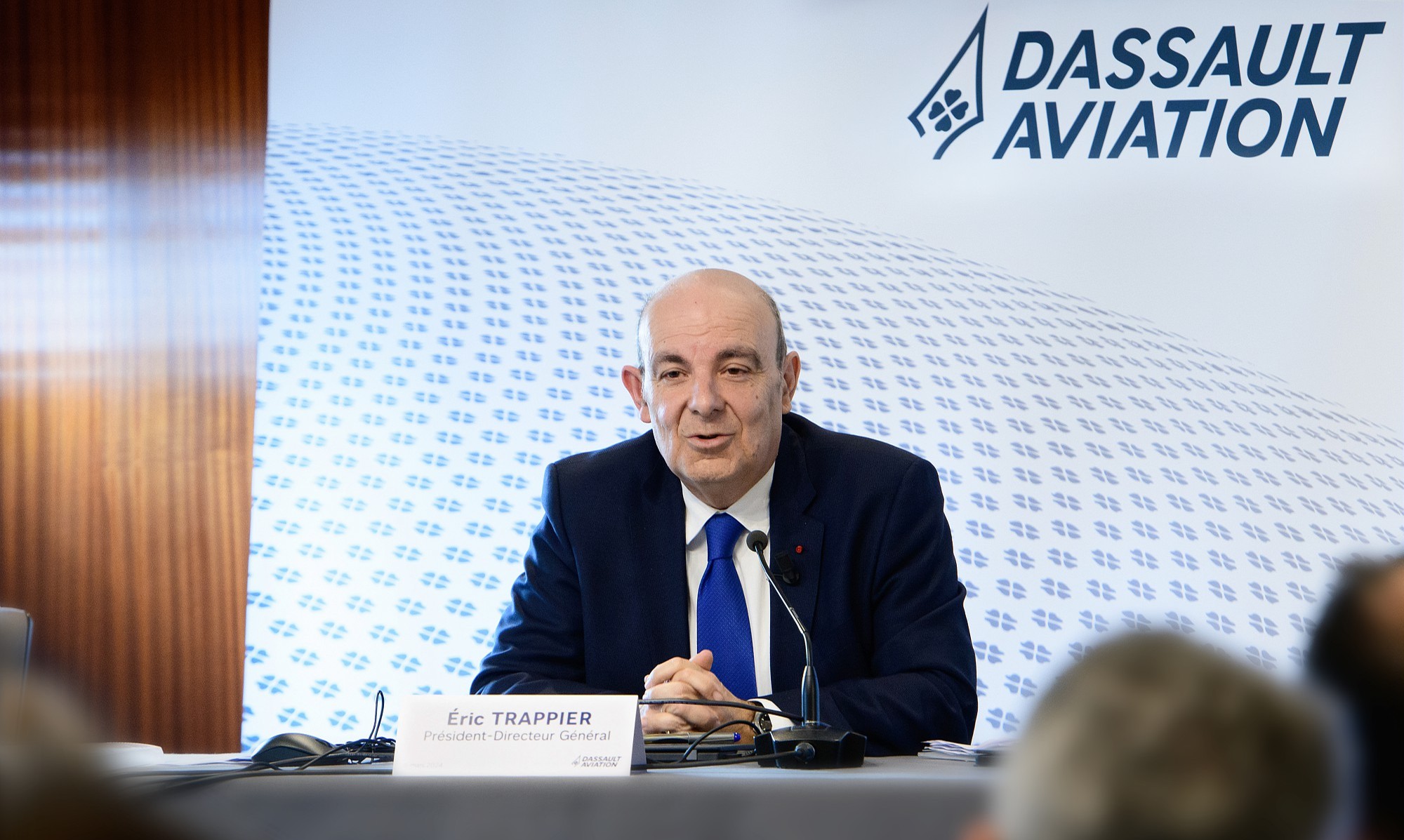
Dassault Aviation has effectively closed the door on hydrogen propulsion as a development pathway for its future aircraft, with Chairman and CEO Éric Trappier saying the manufacturer has stopped investigating the technology because of significant engineering challenges and insufficient technological maturity.
Speaking on 15 November 2026 during Le Grand Jury, the political interview program jointly broadcast by RTL, Public Sénat, Ouest-France and M6, Trappier delivered a particularly clear assessment of hydrogen's prospects in business aviation.
His comments represent a significant development in the industry's debate over alternative propulsion technologies, particularly as aircraft manufacturers face increasing pressure to reduce aviation-related carbon emissions.
In an interview reported by RTL, Trappier stated: "L'hydrogène n'est pas la bonne solution" (Hydrogen is not the right solution).
He added that Dassault had stopped looking into the technology, explaining that its current level of technological maturity did not justify continued development efforts.
Engineering challenges make hydrogen unsuitable for the Falcon 10X
Trappier's principal objection concerns the difficulty of integrating hydrogen storage systems into aircraft without compromising fundamental design requirements.
Unlike road vehicles, aircraft operate under extremely demanding constraints involving aerodynamic efficiency, structural weight, available volume, safety, and operational range.
Hydrogen has a significantly lower volumetric energy density than conventional aviation kerosene. Consequently, storing sufficient hydrogen for long-distance operations requires substantially larger tanks, generally involving cryogenic storage when using liquid hydrogen.
These requirements create major aircraft integration challenges, potentially affecting fuselage configuration, available cabin space, structural design, and overall performance.
For Dassault, these considerations become particularly important when applied to large, long-range business jets.
Trappier specifically referenced the company's flagship Falcon 10X program, stating that he could not see a realistic prospect, within a foreseeable timeframe, of an aircraft of that size operating on hydrogen.
His comments suggest that Dassault does not consider hydrogen propulsion a commercially or technically credible solution for its large business aircraft in the foreseeable future.
Why Dassault is stepping away from hydrogen
Hydrogen propulsion presents several interconnected challenges:
These challenges are particularly significant for business jets, where long-range capability, cabin comfort and operational flexibility are central to aircraft design.
Importantly, Trappier's comments should be understood as Dassault's assessment of hydrogen's suitability for its aircraft programs, rather than a declaration that hydrogen has no future in aviation.
SAF emerges as Dassault's preferred alternative
Instead of pursuing hydrogen propulsion, Trappier is advocating a more incremental approach to aviation decarbonization, centered on sustainable aviation fuels (SAF), improved engine efficiency, and aircraft modernization.
He believes conventional aviation kerosene will remain an important part of the industry's energy mix for many years, while alternative fuels gradually increase their contribution.
SAF offers a significant practical advantage: it can be used as a drop-in replacement for conventional jet fuel within approved blending limits, without requiring an entirely new aircraft propulsion architecture.
These fuels include:
Trappier also called for stronger government incentives to encourage airlines and aircraft operators to adopt alternative fuels, arguing that incentives would be more effective than simply imposing additional penalties on aviation.
Alongside fuel substitution, he highlighted the importance of continued improvements in aircraft engines and accelerating fleet renewal.
Newer aircraft benefit from improved aerodynamics, more efficient engines, advanced materials, and optimized systems, all contributing to lower fuel consumption.
Dassault's recently introduced Falcon 10X is part of this broader technological approach. The aircraft completed its maiden flight on 19 June 2026 and is powered by Rolls-Royce Pearl 10X engines.
Airbus's hydrogen ambitions face a different challenge
Dassault's position comes amid a reassessment of hydrogen aviation across the aerospace industry.
In February 2025, Airbus acknowledged delays to its ZEROe hydrogen aircraft program, moving away from its original ambition of introducing a hydrogen-powered commercial aircraft by 2035.
Reports citing French trade union Force Ouvrière indicated that the program's budget had been reduced by approximately 25% and that certain demonstrator activities, including planned A380 flight testing, had been discontinued.
However, an important distinction is necessary: Airbus did not abandon hydrogen aviation altogether.
In March 2025, Airbus publicly reaffirmed its commitment to hydrogen-powered aircraft, while revising its technical approach and prioritizing hydrogen fuel-cell propulsion over hydrogen combustion.
Its revised concept involves four electric propellers powered by hydrogen fuel-cell systems, with liquid hydrogen stored in dedicated tanks.
Airbus also reported successful earlier testing of a 1.2-megawatt hydrogen propulsion system and outlined further development activities involving hydrogen storage, distribution and propulsion technologies.
This demonstrates that the industry is not following a single direction. While Dassault is stepping away from hydrogen research for its aircraft, Airbus continues to pursue the technology through a revised development strategy.
From optimism in 2020 to withdrawal in 2026
Trappier's latest comments also illustrate how dramatically the industry's expectations have changed over the past six years.
In 2020, while serving as president of the French aerospace association GIFAS, he described hydrogen as a serious avenue for aviation's future and considered technology demonstrators around 2035 a possibility.
By May 2023, however, he was already expressing reservations about investing in the technology.
His November 2026 declaration that Dassault has stopped investigating hydrogen represents the clearest expression yet of that change in direction.
The shift reflects the growing recognition that reducing aviation emissions will require technologies that can meet demanding operational requirements while remaining economically and technically viable.
What this means for the future of aviation
Trappier's position highlights an important distinction in the aviation industry's decarbonization debate: a technology may offer considerable environmental potential without necessarily being suitable for every aircraft category.
Hydrogen could eventually find applications in selected aircraft configurations, particularly where shorter ranges and different aircraft architectures make its storage and integration more manageable.
However, its adoption in long-range business aviation faces substantial technical and infrastructure challenges.
For Dassault, the immediate priority is therefore improving the efficiency of conventional aircraft and supporting the transition towards sustainable aviation fuels.
The broader challenge for the industry will be ensuring that SAF production can scale, that sufficient renewable energy is available and that alternative fuels become economically accessible to aircraft operators.
The message from Dassault is clear: rather than betting on hydrogen for its future business jets, the manufacturer intends to concentrate on technologies and fuels that it considers more achievable within the foreseeable future.
Sources:
7. RTL, 15 November 2026: Éric Trappier: why Dassault no longer believes in hydrogen aircraft — Original report covering the interview, direct quotations, historical context and SAF strategy.
8. Public Sénat, 15 November 2026: Éric Trappier, guest on Le Grand Jury — Program listing confirming the interview.
9. Airbus, 25 March 2025: Airbus showcases hydrogen aircraft technologies — Official explanation of the revised ZEROe development strategy.
10. Dassault Aviation, 19 June 2026: Falcon 10X makes maiden flight — Official aircraft programme and first-flight information.