
.jpg)
The U.S. National Transportation Safety Board (NTSB) has released its preliminary report into the August 19, 2026, midair collision between a Pennsylvania State Police Bell 407 helicopter and a Cessna 150H near Carlisle Airport in Pennsylvania, providing a detailed account of the final moments before the two aircraft collided.
The accident involved Bell Helicopter Textron Canada 407, N873ST, operated by the Pennsylvania State Police as a public aircraft, and Cessna 150H, N23330, conducting a Part 91 personal flight.
The collision occurred at approximately 6:52 p.m. EDT. The two commercial pilots aboard the Bell 407 suffered serious injuries, while the Cessna's commercial pilot was fatally injured. Both aircraft sustained substantial damage, with the Cessna destroyed.
.png)
According to the preliminary investigation, the Bell 407 departed Capital City Airport near Harrisburg and flew approximately 15 nautical miles to Carlisle Airport (N94) to conduct flight-instruction training.
ADS-B data showed the helicopter flying a straight-in approach to Runway 28. It crossed the runway threshold at approximately 50 feet and then continued along the runway before transitioning into a hover taxi approximately 1,800 feet down the 4,008-foot runway.
The helicopter subsequently left the paved runway and hovered over a grass-covered area north of the runway.
At approximately the same time, the Cessna was approaching Carlisle Airport to enter the traffic pattern for Runway 28.
One of the most significant elements of the investigation is that the two aircraft were communicating on the airport's Common Traffic Advisory Frequency (CTAF).
The helicopter crew instructed the Cessna pilot to extend his downwind. The Cessna pilot acknowledged the instruction and indicated that he was number two for landing.
The flight instructor aboard the helicopter later told investigators that the crew initially saw the Cessna on the helicopter's Traffic Alert and Collision Avoidance System (TCAS) and subsequently visually identified the aircraft on the crosswind leg.
The instructor then announced the helicopter's position on final approach. After the Cessna pilot asked whether the helicopter wanted him to extend downwind, the instructor replied affirmatively.
However, the subsequent sequence demonstrates why radio communication alone does not guarantee traffic separation.
Airport surveillance video, combined with ADS-B data, showed the Cessna turning onto the left base leg approximately 2,500 feet from the Runway 28 threshold.
ADS-B tracking was then lost, but three airport security cameras recorded the remainder of the flight.
The helicopter crossed the runway threshold while the Cessna was still on the base leg.
Approximately 30 seconds later, the Cessna crossed the runway threshold while the helicopter remained in the vicinity of the runway.
Investigators said the Cessna's wings rocked from side to side as it flew low over the runway. The aircraft appeared to make several lateral and vertical movements and did not touch down.
As the Cessna approached, the Bell 407 was hovering over the grass north of the runway.
The helicopter pilots told investigators that, because of the helicopter's position and orientation, they were unable to see the Cessna approaching from behind.
This became critical as the Cessna continued along the runway.
The airplane eventually pitched up and began climbing. After reaching the apex of its climb—approximately one and a half wingspans above the runway—its right wing dropped and the aircraft immediately turned toward the northwest.
The helicopter remained approximately 50 feet north of the runway.
The Cessna then rapidly pitched up and collided with the rear of the Bell 407, striking its tail rotor and main rotor blades.
Only approximately eight seconds elapsed between the helicopter leaving the runway surface and the collision.
.png)
The impact resulted in major structural breakup of both aircraft.
The Bell 407's main rotor blades and tail boom separated during the collision. The helicopter's primary fuselage structure, including the cockpit, engine and transmission, remained relatively intact before falling onto its left side.
The Cessna was destroyed and separated into four major sections:
The major wreckage was distributed over approximately 250 feet, while additional fragments were scattered in a fan-shaped pattern.
Investigators accounted for and recovered all major portions of both aircraft.
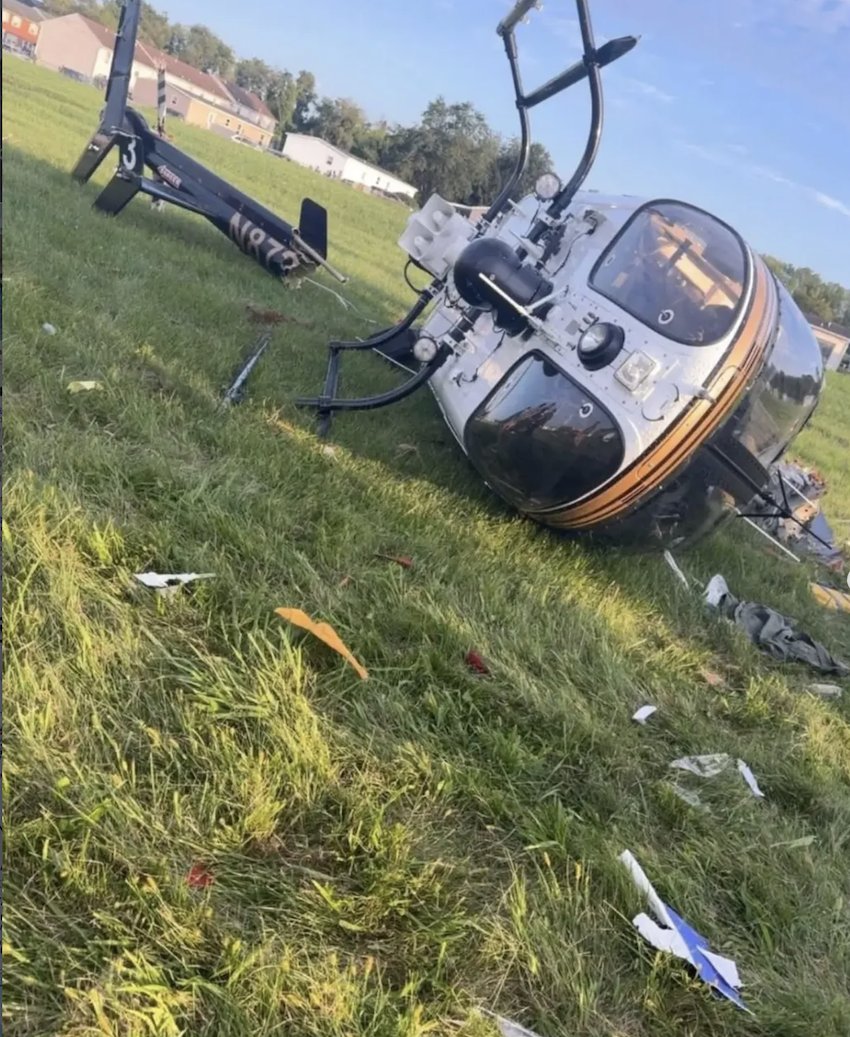
The preliminary examination has not identified evidence of a mechanical malfunction that would have prevented either aircraft from operating normally.
Investigators found paint transfer and structural cuts consistent with an in-flight collision.
The Cessna's flap actuators were also found in the retracted position during the initial examination.
Both aircraft's wreckage and avionics capable of recording digital information have been recovered and retained for further examination.
The NTSB has not yet determined probable cause. The preliminary report is not a final analysis, and investigators will continue examining the recorded data, wreckage and other evidence.
The Carlisle accident comes amid continued concern over the ability of pilots, controllers and onboard systems to maintain adequate separation when aircraft converge in complex airspace.
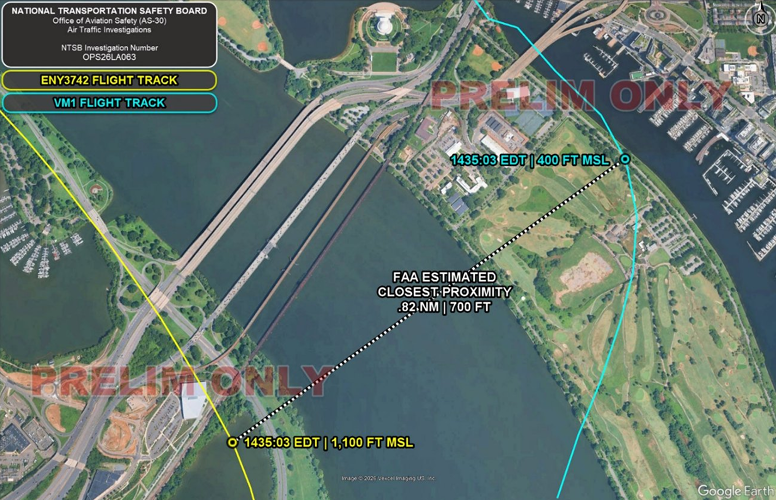
One of the most serious recent examples occurred near Ronald Reagan Washington National Airport, when a U.S. Army UH-60L Black Hawk collided with an American Airlines CRJ700 during approach on January 29, 2025.
All 67 people aboard the two aircraft were killed.
The accident triggered extensive scrutiny of the Washington-area airspace, helicopter routes, controller workload, traffic awareness and the limitations of relying on visual separation.
The investigation demonstrated how rapidly a seemingly manageable traffic situation can deteriorate when multiple aircraft operate in close proximity.
Another significant example occurred near San Diego International Airport in October 2023, when two aircraft came dangerously close to one another during approach.
The incident highlighted the importance of maintaining accurate traffic information and visual awareness even when aircraft are operating under established procedures.
At New York's John F. Kennedy International Airport, a Delta Boeing 737 and an American Airlines Boeing 777 were involved in a serious runway incursion in January 2023.
The American 777 crossed an active runway while the Delta 737 was beginning its takeoff roll. The Delta crew rejected the takeoff, preventing a potentially catastrophic collision.
The event demonstrated another dimension of the same safety problem: aircraft can be in conflict even when each crew believes it understands the traffic situation.
At Austin-Bergstrom International Airport, a Southwest Boeing 737 and FedEx Boeing 767 came dangerously close during a departure and arrival sequence in February 2023.
The NTSB's subsequent investigation examined issues involving controller assumptions, surveillance information and the coordination required to maintain separation.
The preliminary Carlisle findings are particularly significant because the aircraft were not simply unaware of each other's presence.
They communicated.
The helicopter crew reportedly detected the Cessna using onboard traffic-alerting equipment.
The Cessna pilot acknowledged the helicopter's request to extend downwind.
The helicopter crew also made position reports.
Yet the aircraft ultimately occupied conflicting trajectories.
The accident therefore illustrates an important principle in aviation safety: traffic communication, ADS-B and collision-alerting systems are layers of protection—not substitutes for maintaining an accurate mental picture of where other aircraft are and where they will be.
The situation was also complicated by the helicopter's low-altitude hover position and orientation, which left the approaching airplane outside the pilots' visual field.
For general aviation airports, the event reinforces the importance of predictable traffic patterns, clear position reporting, visual acquisition of conflicting traffic and disciplined go-around decisions when the runway environment is no longer as expected.
The NTSB's continuing investigation will be closely watched for its assessment of the pilots' decision-making, traffic-pattern geometry, communications, visibility, aircraft performance and the role of onboard traffic-alerting technology.
The final report—and particularly the NTSB's probable-cause determination—will be needed before definitive conclusions can be drawn about why the collision occurred.
Report and Visual credit: National Transportation Safety Board (NTSB)
You may like to read.......

.jpg)