
.jpg)
A preliminary Airbus engineering assessment has significantly changed the picture surrounding Air India Flight AI2379, which suffered a sudden 300-foot altitude loss on August 4 while flying from Phuket to Delhi.
What was initially described publicly as a brief turbulence event now appears to have involved a much more complex flight-control and hydraulic-system anomaly. Airbus' Customer Services dossier, dated August 4 and exported August 10, says the aircraft experienced a sequence in which the Green, Blue and Yellow hydraulic systems were lost or indicated low pressure almost simultaneously, resulting in the temporary loss of elevator and aileron control.
Airbus fly-by-wire aircraft rely on three independent hydraulic systems—Green, Blue, and Yellow—to power primary flight control actuators. The digital flight data recorder (DFDR) analysis reveals that just prior to 04:02:44 GMT, the Flight Warning System declared an initial pressure drop in the Green system, prompting an automated reconfiguration of control computers (ELAC1 taking over pitch control via the Blue system).
Within seconds, at 04:02:45 GMT, pressure readings across the Blue and Yellow systems simultaneously dropped.
When all three hydraulic systems register low pressure, control actuators can no longer maintain surface deflection against aerodynamic slipstreams. For approximately 4 seconds, the A320neo lost all elevator and aileron surface control.
Without hydraulic pressure to hold them in position, the unpowered ailerons reverted to damping mode, floating upward toward their zero-hinge moment position ($-13.6^\circ$). This surface floating generated an immediate, uncommanded pitch-up moment.
At 04:02:46 GMT, Autopilot 2 automatically disconnected. The First Officer immediately responded by pushing the sidestick full nose-down.
However, because the primary elevators were unpowered and stuck in damping mode, the aircraft was physically incapable of translating pilot input into surface deflection.
The aircraft involved was Airbus A320neo MSN 08470, registration VT-EXO, according to fleet records.
Reuters has reported that Airbus' preliminary analysis found the aircraft's elevators and ailerons were unavailable for approximately four seconds, while the aircraft subsequently recovered and landed safely in Delhi.
The distinction is important: the Airbus document does not establish the root cause. It identifies a sequence of system events and recommends further testing and inspections.
AI2379 was operating from Phuket International Airport to Delhi on August 4, 2026, when the aircraft suddenly lost approximately 300 feet (about 91 metres) of altitude during cruise.
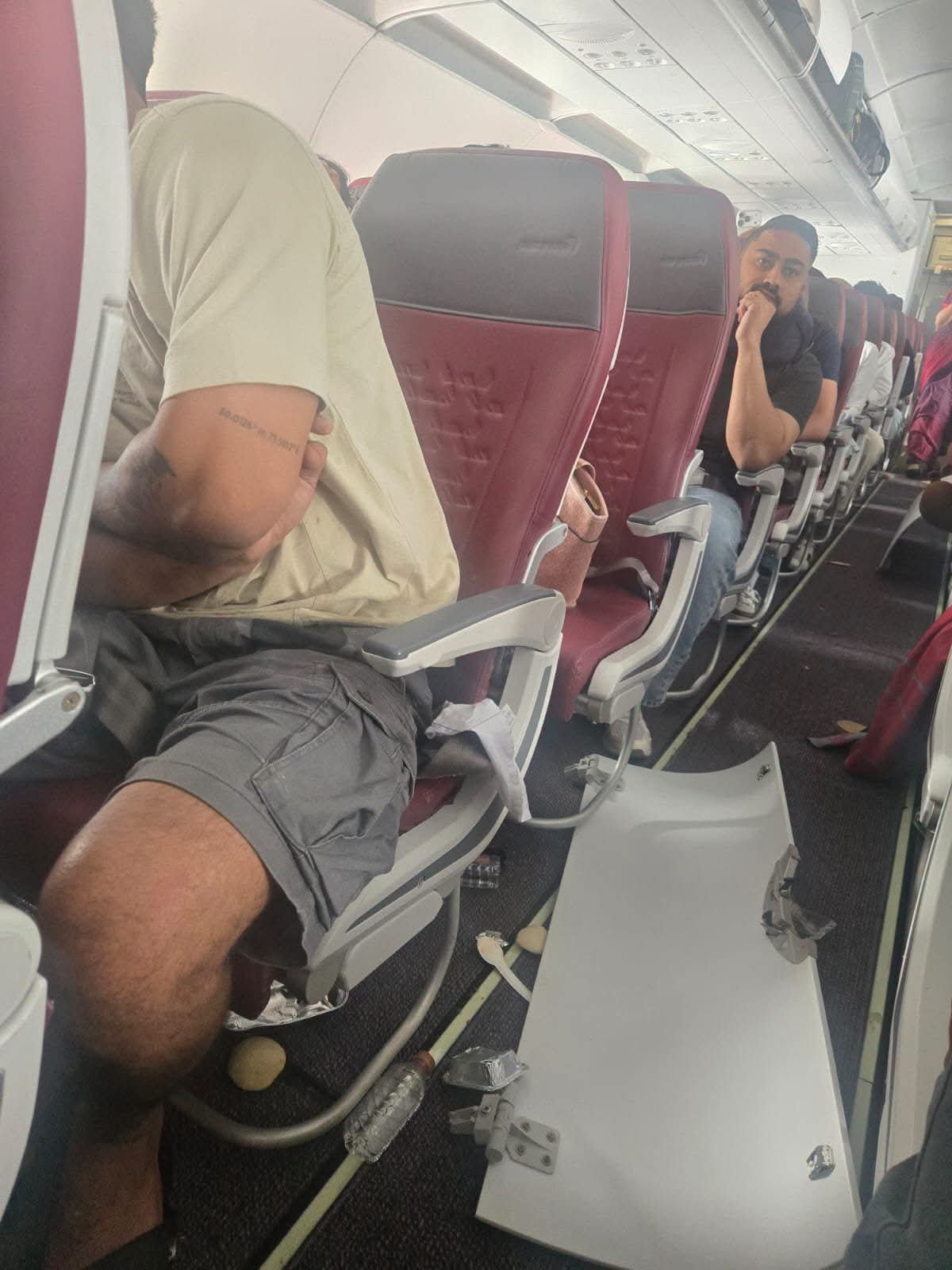
The event injured passengers and crew. Early reporting put the number of injured at 17, while a later Airbus-related account cited by Reuters said 24 people were injured.
The aircraft continued to Delhi and landed safely.
At first, the event was characterized as severe turbulence. But the Airbus engineering analysis of the aircraft's DFDR data provides a substantially different technical dimension.
Rather than simply describing an atmospheric disturbance, Airbus identified a sequence involving hydraulic pressure, flight-control computers and primary flight-control surfaces.
The most important section of the Airbus assessment concerns the sequence beginning at approximately 04:02:44.
Initially, the Flight Warning System detected a loss associated with the Green hydraulic system.
The aircraft's flight-control architecture responded through its designed reconfiguration logic.
Airbus notes that:
Then came the critical development.
Airbus says the Blue and Yellow hydraulic systems were lost.
The consequences were dramatic.
The loss resulted in:
Airbus states that the elevators and ailerons were unavailable for approximately four seconds.
That is the central revelation of the document.
This was not simply a case of the aircraft experiencing turbulence while its flight controls remained fully powered.
For a short period, the A320's primary control surfaces could not provide their normal hydraulic-powered response.
The Airbus description is particularly interesting because the aircraft did not simply become uncontrollable in the conventional sense.
During the loss of hydraulic-powered control, the elevator surfaces moved to different positions:
At the same time, the ailerons entered a damping mode.
Airbus says the ailerons began moving toward their zero-hinge-moment positions, reaching approximately −13.6°/−13.1°.
This aerodynamic movement produced a pitch increase.
In other words, the aircraft's control surfaces were temporarily being governed more by aerodynamic forces than by normal hydraulic actuation.
That created an extremely unusual flight-control condition.
At approximately 04:02:46, the aircraft's autopilot disconnected.
The first officer responded by applying a full nose-down pitch input through the sidestick.
But there was an immediate limitation.
The aircraft's primary flight-control surfaces were still in the process of recovering from the hydraulic-pressure loss.
Airbus states that there was no direct response from the flight-control surfaces because they remained in damping mode.
This means that the pilot's control input and the aircraft's physical response were temporarily decoupled.
The crew was commanding nose-down.
The aircraft could not immediately translate that command into conventional elevator movement.
The critical sequence ended almost as quickly as it began.
At approximately 04:02:51, Airbus says the Blue hydraulic system recovered.
The Yellow system recovered a few seconds later, followed by the Green system.
With hydraulic pressure restored, the flight-control surfaces returned to normal functionality.
The aircraft was therefore without normal elevator and aileron authority for only a few seconds — but those seconds were sufficient to produce the reported 300-foot altitude excursion and substantial vertical loads.
This is why the title "four seconds without controls" is useful as shorthand, but should be understood precisely: the aircraft did not lose all means of control for an extended period. It experienced a short-duration loss of normal hydraulic-powered elevator and aileron authority.
This is where the investigation becomes considerably more complicated.
The A320 has three independent hydraulic systems:
Green — Blue — Yellow
They provide redundancy precisely so that a single hydraulic-system failure does not normally eliminate primary flight-control capability.
The simultaneous loss or low-pressure indication involving all three systems is therefore the key technical issue.
Airbus has not concluded that all three systems physically lost hydraulic pressure.
Instead, its engineering team is investigating whether the recorded indications resulted from:
That distinction is critical.
A sensor or electrical problem that falsely reports low pressure would be fundamentally different from an actual simultaneous loss of hydraulic pressure.
The Airbus dossier specifically calls for additional work under ATA 29 — Hydraulic Power.
The manufacturer requested operational tests of the Green, Yellow and Blue hydraulic systems.
It also requested testing of:
Airbus also specifically identified an issue involving Green hydraulic pressure switch 1151GN in the Aircraft Flight Warning System information.
The document further asks the operator to remove and identify the pressure transducers and leak-measurement switches installed on 50VU.
These recommendations demonstrate why it would be premature to declare that the aircraft actually suffered a simultaneous physical failure of all three hydraulic systems.
The Airbus assessment also examines ATA 22 — Auto Flight.
The manufacturer requests data from:
It recommends additional tests involving the automatic flight system.
This is important because the autopilot disconnect occurred during the event, but the dossier does not say that the autopilot caused the altitude loss.
Instead, the autopilot disconnect appears in the sequence after the hydraulic/control-system degradation.
The investigation must determine whether the autopilot behavior was simply a consequence of the flight-control configuration or whether it contributed to the event.
One of the most interesting aspects of the Airbus analysis is that it appears to show the A320's flight-control architecture reconfigured as designed as hydraulic availability changed.
Initially, the system shifted control responsibilities.
Then, when hydraulic resources became unavailable, the aircraft entered a degraded control state.
Once hydraulic pressure returned, normal flight-control functionality was restored.
This suggests that the aircraft's control laws and reconfiguration logic may have behaved as designed.
But that does not answer the more important question:
That remains unresolved.
The 300-foot altitude excursion was not the only consequence.
Airbus says load exceedances were detected during the sudden altitude change.
As a result, it directed the operator to perform inspections under AMM 05-51-17.
The manufacturer specifically requested the results of those inspections before completing its assessment.
This is standard engineering logic: even if the aircraft subsequently flew normally, an abrupt altitude excursion can impose significant loads on the airframe.
Airbus therefore cautioned that the event requires a detailed assessment of both:
aircraft systems + structural integrity
The final resolution could take longer than a standard aircraft-on-ground case.
The initial description of AI2379 as a turbulence event now requires qualification.
Air India initially described the event as turbulence-related, and passengers reported a sudden drop and violent movement inside the cabin.
But Airbus' DFDR analysis indicates that a flight-control/hydraulic anomaly occurred at essentially the same time as the altitude excursion.
That does not yet prove that a hydraulic malfunction caused the entire event.
It is entirely possible that atmospheric turbulence and a systems anomaly were both involved.
The investigation therefore needs to establish the chronology:
Atmospheric conditions → hydraulic indications → flight-control reconfiguration → loss of control-surface authority → aircraft response → hydraulic recovery
or perhaps:
Hydraulic/system anomaly → aircraft upset → atmospheric effects
The data should ultimately establish which came first.
The aircraft identified in the Airbus dossier is MSN 08470.
Fleet-production records identify MSN 08470 as an Airbus A320neo, registration VT-EXO, operated by Air India, and an Air India fleet reference lists it as an A320-251N powered by CFM LEAP-1A26 engines.
That makes the incident particularly relevant to India's rapidly expanding A320neo fleet.
It also means the investigation could have implications beyond one aircraft if a common component, maintenance practice, wiring configuration or system architecture is ultimately implicated.
The Airbus document should not be interpreted as a final accident-investigation report.
It is explicitly an initial assessment and recommendation.
Several conclusions therefore remain premature:
The Indian Aircraft Accident Investigation Bureau (AAIB) is conducting the investigation, with Airbus and France's BEA involved. Reuters has also reported that authorities have urged caution against drawing conclusions before the evidence is fully assessed.
Four seconds may sound insignificant.
In high-speed flight, it is not.
At cruise speed, an aircraft can travel hundreds of metres in four seconds.
More importantly, an A320 relies on continuous flight-control authority to manage its attitude and trajectory.
The AI2379 event demonstrates what happens when multiple layers of redundancy are temporarily overwhelmed or appear to be simultaneously unavailable.
The aircraft did not remain in that state.
The hydraulic systems recovered.
The control surfaces returned.
The crew regained effective control.
And AI2379 reached Delhi safely.
But the incident exposes a crucial question for investigators and engineers:
What common-mode event could make three normally independent hydraulic systems unavailable to the flight-control system at essentially the same moment?
That is the question that matters far more than the initial 300-foot figure.
The investigation now has several critical paths:
1. Hydraulic testing
Determine whether the Green, Blue and Yellow systems actually lost pressure.
2. Sensor and switch examination
Investigate pressure switches, transducers and associated electrical circuits.
3. Wiring inspection
Establish whether a common electrical fault could have generated simultaneous low-pressure indications.
4. Flight-control computer analysis
Determine exactly how ELACs and other flight-control computers responded.
5. FDR/CVR correlation
Match aircraft-system data with crew inputs, autopilot status and aircraft motion.
6. Structural inspection
Determine whether the high-load event caused any damage requiring corrective action.
7. Meteorological reconstruction
Establish the atmospheric conditions at the precise location and time of the altitude excursion.
The Airbus dossier turns the August 4 AI2379 event from a relatively straightforward "300-foot turbulence drop" into a potentially significant flight-control systems investigation.
For approximately four seconds, the A320's normal hydraulic-powered elevator and aileron control was lost while multiple hydraulic systems were unavailable or indicated low pressure. The autopilot disconnected, the first officer applied nose-down input, and the aircraft's control surfaces initially could not respond normally.
Then the hydraulics recovered.
The aircraft recovered.
And it landed safely.
The crucial unanswered question is no longer simply "How severe was the turbulence?"
It is:
Until investigators answer that question, the Airbus document should be viewed as a major new piece of evidence, not a final determination of cause.
The four seconds may have been brief. The investigation they triggered could be much longer.
Related article......


.jpg)