
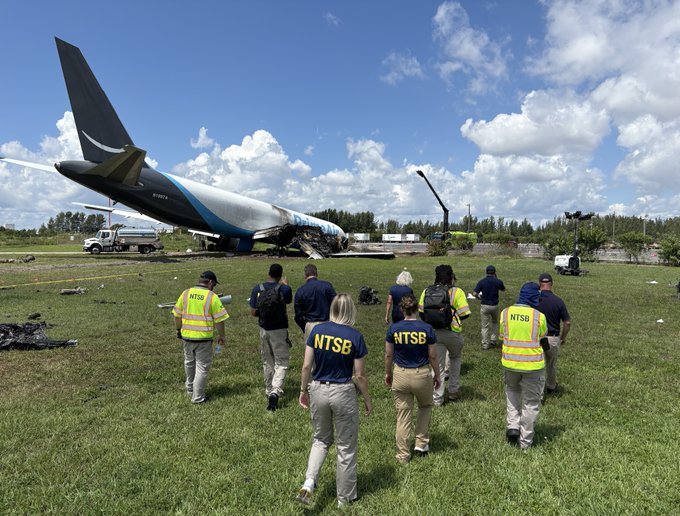
The National Transportation Safety Board has begun its investigation into the deadly Amazon cargo-plane crash at Miami International Airport, with NTSB Chair Jennifer Homendy warning that lessons from the tragedy must result in concrete safety action.
• An Amazon Prime Air Boeing 767-300, operated by 21 Air, overran Runway 30 while landing at Miami International Airport on Sunday.
• The aircraft had arrived from San Juan, Puerto Rico, with two crew members aboard. Both crew members survived.
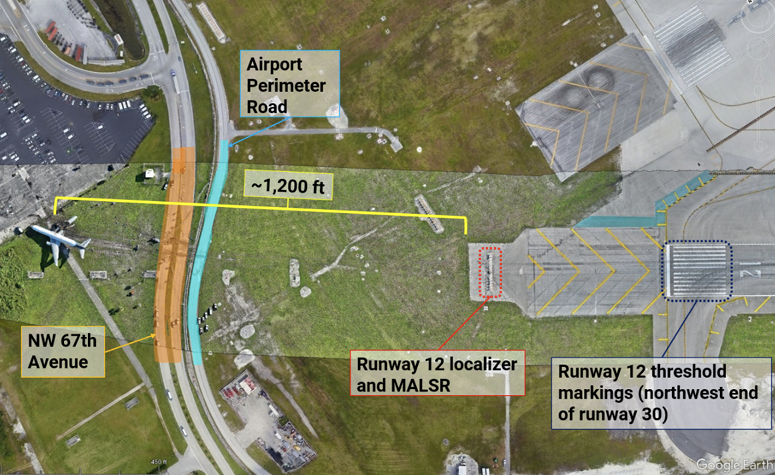
• After leaving the paved runway, the aircraft traveled approximately 1,300 feet beyond the paved surface.
• The plane struck airport equipment and a Ford Econoline van carrying seven people before breaching the airport perimeter.
• It then struck a Toyota Corolla Cross traveling on a road outside the airport and continued into a grassy area.
• The aircraft ultimately came to rest after causing extensive damage and a fire.
5 people were killed
5 people were injured, including three reported to be critically injured.
• The five fatalities were people in the vehicles struck by the aircraft.
• Homendy emphasized that the priority at the scene was first the recovery of victims, with investigators waiting as necessary before accessing evidence.
After personally walking the aircraft's path from the runway to the crash site, Homendy described the scene in stark terms:
“I would describe it in one word: devastating — utter devastation.”
She pointed to tire marks continuing from the paved surface into the grass, extensive aircraft and vehicle debris, damaged airport equipment, fencing and the destroyed cleaning van.
The NTSB has not determined the probable cause of the crash.
Investigators are examining multiple aspects of the accident, including:
• Aircraft performance and speed
• Braking and stopping performance
• Weather and wind conditions
• Flight crew experience, training and actions
• Air traffic control communications
• The aircraft’s operational history
• 21 Air’s policies and procedures
• Runway and airport safety features
• Other mechanical and operational factors
The NTSB has stressed that it is far too early to draw conclusions about what caused the overrun.
Investigators have recovered both:
Flight Data Recorder (FDR)
Cockpit Voice Recorder (CVR)
The recorders are being sent to NTSB headquarters in Washington for download and analysis.
Homendy said investigators have some information about the aircraft’s speed from other sources, but the NTSB wants to verify that information against the flight data recorder before releasing conclusions.
One significant area the NTSB plans to examine is the absence of an Engineered Materials Arresting System (EMAS) at the end of the runway.
EMAS is designed to help slow and stop an aircraft that overruns a runway.
Homendy made clear, however, that investigators have not concluded that the absence of EMAS caused or would have prevented this crash. That is part of the investigation still underway.
The NTSB has deployed a team of approximately 32 investigators, divided into specialized areas to examine the crash.
The investigation includes the aircraft, flight operations, human performance, weather, air traffic control, crew experience and training, company procedures, runway characteristics and other potential contributing factors.
The most striking message from the briefing was not about assigning blame — it was about preventing the next accident.
Homendy stressed that NTSB safety recommendations only have value if they are actually implemented.
“Our recommendations MUST be implemented or we’re going to be here again.”
And when asked whether these types of incidents are happening too often, her response was unequivocal:
“One is too often for the NTSB. Just one.”
She emphasized that whether an accident results in fatalities or not, a single preventable tragedy is too many.
The Miami crash investigation is still in its early stages.
No probable cause has been determined. No final conclusions have been reached.
But Homendy’s message was clear:
➡️ Investigate thoroughly.
➡️ Identify what went wrong.
➡️ Turn the findings into safety recommendations.
➡️ And most importantly — implement those recommendations.
Because, as Homendy warned:
“Our recommendations MUST be implemented or we’re going to be here again.”

.jpg)
.jpg)