
The July 10 Ryanair/Malta Air engine failure bears striking similarities to the 2016 and 2018 Southwest CFM56-7B fan-blade-out events — but the latest NTSB evidence points to a complex combination of fan-blade fatigue, previous bird-strike history and nacelle vulnerability.
The U.S. National Transportation Safety Board (NTSB) has released its preliminary report into the July 10, 2026 fan-blade-out involving Ryanair Flight 1879, operated by Malta Air, during climb from Thessaloniki International Airport in Greece.
The Boeing 737-8AS, registration 9H-QEU, was climbing toward Memmingen, Germany, when its right-hand CFM International CFM56-7B26 engine developed severe vibration.
A fan blade subsequently fractured and separated.
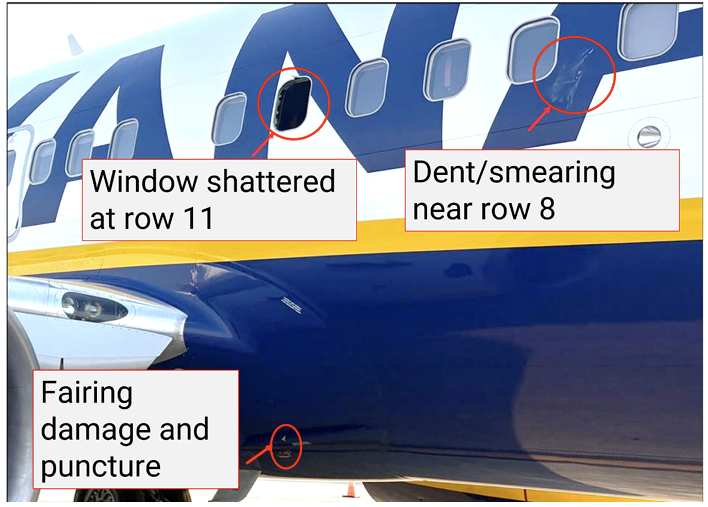
Engine debris struck the aircraft, penetrating the fuselage and destroying a passenger cabin window. The resulting depressurisation caused a passenger to be partially pulled toward the opening and seriously injured.
The crew performed an emergency descent and returned safely to Thessaloniki.
The preliminary findings are significant not only because of the severity of the incident, but because they bring back a familiar issue in the history of the CFM56-7B:
fan-blade fatigue and the ability of the Boeing 737's nacelle structure to protect the aircraft when a fan blade separates.
The NTSB investigation is continuing, and its preliminary findings are subject to change.
Flight 1879 was a scheduled international passenger service from Thessaloniki to Memmingen.
On board were:
As the aircraft climbed through approximately 16,000 feet near Polykastro, the crew received a No. 2 engine HIGH VIBRATION warning.
The pilots reduced engine power and began the appropriate non-normal checklist.
For a short period, the vibration decreased.
The aircraft then continued its climb on autopilot.
The vibration subsequently increased sharply.
The crew heard a loud bang and the autopilot disconnected.
Almost simultaneously, the cabin altitude warning activated.
The pilots donned oxygen masks, declared an emergency and initiated an immediate descent.
The flight attendants reported feeling a loud, continuous vibration and seeing a small amount of fog or smoke before the passenger oxygen masks deployed.
The cabin crew then discovered that the right-side window at row 11 was missing.
A passenger seated at 11F had been partially drawn toward the opening.
Other passengers pulled the injured person back into the cabin.
An onboard doctor subsequently treated the passenger, while the cabin crew provided first-aid equipment.
The flight crew was advised of the cabin condition and continued the emergency descent.
After descending below 10,000 feet, the No. 2 engine was shut down.
The aircraft returned to Thessaloniki and landed safely.
The successful landing prevented what could have been a much more serious accident.
But the preliminary examination has revealed an unusually complicated chain of events.
The No. 2 engine was a CFM56-7B26, manufactured by CFM International, the joint venture between GE Aerospace and Safran Aircraft Engines.
The CFM56-7B uses 24 fan blades.
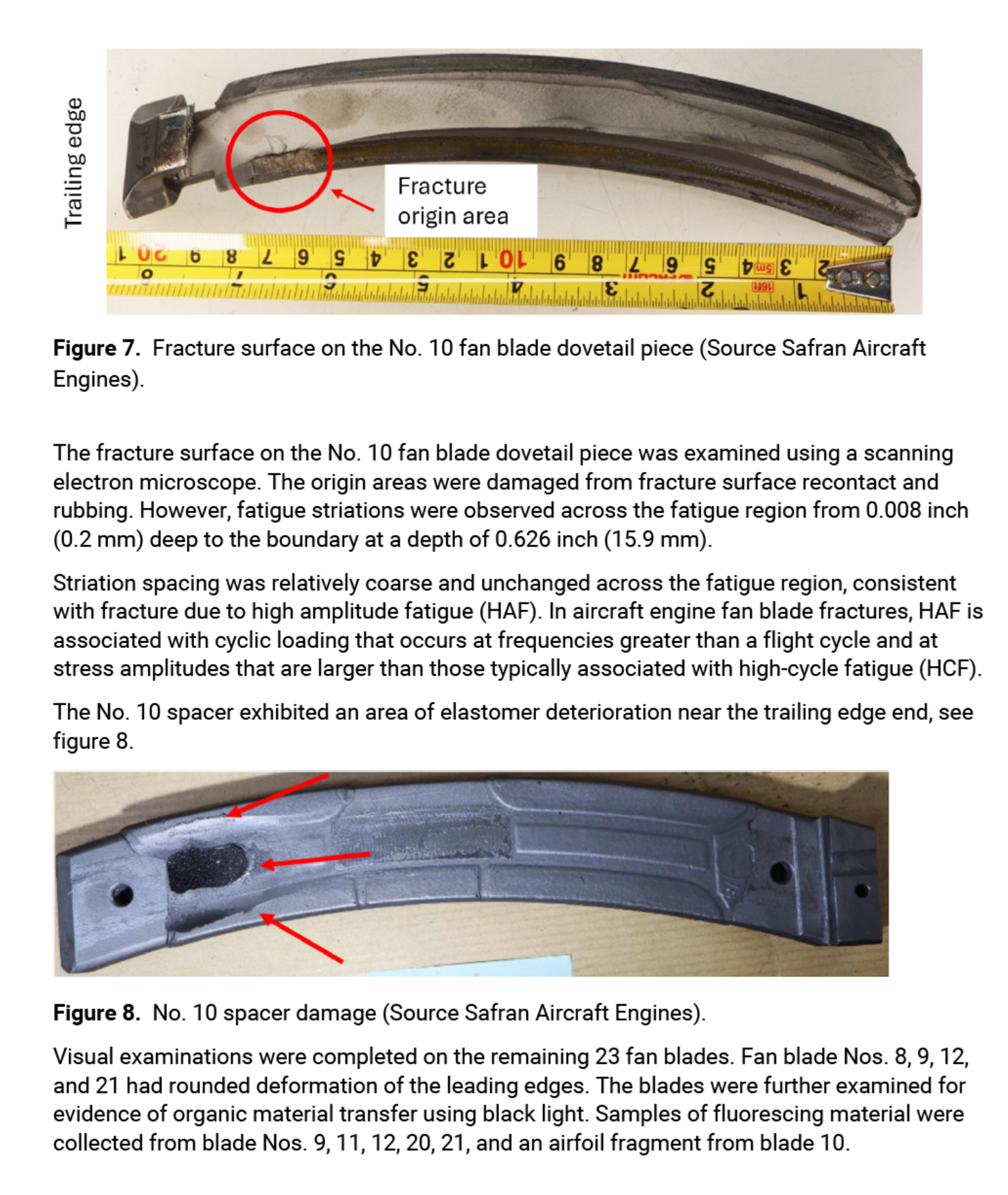
Investigators found that fan blade No. 10 had fractured through its dovetail, the portion of the blade that secures it to the fan disk.
Two additional blades — Nos. 16 and 21 — suffered separation of their outer tips.
Three loose fan-blade fragments were recovered from the engine.
The remaining blades were present but showed varying degrees of impact deformation.
Importantly, investigators found no evidence of radial core uncontainment through the engine cases and no evidence of an under-cowl fire.
The major damage was associated with the fan and nacelle system.
The most important technical discovery in the preliminary report concerns the fracture surface of fan blade No. 10.
Investigators examined the blade at Safran Aircraft Engines in France.
Approximately 37% of the fracture surface exhibited relatively smooth features consistent with fatigue.
The fatigue features were traced to an origin area on the concave side of the blade near the trailing edge.
Investigators identified ratchet marks consistent with multiple fatigue origins.
There was also significant fretting damage around the dovetail contact area and the associated shim.
Scanning-electron-microscope examination subsequently identified fatigue striations across the affected region.
The NTSB's preliminary assessment describes the fracture characteristics as consistent with high-amplitude fatigue (HAF).
This is an important distinction.
The report does not yet say that investigators have determined the ultimate cause of the fatigue.
It establishes that the blade fracture contained characteristics of fatigue, but the investigation still has to determine how and why that fatigue developed.
That could involve a combination of loading, fretting, material condition, previous damage, operating history or other factors.
The distinction becomes especially important when the event is compared with Southwest Airlines Flight 1380, the 2018 CFM56-7B accident.
In the Southwest case, the NTSB determined that fan blade No. 13 fractured because of a low-cycle fatigue crack in the blade dovetail.
That crack initiated because of higher-than-expected dovetail stresses under normal operating loads.
The fracture ultimately caused the fan cowl to separate, damaging the fuselage and ejecting a passenger window.
One passenger was killed.
The Ryanair event therefore shares a broad failure family with Southwest 1380 — fatigue-related fan-blade fracture — but the preliminary evidence indicates a potentially different fatigue mechanism.
Low-cycle fatigue
High-amplitude fatigue indicated in preliminary metallurgical examination
That difference matters.
It would be incorrect to say that the NTSB has already established that the Ryanair blade suffered the same failure mechanism as Southwest 1380.
It has not.
Instead, the latest evidence suggests that the industry may be dealing with another manifestation of fatigue in the same basic fan-blade architecture.
Perhaps the most intriguing aspect of the investigation is the maintenance history.
The fan blades on the engine underwent ultrasonic inspections under CFM Service Bulletin 72-1033 Revision 3 on:
November 11, 2025
and most recently:
May 24, 2026
The second inspection took place only 253 flight cycles before the July 10 event.
No findings were recorded.
That is highly relevant because the service bulletin itself exists because of earlier CFM56-7B fan-blade-out events and requires ultrasonic examination of the fan-blade dovetail areas for evidence of cracking.
The investigation will therefore have to establish whether:
The fact that an inspection was recently completed does not by itself demonstrate a maintenance failure.
Modern nondestructive inspection techniques have limitations, and cracks can develop or propagate between inspection intervals.
Nevertheless, the extraordinarily short interval between the inspection and failure makes this one of the most important questions in the investigation.
The NTSB also found bird remains, including feathers, associated with the engine.
The remains were recovered from several areas, including near the engine's fan case and thrust-reverser components.
The investigation also found that the aircraft's No. 2 engine had experienced four suspected bird strikes during the previous 12 months.
Bird remains were reportedly found in two of those earlier events.
However, maintenance inspections following those incidents found no damage.
This creates an important investigative question:
Did bird ingestion contribute to the fan-blade failure?
At this stage, the answer is unknown.
The presence of bird remains does not prove that a bird strike caused the fan blade to fracture.
Indeed, the metallurgical examination currently provides evidence of a fatigue process at the blade root.
Investigators therefore need to determine whether bird exposure:
Recent public reporting has highlighted the bird remains, but the NTSB has not established bird strike as the probable cause.
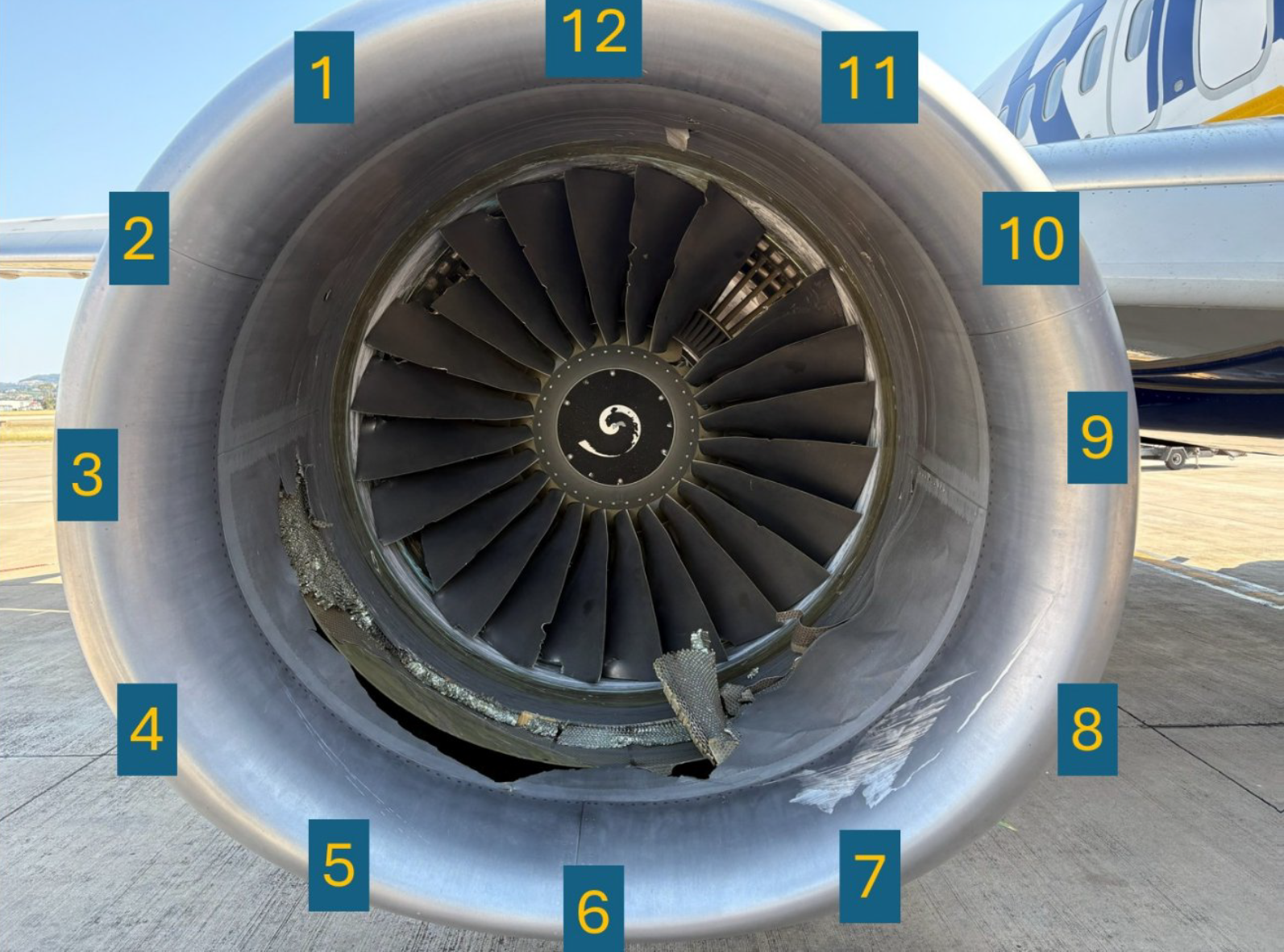
The aircraft's recorded engine data provides a timeline of the deterioration.
During the takeoff roll, the fan-frame compressor-case vibration sensor suddenly increased from approximately 0.2 cockpit units to 1.7.
The vibration then increased to about 2.0 over the following 175 seconds.
It subsequently rose from approximately 2.0 to 4.3 over another 250 seconds.
At that point, the crew reduced engine power.
Vibration dropped to approximately 1.2.
When power was subsequently increased, vibration climbed first to about 2.2 and then reached the recording limit of 5 cockpit units within 19 seconds.
The loud bang was recorded approximately nine minutes and 20 seconds after the beginning of the takeoff roll.
This sequence could prove extremely valuable.
It suggests that the engine was experiencing abnormal vibration before the final blade separation.
The crew responded to the first warning by reducing power, which may have helped preserve the engine and aircraft until the emergency descent could begin.
The fan blade was the initiating mechanical failure.
But the passenger injury occurred because debris escaped the engine/nacelle system and reached the aircraft's pressure vessel.
That makes the nacelle just as important to the investigation.
The NTSB found damage to:
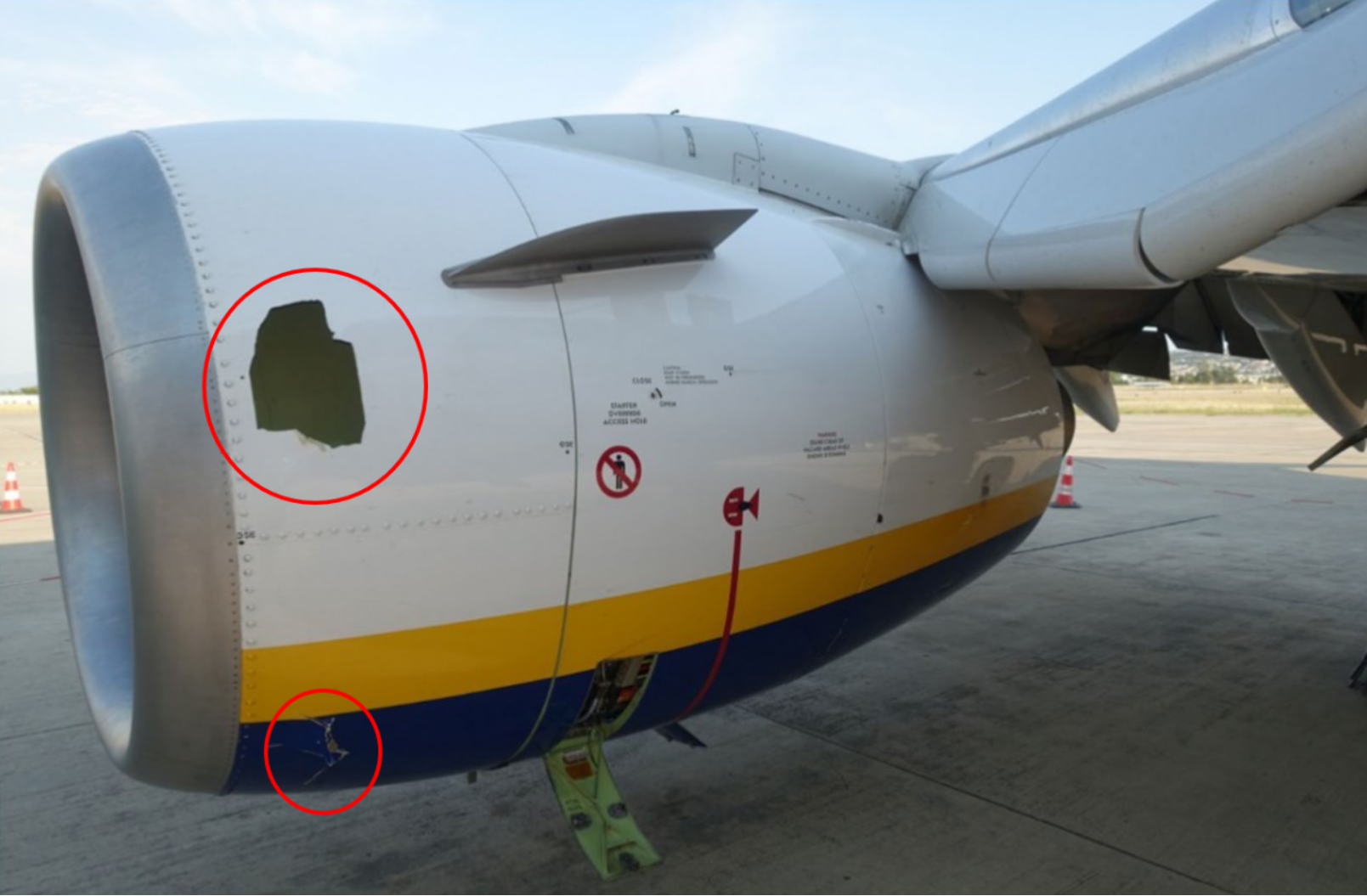
The inlet cowl suffered substantial tearing and puncturing.
Several inlet-cowl fasteners failed.
The fan cowl also suffered structural damage.
And the exhaust nozzle experienced cracking and shear buckling.
This is significant because the FAA had already introduced new airworthiness requirements addressing the CFM56-7B-powered 737 nacelle following previous fan-blade-out events.
Three FAA airworthiness directives are particularly relevant.
AD 2025-04-01 addressed inlet-cowl attachment hardware.
AD 2025-04-02 addressed fan-cowl structural improvements.
AD 2025-04-03 addressed the exhaust nozzle and related structural protection.
The actions followed lessons from previous CFM56-7B fan-blade-out events.
The NTSB preliminary report notes that the enhancements covered by these directives had not yet been incorporated on the accident aircraft.
The applicable compliance date was July 2028.
This does not mean that the aircraft was operating illegally or that the modifications would necessarily have prevented the July 10 event.
The aircraft was still within the regulatory compliance period.
But the overlap is remarkable.
The aircraft suffered exactly the type of fan-blade-out-related nacelle damage that prompted the regulatory changes.
That gives investigators an opportunity to answer a critical engineering question:
Would the upgraded nacelle structure have reduced the damage in the Ryanair event?
The 2018 Southwest accident changed the industry's understanding of an FBO on the 737NG.
Southwest Flight 1380 was operating a Boeing 737-700 from New York to Dallas when the left CFM56-7B engine suffered a fan-blade fracture.
The blade separated at its root.
The resulting forces damaged the fan case and nacelle.
The fan cowl separated.
Debris struck the fuselage near a passenger window.
The window departed the aircraft.
The cabin rapidly depressurised.
One passenger was killed.
The aircraft landed safely at Philadelphia.
The NTSB concluded that the initiating failure was a low-cycle fatigue crack in the fan-blade dovetail.
The investigation also produced a broader lesson.
The NTSB warned that a fan blade can fail and release in a manner different from that anticipated by certification testing and airframe structural analysis.
That led to recommendations concerning not only fan-blade inspection but also the structural integrity of the engine nacelle following an FBO.
That lesson is directly relevant to the Ryanair case.
Southwest Flight 3472 in 2016 had already demonstrated the same general vulnerability.
A CFM56-7B fan blade fractured during flight, causing major damage to the engine inlet and nacelle and ultimately damage to the fuselage.
The aircraft landed safely at Pensacola.
No passengers were injured.
The 2016 event led to increased attention on CFM56-7B fan-blade inspections.
Then came Flight 1380 in 2018.
The second event showed that the risk had not been completely eliminated.
The industry responded with more sophisticated inspection requirements, including ultrasonic inspections of fan-blade dovetails.
The 2026 Ryanair event now represents another real-world test of those measures.
| Event | Engine | Blade issue | Aircraft consequence | Human consequence |
|---|---|---|---|---|
| Southwest 3472 — 2016 | CFM56-7B | Fan-blade fracture | Nacelle/fuselage damage | No injuries |
| Southwest 1380 — 2018 | CFM56-7B | Low-cycle fatigue in blade dovetail | Window lost, rapid decompression | 1 fatality |
| Ryanair 1879 — 2026 | CFM56-7B26 | High-amplitude fatigue features in blade No. 10 | Window lost, fuselage penetration, decompression | 1 serious injury |
The comparison should not be interpreted as proof that the same defect has reappeared.
The CFM56-7B fleet is enormous, and fan-blade-out events are rare relative to the number of engines and flight cycles accumulated.
But the recurring pattern deserves serious attention.
Blade failure → nacelle damage → debris escape → fuselage penetration → decompression
is precisely the chain that modern nacelle protection is intended to break.
The Ryanair case could ultimately become a major test of the industry's post-2018 fan-blade inspection programme.
The CFM56-7B fan-blade inspection regime was strengthened specifically because fatigue cracks can develop in the dovetail region and may not be visible through ordinary visual examination.
After Southwest 1380, ultrasonic inspection became an important tool for identifying cracks before they reached critical dimensions.
The Ryanair blade had undergone such an inspection.
Yet investigators found a fatigue-related fracture only 253 cycles later.
There are several possible explanations.
The May inspection may have been completely effective, with fatigue initiating later.
The defect may have been below the sensitivity threshold of the inspection.
A crack's orientation and location can influence the response of an ultrasonic inspection.
Fretting, impact, loading history or another condition may have contributed to the fatigue process.
The bird remains and previous bird-strike history make this an important possibility to investigate.
The final NTSB report will have to separate evidence from speculation.
The Boeing 737-8AS involved in the event is part of the large and mature 737NG fleet.
The age of the airframe and engine is therefore likely to be examined as part of the broader maintenance and structural history.
But age alone should not be treated as an explanation.
Commercial aircraft are designed and maintained for long service lives, and the CFM56-7B has accumulated enormous global experience.
The relevant question is not whether an aircraft is "old."
It is whether a particular component has experienced the combination of cycles, stresses, environmental exposure and maintenance history that could lead to fatigue.
That distinction is fundamental to aircraft structural and engine engineering.
While the investigation will rightly concentrate on the mechanical failure, the human response also deserves attention.
The pilots recognised the high-vibration indication.
They reduced power.
They followed the non-normal procedure.
When the vibration returned at a much higher level, they reacted immediately.
After the loud bang and decompression warning, they initiated an emergency descent.
The cabin crew simultaneously dealt with:
An onboard doctor assisted the injured passenger.
The aircraft then returned safely to Thessaloniki.
This was a textbook example of multiple independent safety barriers preventing a serious mechanical failure from becoming a mass-casualty accident.
The most troubling aspect is not simply that a fan blade broke.
Jet engines occasionally experience component failures.
The central safety question is what happens after the failure.
The passenger window at row 11 was destroyed.
The pressurised fuselage was penetrated.
A passenger was partially pulled toward the opening.
The event therefore bypassed multiple layers of protection that are supposed to keep an engine failure from becoming a cabin emergency.
The 2018 Southwest accident demonstrated exactly how dangerous this chain can become.
The Ryanair event fortunately ended differently.
You may like to read.......
The NTSB investigation is continuing with specialist groups examining:
The engine, fan, nacelle and blade-separation sequence.
The fracture surface, fatigue origins, blade material and associated components.
The nacelle-to-fuselage damage path, cabin decompression, passenger injury and window failure.
The CVR and FDR have been sent to NTSB laboratories.
The failed fan blade and associated components have been retained.
Investigators are also examining the engine's electronic engine-control and vibration-monitoring systems.
The final report could therefore provide a much more complete picture than the preliminary report.
Several questions now matter to airlines, regulators and engine manufacturers.
First: Was the fatigue crack detectable during the May 24 ultrasonic inspection?
Second: What caused the high-amplitude fatigue?
Third: Did previous bird encounters contribute?
Fourth: Could the fan-blade failure mechanism be present elsewhere in the CFM56-7B fleet?
Fifth: Would the FAA-mandated nacelle modifications have prevented the fuselage/window penetration?
Sixth: Should the compliance timeline for those modifications be reconsidered if investigators establish that they materially reduce FBO consequences?
Those are very different questions from simply asking whether the engine is "safe."
The July 10 Ryanair event is important precisely because it sits at the intersection of several known aviation-safety issues.
The industry already knew:
The new question is whether another fatigue mechanism or another combination of factors can defeat those protections.
That is why the metallurgical finding of high-amplitude fatigue is so important.
It does not yet establish a systemic fleet problem.
It does, however, give investigators a concrete technical phenomenon to understand.
The NTSB's preliminary report turns the July 10 Ryanair Flight 1879 incident from a dramatic inflight emergency into a potentially important engineering case study.
The immediate initiating event was a CFM56-7B26 fan-blade failure.
The failed No. 10 blade fractured through the dovetail, and preliminary metallurgical examination found features consistent with high-amplitude fatigue.
Bird remains were also found in the engine, while the aircraft had experienced four suspected bird strikes involving the No. 2 engine during the preceding year. But investigators have not determined that bird ingestion caused the fan-blade fracture.
The blade had also passed a recent ultrasonic inspection, making the timing and detectability of the fatigue crack a central issue.
Then came the second failure in the safety chain: the FBO produced nacelle and fuselage damage, destroyed a passenger window and caused cabin depressurisation.
That brings the investigation directly back to the lessons of Southwest 3472 and, especially, Southwest 1380.
The aviation industry's goal after those accidents was not merely to make fan blades less likely to fail.
It was to ensure that if a blade does fail, the aircraft remains protected from the consequences.
The Ryanair incident will show how well those lessons have translated into real-world safety.
For now, the most accurate conclusion is also the most important:
The NTSB has found evidence of fatigue in the failed fan blade — but the cause of that fatigue, the role of the bird remains, and the effectiveness of the aircraft's existing nacelle protection remain under investigation.
The final answers could influence inspection programmes, component-life assumptions and nacelle protection requirements across a large portion of the global 737NG fleet.
And that is why Flight 1879 matters far beyond one Ryanair aircraft over northern Greece.
Courtesy: NTSB Report
Related Article........

.jpg)
.jpg)