
A communication failure between Marine One and air traffic control was a key factor preceding an August 4 loss-of-separation event involving the U.S. presidential helicopter and an Envoy Air Embraer E-170 departing Ronald Reagan Washington National Airport (DCA), according to preliminary information released by the National Transportation Safety Board (NTSB).
The incident involved Marine One (VM1), a Sikorsky VH-3D, operating from the Ellipse in Washington, D.C., and Envoy Air Flight 3742 (ENY3742), an Embraer E-170 operating a scheduled passenger flight from DCA to Pensacola International Airport (PNS).
The NTSB investigation, OPS26LA063, remains ongoing.
At approximately 2:34 p.m. EDT on August 4, 2026, Marine One departed the Ellipse while Envoy Flight 3742 was departing Runway 1 at DCA and beginning its initial climb.
The critical issue occurred before Marine One's departure.
Under the established coordination arrangement between Marine Helicopter Squadron One (HMX-1) and Washington-area air traffic control, a presidential helicopter operation with the President aboard requires the crew to contact the DCA tower three minutes before departure. The purpose is to give controllers sufficient time to coordinate the helicopter's movement and protect it from conflicting aircraft operations.
However, Marine One's initial attempts to establish communication with the DCA tower were unsuccessful.
According to the NTSB's preliminary information, the first transmission was not received at all, while the second transmission was received as broken and completely unreadable. The helicopter crew ultimately departed without the required three-minute coordination being successfully established.
At that point, the local controller was unaware that Marine One was about to depart and subsequently cleared Envoy 3742 for takeoff.
The two aircraft therefore became airborne at essentially the same time.
The preliminary findings point to an important technical distinction.
The NTSB said there was no known outage or degradation of the DCA helicopter-control frequency on August 4, and FAA personnel had no documented history of problems with the frequency.
After the event, FAA Spectrum Engineering conducted a coverage analysis.
The analysis found that there was inadequate line-of-sight coverage between the helicopter-control radio installation and the Ellipse, where Marine One was temporarily operating because of construction activity at the White House.
This is significant because VHF/UHF air-ground communications are fundamentally dependent on radio line-of-sight. Buildings, terrain, antenna elevation and the relative positions of the aircraft and transmitting/receiving facilities can create coverage limitations even when the radio equipment itself is functioning normally.
In this case, the equipment was apparently operating, but the geographic geometry of the radio system did not provide reliable coverage at Marine One's temporary operating location.
Following the incident, FAA technical personnel relocated the helicopter-control frequency radio equipment from a nearby residential location to the top of the DCA control tower.
Subsequent radio checks with HMX-1 helicopters operating from the Ellipse and nearby areas reportedly found no communication deficiencies.
The event illustrates why the three-minute presidential helicopter notification is operationally important.
The agreement between HMX-1 and DCA ATC provides a defined coordination window before a presidential helicopter departure.
The preliminary information indicates that, because the tower did not receive the required three-minute call, the normal protective coordination did not occur.
The local controller subsequently cleared ENY3742 for takeoff from Runway 1.
At approximately the same time, Marine One established communications after climbing to an altitude where adequate line-of-sight communication with the tower became possible.
The controller then provided Marine One with the current altimeter setting and a traffic advisory concerning the departing E-170.
Marine One's crew immediately reported that they had the traffic in sight.
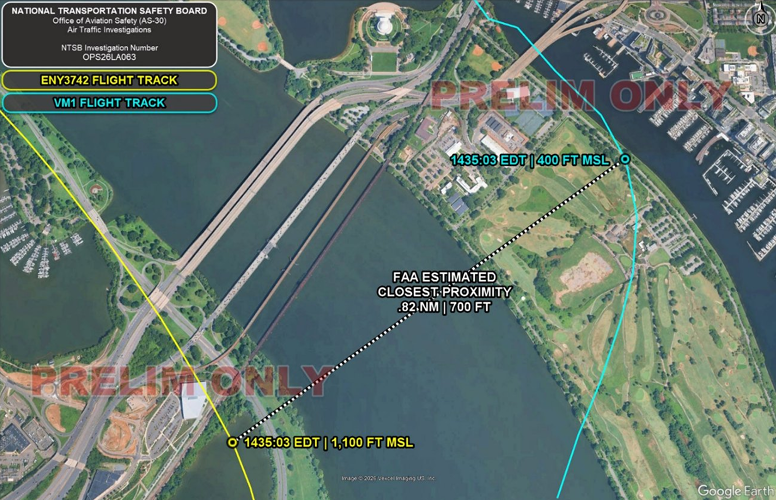
The FAA's preliminary estimate placed the aircraft at approximately:
The NTSB is continuing to examine surveillance information to determine and confirm the actual closest point of approach.
Importantly, the preliminary numbers require careful interpretation.
The NTSB material states that the estimated separation would meet the applicable radar-separation requirement cited in FAA Order JO 7110.65BB, which specified 1.5 NM lateral or 500 feet vertical separation in the applicable Class B airspace situation involving a VFR aircraft and an aircraft weighing more than 19,000 pounds or a turbojet aircraft.
Thus, the event should not automatically be characterized as a confirmed penetration of the numerical radar minimum based solely on the preliminary 0.82-NM/700-ft estimate.
The more significant safety issue was the failure of the established coordination and traffic-management process, which allowed the presidential helicopter and commercial aircraft to begin their departures simultaneously.
The NTSB is still reviewing surveillance data, so the final closest approach could differ from the preliminary estimate.
The E-170 crew provided important information about the encounter.
The first officer was the pilot flying, while the captain was the pilot monitoring.
After takeoff from Runway 1, the aircraft's Traffic Alert and Collision Avoidance System (TCAS) generated a Traffic Advisory (TA) with the standard “Traffic, Traffic” aural alert.
Neither pilot visually acquired the helicopter.
According to their statements, the TCAS traffic symbol remained to the right and below the E-170's own-ship symbol.
The crew observed approximately 600 feet of vertical separation on TCAS as the traffic passed behind the right side of their own-ship symbol.
Critically, the crew reported that no Resolution Advisory (RA) was issued.
This distinction is technically important.
A TCAS Traffic Advisory alerts pilots to potentially conflicting traffic and instructs them to visually acquire and monitor the target. A Resolution Advisory, when generated, provides a vertical maneuver command intended to resolve the conflict.
In this encounter, the E-170 crew received a TA but did not receive an RA.
Once communication with DCA tower was established, the helicopter crew received a traffic advisory regarding the departing Envoy aircraft.
The Marine One crew immediately reported visual contact with the E-170.
This allowed the helicopter crew to maintain awareness of the commercial aircraft while the two aircraft moved away from one another.
Neither aircraft was damaged, and no injuries were reported. Marine One completed its local mission, while Envoy Flight 3742 continued to Pensacola without further incident.
One of the most significant findings emerging from the preliminary investigation is that the communication problem was not entirely unexpected.
The NTSB said that approximately one week before the August 4 event, DCA air traffic controllers and Marine One pilots had met to address communication difficulties.
The participants agreed on an alternative communication method intended to ensure reliable coordination.
However, the alternative method also failed on August 4.
That sequence raises important human-factors and organizational questions for the continuing investigation: Was the backup communication procedure sufficiently robust? Was there a clearly defined point at which the helicopter should not depart if communication with ATC could not be established? And did all parties have a common understanding of what constituted successful three-minute coordination?
The NTSB has not yet issued findings of probable cause, and those questions remain part of the investigation.
The August incident occurred in an airspace environment that had already undergone substantial safety changes following the January 29, 2025 midair collision near DCA, when a U.S. Army UH-60 Black Hawk and an American Airlines regional jet collided over the Potomac River.
That accident killed 67 people and prompted major changes to helicopter operations around Reagan National.
The FAA subsequently established procedures designed to eliminate mixed helicopter/fixed-wing traffic near DCA, eliminated visual separation between helicopters and fixed-wing aircraft within five miles of the airport, revised military coordination agreements and modified helicopter routes and zones.
The FAA also implemented permanent restrictions on certain helicopter operations when DCA's Runways 15 and 33 are in use, following NTSB recommendations arising from the 2025 accident.
Presidential transport, however, is treated as an essential operation and remains subject to specialized coordination procedures.
The Marine One event highlights a fundamental principle of aviation safety: a communication system should not depend on a single point of failure when the operation involves highly protected airspace and simultaneous aircraft movements.
The sequence was effectively:
Marine One prepares to depart → three-minute call attempted → communication not successfully received → ATC does not receive the expected notification → commercial aircraft cleared for departure → Marine One departs → communication restored after altitude increases → traffic advisory issued → crews visually/ electronically identify the traffic → aircraft separate.
The fact that the aircraft ultimately maintained substantial vertical separation does not eliminate the underlying operational concern.
The safety barrier that was supposed to prevent the simultaneous departure was the coordination procedure, and that barrier did not function as intended.
The subsequent discovery of inadequate radio line-of-sight coverage adds another layer: the issue involved not merely pilot or controller performance, but the interaction between radio-system architecture, operating location, communication procedures, ATC coordination and human decision-making.
The NTSB has classified the investigation as ongoing. The Board is examining certified ATC communications, STARS surveillance data, flightcrew statements, radio coverage, ATC procedures and coordination arrangements.
The FAA, Department of the Navy and Envoy Air are participating as parties to the investigation, while Brazil's CENIPA was notified as the representative of the State of Design for the Embraer E-170.
The preliminary report is not a probable-cause determination. The NTSB itself emphasizes that preliminary reports contain factual information collected during the early investigation and are subject to change; probable cause and safety recommendations come later.
The August 4 Marine One event was not a collision and did not result in injuries or aircraft damage, but it exposed a serious weakness in the communication and coordination chain surrounding presidential helicopter operations at one of the United States' most complex airspace environments.
The most important finding so far is not simply how close the aircraft came, but why a procedure specifically designed to prevent simultaneous conflicting operations failed after a communication problem that had already been discussed with the crews and controllers one week earlier.
The NTSB's continuing analysis of surveillance data, communications and operational procedures will determine whether additional systemic safety measures are required.
You may like to read.......


.jpg)
.jpg)