
Highlights
The U.S. National Transportation Safety Board (NTSB) is investigating a serious runway incursion at Boston Logan International Airport (BOS) after a Delta Air Lines Airbus A319 was forced to execute a go-around when an American Airlines Boeing 737-800 began its takeoff roll on an intersecting runway.
The incident occurred at approximately 11:34 a.m. EDT on June 20, 2026, involving Delta Air Lines Flight DL2351, arriving from Dallas/Fort Worth, and American Airlines Flight AA3161, departing for Charlotte, North Carolina.
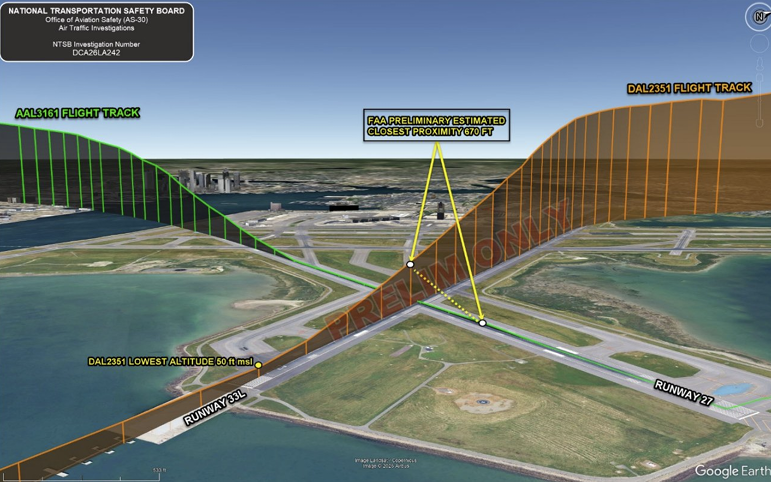
Although no injuries or aircraft damage were reported, the aircraft came within approximately 670 feet (204 meters) of each other, prompting a comprehensive federal investigation into air traffic control procedures, flight crew actions, and the performance of airport safety systems.
According to the NTSB's preliminary report, Delta Flight 2351 was conducting an approach to Runway 33L, while American Flight 3161 was positioned for departure from Runway 27, an intersecting runway at Boston Logan.
Before the incident, a Tradewind Aviation Pilatus PC-12 had landed on Runway 33L and was clearing the runway intersection. Once controllers believed sufficient separation existed, they cleared the American Airlines Boeing 737-800 for takeoff.
The Delta crew expected the American aircraft to depart and clear the runway intersection before their arrival. However, shortly after initiating the takeoff sequence, the American crew received an unexpected takeoff configuration warning after pressing the Takeoff/Go-Around (TOGA) button.
The pilots reduced engine thrust and stopped the takeoff roll while verifying aircraft configuration. After confirming the flaps, trim, parking brake, and speedbrake were properly configured, they concluded the warning was likely erroneous and resumed the departure.
By then, Delta Flight 2351 was rapidly approaching the runway intersection on short final.
Observing the Boeing accelerating toward the crossing point, the Delta captain instructed the first officer to execute an immediate go-around at approximately 500 feet above ground level.
The maneuver was completed safely, allowing the Airbus A319 to climb away before returning for an uneventful landing. American Flight 3161 continued its departure and landed safely in Charlotte.
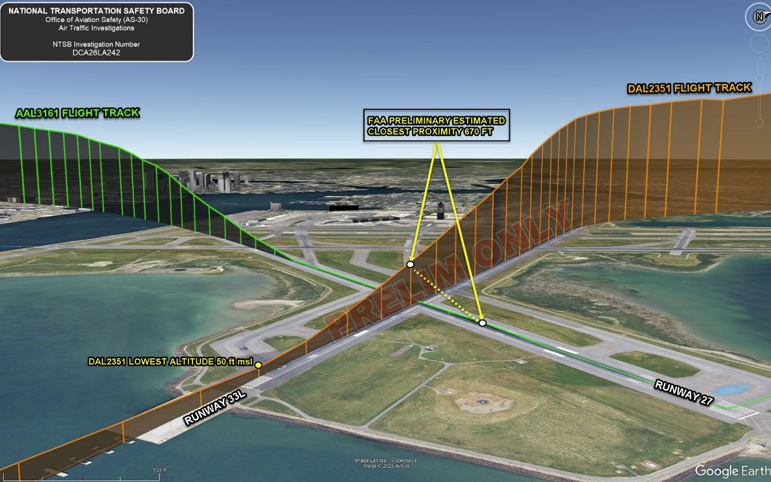
One of the central issues emerging from the preliminary investigation is the delay between American Airlines receiving takeoff clearance and beginning its departure.
According to investigators, the American crew acknowledged the takeoff clearance but remained stationary while troubleshooting the takeoff configuration warning.
Aviation experts note that remaining on an active runway for an extended period after receiving takeoff clearance—without immediately advising air traffic control—can significantly alter the traffic sequence, particularly at airports such as Boston Logan, where intersecting runways require precise timing.
While some reports have highlighted a 54-second delay, the NTSB has not concluded that the delay or the American Airlines crew was responsible for the incident. The agency emphasized that the investigation remains ongoing and no probable cause has been determined.
The Delta flight crew reported that the first officer was flying the aircraft while the captain monitored the approach.
The captain stated that he initially believed the departing American aircraft would clear the runway in time. When the Boeing appeared to pause, he closely monitored both the departing aircraft and the Pilatus clearing the runway.
After observing American Flight 3161 begin accelerating as the Delta aircraft neared the airport, he instructed an immediate go-around.
The first officer later reported that he was unable to see the departing aircraft during the maneuver because the cockpit window pillar obstructed his view.
The Delta crew also stated that they did not receive a Traffic Collision Avoidance System (TCAS) alert during the incident.
The American Airlines crew told investigators that they received a takeoff clearance and initiated the departure normally before encountering an unexpected takeoff configuration warning after pressing the takeoff/go-around (TOGA) button.
After confirming that the aircraft's flaps, trim, parking brake, and speedbrake were properly configured, the crew concluded the warning was likely false and resumed the takeoff.
As they approached the runway intersection, the captain observed the Delta aircraft beginning a go-around. Believing no further conflict existed, the crew elected to continue the takeoff.
Controllers described traffic levels at Boston Logan as moderate to light with no significant distractions before the event.
The Local Control West (LCW) controller stated that after issuing the takeoff clearance, he believed American Flight 3161 had begun departing and shifted his attention toward ensuring the Pilatus PC-12 cleared Runway 33L before Delta's arrival.
Moments later, the airport's surface surveillance system generated a conflict alert.
The controller later acknowledged briefly questioning whether he had actually issued the takeoff clearance because the American flight strip had not yet been marked in his usual manner.
An assisting controller said he became aware of the conflict only after hearing Delta report the go-around and observing the aircraft climb away.
The operations supervisor also reported noticing the event shortly before the automated conflict alert activated.
Boston Logan is equipped with several advanced runway safety technologies, all of which functioned during the incident.
According to the FAA's preliminary review:
Investigators are evaluating whether the timing and controller response to these automated alerts could have further mitigated the incident.
Both aircraft carried cockpit voice recorders capable of storing at least two hours of cockpit audio.
However, investigators found that by the time the recorders were removed and secured, the relevant cockpit conversations had already been overwritten.
Flight data recorders from both aircraft successfully preserved operational data from the flight and are now being analyzed.
The NTSB has established specialized investigative teams focusing on:
Participating organizations include:
Because the Delta aircraft was an Airbus A319 designed in France, the French Bureau of Enquiry and Analysis for Civil Aviation Safety (BEA) has also been notified under international accident investigation protocols.
The NTSB stressed that its report is preliminary and does not assign blame or identify a probable cause.
While the American Airlines crew's delayed departure following the takeoff configuration warning has become a key area of investigation, officials are also examining controller decision-making, runway safety systems, aircraft performance, and human factors before determining what led to the runway incursion.
A final NTSB report, expected after the completion of the investigation, will include the agency's analysis, probable cause determination, and any resulting safety recommendations.

.jpg)
.jpg)