
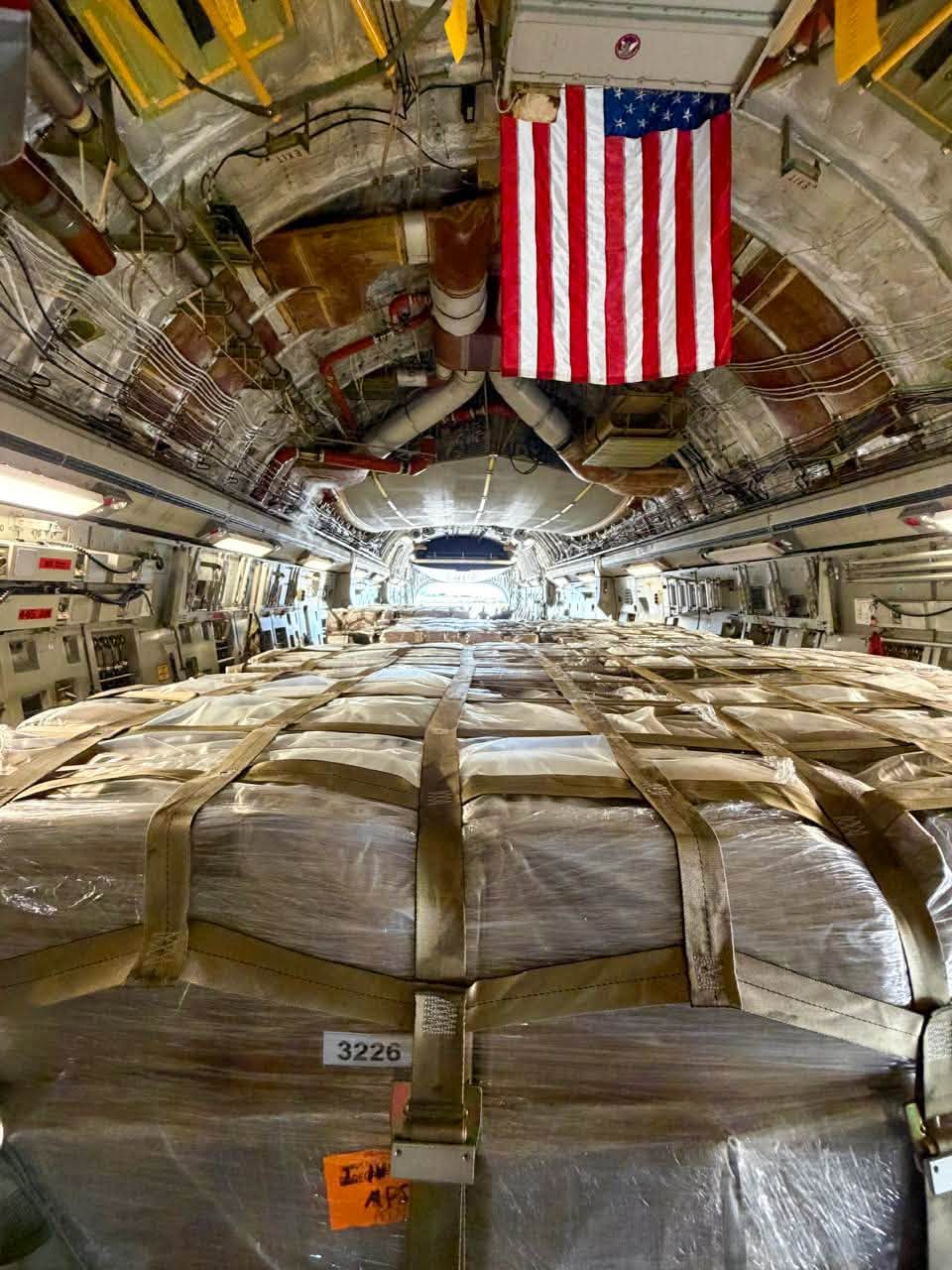
A U.S. Air Force C-17 Globemaster III has transported approximately 45 tonnes of cocaine seized in Costa Rica to the United States, where the drugs are being destroyed under a bilateral anti-narcotics cooperation arrangement.
The shipment was moved from Base 2 of Costa Rica’s Air Surveillance Service in Alajuela, near Juan Santamaría International Airport. The cocaine had been seized during multiple operations conducted by Costa Rican authorities with assistance from the U.S. Drug Enforcement Administration (DEA) and other international partners.
Costa Rica’s judicial authorities said the actual quantity scheduled for destruction was 44,697.13 kilograms. A court order authorized its transport to Reworld Solutions in Indianapolis, Indiana, where the cocaine was scheduled to be incinerated on September 26. The court cited Costa Rica’s limited domestic incineration capacity and the large volume of seized drugs as reasons for conducting the destruction in the United States.
The operation involved extensive security measures. The cocaine was sealed and palletized by Costa Rican authorities before being transferred under armed security to the airfield. A Costa Rican judge accompanied the shipment to oversee the legal transfer and destruction process, while U.S. officials, including DEA personnel, participated in the operation.
Transporting nearly 100,000 pounds of contraband requires meticulous planning and tight security:
Palletization and Chain of Custody: Before loading, Costa Rican authorities sealed and palletized the cocaine onto standard 463L military cargo pallets. Armed escorts guarded the transfer to the tarmac.
Judicial Oversight: A Costa Rican judge accompanied the shipment aboard the C-17 to maintain the unbroken chain of custody through legal transfer and eventual destruction. U.S. Drug Enforcement Administration (DEA) agents and USAF loadmasters managed the cargo deck.
Strategic Necessity: The operation highlights a growing regional challenge: local law enforcement agencies frequently intercept quantities of narcotics that far exceed domestic destruction capacities. With Costa Rica lacking industrial-scale incineration facilities capable of burning 45 tonnes without environmental hazard or security risks, heavy military airlift provided the only practical solution.
While tactical turboprops like the C-130 Hercules handle regional interdictions, utilizing strategic transports like the C-17 for contraband destruction has a proven track record.
Domestic High-Volume Transfers: The USAF regularly leverages C-17 capacity to streamline domestic inter-agency drug destruction operations. In mid-2026, a C-17 moved 50 metric tons of seized illegal narcotics from California facilities to high-capacity incinerators in the Midwest in a single sortie, demonstrating the cost-efficiency of one heavy flight versus multiple convoy runs or smaller air flights.
Operation Southern Watch & Counter-Drug Air Bridges: Beyond transport, USAF heavy lifters have historically formed the logistical backbone of multinational anti-narcotics frameworks across Central and South America. Under initiatives like the Shield of the Americas, C-17s routinely deploy radar gear, specialized counter-drug units, and mobile ops centers to partner nations to bolster maritime and aerial interdiction capabilities.
| Specification | Operational Advantage for High-Security Missions |
| Max Payload | 170,900 lbs (77,519 kg) — effortlessly holds 45 tonnes of palletized cargo in one run. |
| Cargo Bay Dimensions | 88 ft long × 18 ft wide × 12.3 ft high; accepts up to 18 standard 463L pallets. |
| Tactical Ramp Operations | Allows rapid drive-on/drive-off loading with armed escort vehicles on the tarmac. |
| Secure Communications | Encrypted SATCOM suites allow real-time flight tracking by defense and law enforcement agencies. |
The U.S. Embassy in Costa Rica linked the C-17 mission to broader bilateral security cooperation, including the Shield of the Americas initiative and efforts involving Costa Rica and other regional partners. The embassy said the seized cocaine represented more than $1.25 billion that would be kept out of criminal organizations.
The mission demonstrates the C-17's role beyond traditional military airlift. With its large cargo capacity and ability to rapidly move high-priority loads over long distances, the Globemaster III can support international security and law-enforcement missions requiring secure strategic air transport.

.jpg)