
Canada has taken another significant step toward acquiring Saab’s GlobalEye airborne early warning and control (AEW&C) aircraft, signing a non-binding term-sheet agreement that establishes the framework for detailed negotiations over a potential fleet of six aircraft for the Royal Canadian Air Force (RCAF).
Announced on September 25, the agreement does not constitute a final contract or a commitment to purchase the aircraft. Instead, it sets out the scope for negotiations covering the Canadian configuration, industrial participation, capability development, programme execution and schedule. Canada also intends to acquire associated systems, training and support.
The proposed GlobalEye fleet is intended to strengthen Canada's ability to monitor its vast territory and approaches, particularly the Arctic, while supporting the modernization of NORAD and continental defence. The aircraft would provide long-range detection, tracking and identification of threats including aircraft, missiles and drones, while acting as an airborne command-and-control centre.
The latest development follows Canada's decision on May 27, 2026, when Saab was selected as the preferred supplier for Canada's future AEW&C capability.
At that stage, Ottawa emphasized that selecting Saab did not represent a procurement commitment. The government said further discussions would examine the technical, commercial and economic aspects of the proposed GlobalEye solution.
The May announcement also highlighted an important industrial component. Saab's GlobalEye is based on the Bombardier Global 6500, which is manufactured in Canada. Ottawa said the programme could create opportunities for Canadian production, mission integration, technology transfer, skilled employment and participation in international supply chains.
Prime Minister Mark Carney's May announcement had envisaged a broader industrial programme, stating that at least one-third of the projected GlobalEye fleet would be manufactured in Canada over the following 15 years, including aircraft for allied customers. The government said the initiative could support around 3,000 Canadian aerospace and defence jobs.
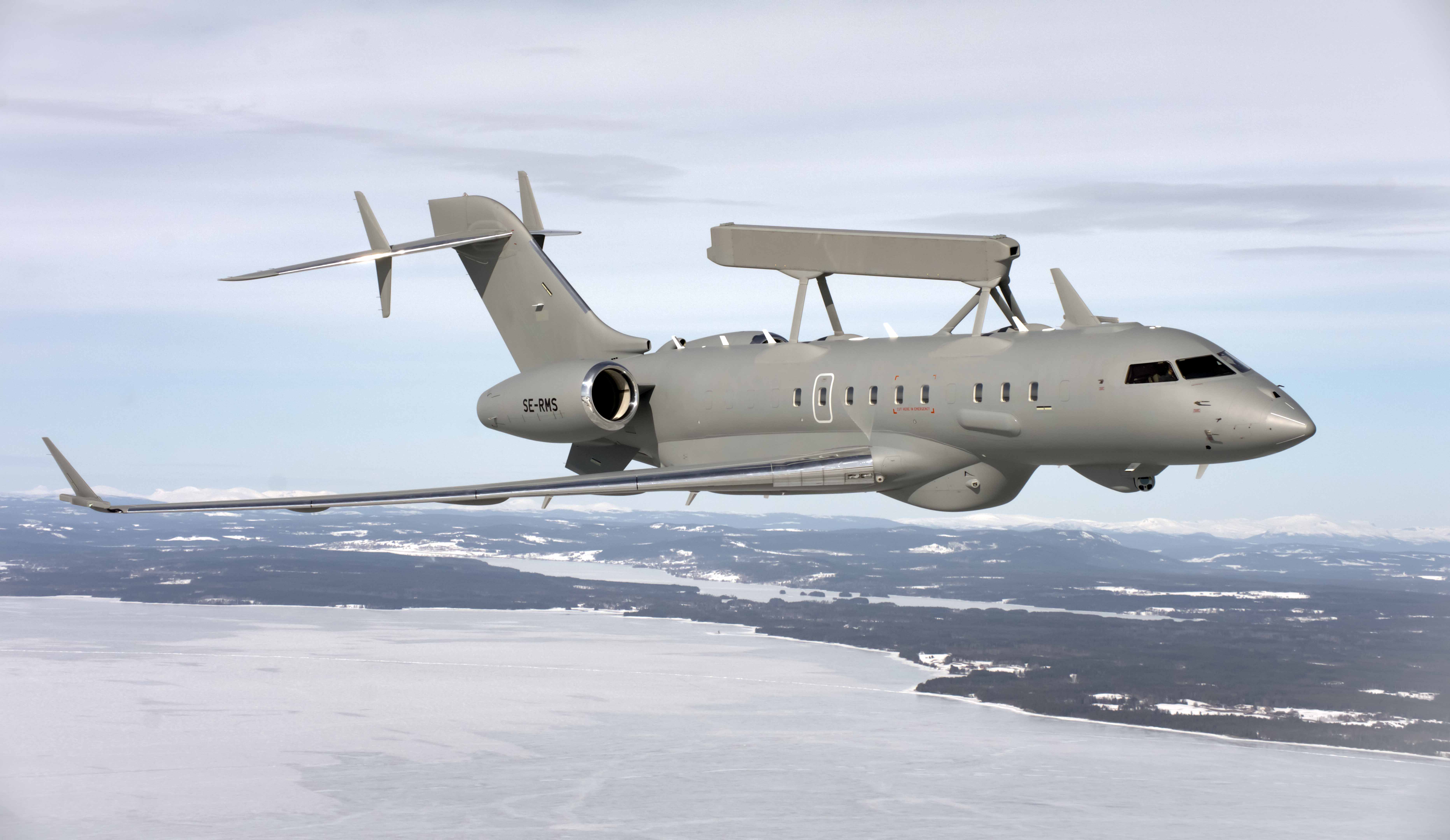
GlobalEye combines a business-jet airframe with an extensive suite of surveillance and mission systems.
Saab describes the aircraft as an AEW&C platform capable of providing long-range surveillance across the air, maritime and land domains. Its sensors feed information to operators and commanders in real time, allowing the aircraft to perform both surveillance and command-and-control functions.
Canada's May announcement stated that GlobalEye's surveillance capability could track objects and signals at ranges of up to 650 kilometres, although actual detection ranges vary according to factors such as target characteristics, altitude, sensor mode and operating conditions.
For Canada, the platform is particularly relevant to the country's enormous northern approaches, where ground-based surveillance infrastructure is challenged by geography and distance. An airborne AEW&C aircraft can patrol well away from the area being monitored and provide a wider operational picture to fighters, ships, ground forces and command centres.
One of the distinctive aspects of the Canadian proposal is the combination of Saab's GlobalEye mission system with Bombardier's Canadian-built Global 6500 business jet.
This gives the programme an industrial dimension beyond simply purchasing an overseas-built military aircraft. Ottawa says it wants Canada to become a centre for future missionization and support activities, potentially allowing Canadian companies to participate in systems integration, training, sustainment, research and development and future exports.
The government says this approach is consistent with its Defence Industrial Strategy and its "Build-Partner-Buy" procurement framework, which seeks to combine military capability with domestic industrial development.
Before Saab became the preferred supplier, Canada had been examining different solutions for its future airborne early warning requirement.
The competition included Saab's GlobalEye, Boeing's E-7 Wedgetail and L3Harris' Aeris X. Canadian officials were looking for an aircraft capable of providing long-range surveillance and command-and-control while also meeting the country's industrial and economic objectives.
The Canadian government ultimately moved into negotiations with Saab in May, while stressing that the preferred-supplier decision was not itself a contract award.
The September term sheet moves the programme into a more detailed negotiation phase.
The next discussions are expected to address:
No final contract value or definitive delivery schedule has been announced.
For now, therefore, Canada has moved closer to GlobalEye but has not yet formally purchased the aircraft. The outcome of the detailed negotiations will determine the final configuration, industrial arrangements and terms of any binding procurement agreement.
May 27, 2026: Canada selected Saab as the preferred supplier for its future AEW&C capability.
May 2026: Ottawa highlighted plans for Canadian industrial participation, including work involving Bombardier's Global 6500 platform.
September 25, 2026: Canada and Saab signed a non-binding term sheet, establishing the framework for detailed negotiations.
Next stage: Negotiations will determine the Canadian configuration, industrial participation, programme schedule and terms of any final contract.

.jpg)