
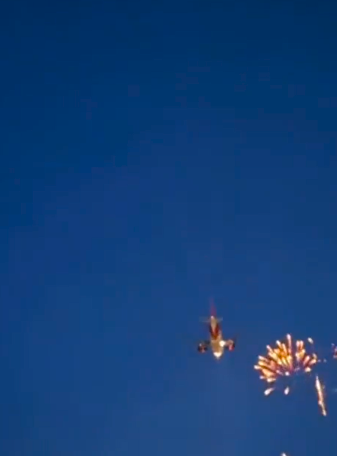
An Avianca aircraft was forced to discontinue its landing approach at Mundo Maya International Airport (FRS) in Flores, Petén, Guatemala, after the flight crew detected fireworks in the aircraft’s final approach path during Guatemala’s Independence Day celebrations on Monday, September 14, 2026.
According to Guatemala’s General Directorate of Civil Aeronautics (DGAC), the crew responded by performing a go-around (approach/landing rejection) as a preventive safety measure. The aircraft subsequently rejoined the airport traffic circuit and made a second approach, landing safely without reported injuries or damage.
The incident occurred at night as Guatemala marked the country’s 205th Independence anniversary. The DGAC said pyrotechnics were detected along the aircraft’s final approach route, creating a potential hazard during one of the most critical phases of flight.
Rather than continuing the approach with an obstruction or hazard in the flight path, the crew discontinued the landing and initiated a go-around.
A go-around is a standard flight-safety procedure, not necessarily an indication that an aircraft has suffered an emergency or engine problem. During the maneuver, the pilots increase thrust, arrest the descent, climb away from the runway environment and follow the applicable missed-approach or traffic-circuit procedure before attempting another landing.
The aircraft subsequently returned for another approach and landed safely. The DGAC did not report injuries or aircraft damage.
The incident highlights why fireworks and other pyrotechnics are particularly dangerous when launched close to airports or aircraft flight paths.
Potential hazards include:
The DGAC specifically warned that fireworks near approach and departure routes can reduce pilots' visibility, damage aircraft or force emergency evasive maneuvers.
Flight-tracking information shows that Avianca operated AV700 from Guatemala City (GUA) to Flores/Mundo Maya (FRS) on September 14, scheduled to depart at 18:00 and arrive at approximately 18:50 local time, using an Airbus A320. Other Avianca services also operated on the route that day, so publicly available information does not independently establish that AV700 was the aircraft involved in the fireworks go-around.
Therefore, the safest formulation is to identify the aircraft as an Avianca flight, as the DGAC and Guatemalan media reports do, rather than assigning a specific flight number unless the DGAC or Avianca confirms it.
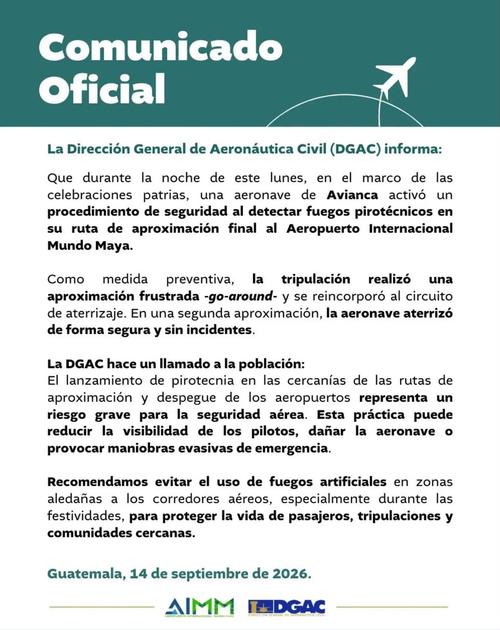
Following the incident, the DGAC urged the public to avoid launching fireworks near airport approach and departure routes, particularly during holiday and national celebrations.
The warning is especially important at night, when aircraft crews may have limited visual references and are relying heavily on instrument procedures, airport lighting and visual cues during the final stages of an approach.
The incident at Mundo Maya demonstrates how an apparently recreational activity on the ground can quickly become an operational hazard for an aircraft carrying passengers.
No injuries or aircraft damage were reported, and the Avianca aircraft landed safely on its subsequent approach.

.jpg)