
France is preparing to develop a new-generation combat aircraft under the Avion de Combat du Futur (ACF), or Future Combat Aircraft, programme. Following the collapse of the Franco-German-Spanish Future Combat Air System (FCAS/SCAF) partnership in June 2026, Paris has shifted towards a nationally led fighter-development effort intended to succeed the Dassault Rafale and preserve France’s independent combat-aircraft design and manufacturing capabilities.
On 14 October 2026, General Jérôme Bellanger, Chief of Staff of the French Air and Space Force, confirmed that ACF would proceed as a national programme. Although France remains open to international cooperation, foreign partners will not determine the aircraft's fundamental development architecture. The stated objective is to achieve conventional operational capability around 2040, followed by a strategic nuclear-delivery role associated with the ASN4G hypersonic missile by approximately 2050.
ACF should therefore be understood as more than a replacement for an existing fighter. It represents a long-term effort to integrate advanced propulsion, low-observable design, artificial intelligence, networked combat systems and crewed-uncrewed cooperation into a sovereign French air-combat capability.
An important qualification: As of October 2026, ACF remains a development programme rather than a fully defined production aircraft. Its operational objectives and broad technological direction are becoming clearer, but definitive specifications for its dimensions, weight, engine configuration, weapons capacity, performance and stealth characteristics have not been publicly established.
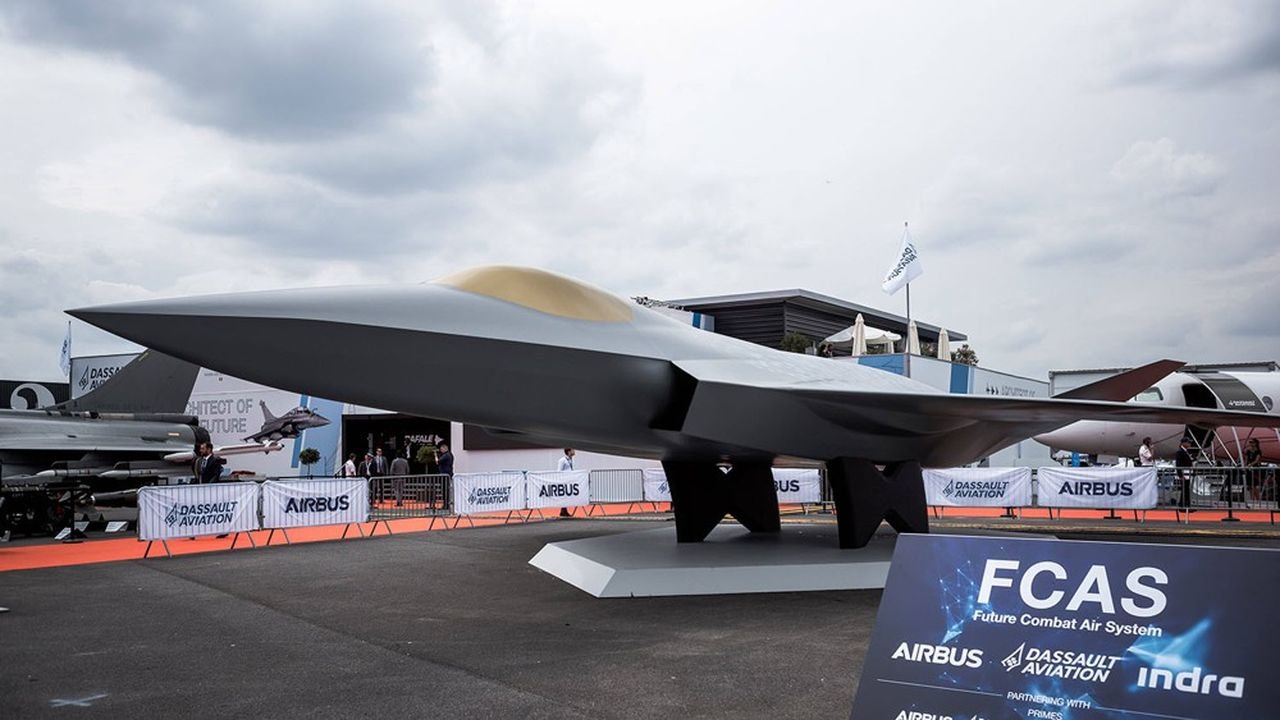
The original FCAS initiative was conceived as a collaborative European combat-air system involving France, Germany and Spain. Its central aircraft component, the New Generation Fighter (NGF), was intended to operate alongside uncrewed aircraft, advanced sensors and a connected combat-cloud architecture.
However, disagreements over industrial leadership, aircraft design authority and the distribution of development responsibilities ultimately undermined the fighter partnership. France subsequently decided to pursue its next-generation aircraft nationally while retaining the option of cooperation in selected technological areas.
The change in programme structure has three major implications.
The transition does not mean that all FCAS research has been discarded. According to Bellanger, previous work on the fighter, stealth technologies, drones and connected combat systems remains useful to France's national effort. The challenge is to translate that accumulated knowledge into an integrated aircraft with a manageable development schedule and a sustainable funding structure.
The ACF programme is being shaped by two principal milestones: the need to introduce a new conventional combat aircraft around 2040 and the longer-term requirement to support France's airborne nuclear deterrent.
Publicly reported planning indicates that the work will progress through technology maturation, prototype development, operational-aircraft development and eventual entry into service. The exact schedule remains subject to technical progress, contracting and funding decisions.
| Period | Expected milestone | Technical significance |
|---|---|---|
| 2026–2027 | National programme preparation and technology maturation | Preserve previous FCAS research and define the aircraft's core architecture. |
| 2027 | Planned start of a further demonstrator phase | Begin work leading to a flying technology demonstrator. |
| 2031–2032 | Indicative first-flight window for the demonstrator | Validate selected aerodynamic, propulsion, flight-control and systems technologies. |
| 2029 onward | Planned development of the operational aircraft | Begin the programme phase intended to produce a service-ready combat aircraft. |
| 2033–2035 | Rafale F5 introduction and associated technology development | Bridge the capability gap and mature technologies potentially applicable to ACF. |
| Around 2040 | Target for conventional operational capability | Introduce the next-generation aircraft for conventional combat missions. |
| Around 2050 | Longer-term nuclear-deterrence objective | Establish the future aircraft's role in delivering the ASN4G nuclear missile, subject to the final operational and integration programme. |
The demonstrator and operational-development dates are based on reporting concerning French planning in October 2026. They should not be interpreted as guaranteed delivery dates for a production aircraft.
The 2040 objective reflects the need to maintain continuity between the Rafale fleet and its eventual successor. Developing a new combat aircraft requires more than achieving first flight: the programme must mature its sensors, weapons, propulsion, software, electronic warfare systems and operational support arrangements.
France must also avoid a capability gap in which the Rafale becomes increasingly expensive to maintain while its successor remains in development.
Consequently, ACF's success will depend not only on aerodynamic performance but also on whether its technologies can be developed, integrated and certified within the available time.
The ACF's final aerodynamic configuration has not been publicly confirmed. Nevertheless, the programme's sixth-generation ambitions and its intended missions indicate several areas that will require substantial engineering attention.
Reduced detectability is expected to be an important consideration in the aircraft's design.
A future combat aircraft intended to operate against advanced integrated air-defence systems must manage its radar signature while retaining sufficient aerodynamic performance, internal volume and weapons capacity.
Potential design priorities include:
These are expected design considerations rather than confirmed ACF specifications. No definitive public figures are available for its radar cross-section, dimensions, internal weapons volume or infrared signature.
The engineering challenge will be to balance stealth with other requirements, particularly sustained high-speed flight, manoeuvrability, payload, thermal management and maintainability.
The aircraft will need to operate across a broad flight envelope, potentially including long-range interception, air superiority, precision strike and missions requiring penetration of defended airspace.
Its configuration will therefore need to balance several competing objectives:
It would be premature to assign ACF a specific maximum speed, service ceiling, combat radius or sustained supersonic-cruise capability. Such figures depend on design decisions that have not been publicly confirmed.
France also has a strategic requirement to maintain a carrier-based nuclear and conventional aviation capability. The updated French military programming framework explicitly identifies the objective of preserving the ability to develop a sixth-generation fighter capable of operating from the future France Libre aircraft carrier.
If ACF is required to serve both land-based and carrier-based roles, naval compatibility could influence the aircraft's structure, landing gear, arresting arrangements, corrosion protection and overall weight.
Carrier operation imposes additional engineering constraints, including:
However, the precise relationship between ACF and the future carrier's aviation requirements remains to be established publicly. A dedicated naval variant should not be assumed until France confirms its design and procurement approach.
Propulsion will be one of the most consequential technology areas in the ACF programme.
A sixth-generation combat aircraft will require an engine capable of supporting its intended flight performance, electrical-power requirements, thermal-management demands and operational range. At the same time, the engine must remain compatible with the aircraft's low-observable characteristics and maintenance objectives.
France possesses an established domestic propulsion capability through Safran Aircraft Engines, which is expected to play an important role in the national combat-aircraft effort.
The Rafale F5 programme provides an important intermediate step.
French plans include developing the higher-thrust M88 T-REX engine for the F5 standard. The national defence-planning framework also identifies propulsion development as part of the effort to preserve the technologies needed for a sixth-generation fighter.
The F5 programme can help sustain industrial expertise in areas such as:
These capabilities could contribute to ACF development, although the extent to which the future aircraft will use technologies derived directly from the Rafale engine remains uncertain.
The ACF engine will need to meet the aircraft's final requirements for thrust, fuel efficiency, reliability and thermal performance.
Depending on the selected architecture, future development priorities could include:
The possibility of a variable-cycle engine is sometimes discussed in connection with sixth-generation fighters internationally. However, there is no sufficiently established public specification confirming that ACF will use a variable-cycle engine.
Likewise, the number of engines, their thrust ratings and the aircraft's intended fuel capacity remain unconfirmed.
The most important engineering objective will be to develop a propulsion system that satisfies the aircraft's operational requirements without creating excessive weight, cost or development risk.
ACF will need an advanced mission system capable of processing information from multiple sensors, coordinating tactical decisions and supporting operations in electronically contested environments.
The aircraft's operational effectiveness will depend on the integration of its sensors and software at least as much as on its airframe.
Potential sensor requirements include:
The purpose of integrating these systems is to give the pilot a coherent tactical picture without requiring constant manual interpretation of separate sensor displays.
Sensor fusion could allow the aircraft to combine radar tracks, infrared observations, electronic emissions and information received from other platforms into a shared assessment of the battlespace.
The final sensor suite, radar technology and electronic-warfare architecture have not yet been publicly specified for ACF.
Artificial intelligence is likely to have an important supporting role in future combat-aircraft systems.
Potential applications include:
AI-assisted systems could help pilots process large volumes of information more rapidly. However, the effectiveness of such systems will depend on data quality, software reliability, resilience to electronic attack and the ability to explain or communicate recommendations to the operator.
For a nuclear-capable aircraft, the distinction between automated assistance and human authorisation will be particularly important. The specific allocation of decision-making responsibilities within ACF has not been disclosed.
France has already pursued AI-related work in the Rafale context, including testing algorithms and investigating the integration of aircraft with uncrewed systems. Such activities provide a possible pathway for maturing relevant technologies before the ACF enters service.
One of the most important lessons from the FCAS experience is that a future fighter cannot be assessed solely as an individual aircraft.
ACF will operate in a wider combat system involving other fighters, uncrewed aircraft, airborne surveillance platforms, ground-based sensors, naval forces and command networks.
This makes communications, data fusion and interoperability central to the programme.
A combat cloud is a distributed information architecture that allows participating platforms to exchange, process and use tactical information.
For ACF, such an architecture could support:
The aircraft's mission system will therefore need to manage information from multiple sources while operating in environments where communications may be jammed, degraded or unavailable.
General Bellanger has emphasised that France should continue cooperating with Germany and other European partners on the combat cloud, even as it pursues ACF nationally. He has identified interoperability between European crewed aircraft as an important requirement for future operations.
This suggests a distinction between two aspects of the programme:
This approach could preserve opportunities for European cooperation without requiring France to return to a single multinational fighter design.
However, interoperability is not achieved merely by installing a common data link. It also depends on compatible information formats, communications security, identification procedures, software interfaces and agreed operating practices.
The challenge will be to create an aircraft that retains national technological independence while remaining an effective participant in coalition operations.
A defining feature of sixth-generation combat-aircraft development is the move towards coordinated operations between crewed fighters and uncrewed platforms.
ACF is expected to emerge within this broader shift in air warfare, although its exact approach to controlling uncrewed aircraft has not been publicly defined.
Future uncrewed systems could perform a range of supporting functions, including:
Such aircraft could allow the crewed fighter to operate with greater situational awareness while distributing risk across several platforms.
The potential benefit is not simply an increase in the number of aircraft available. It is the ability to distribute sensing, communications and mission responsibilities across a coordinated force.
France is already investigating technologies intended to connect crewed fighters with uncrewed aircraft.
The HypAIRion initiative is intended to advance manned-unmanned cooperation, with a first joint Rafale-drone flight planned for 2028 according to October 2026 reporting. Separately, French defence planning identifies a first experiment involving Rafale and accompanying drones around 2028 and a stealth combat-drone demonstrator around 2035.
These activities could help develop the technical foundations for future ACF operations, including communications, flight coordination and mission-system integration.
Nevertheless, several questions remain unanswered:
These are important programme decisions, but no definitive public answers are available.
Weapons integration will be a central design consideration because ACF is intended to serve both conventional combat requirements and France's longer-term nuclear-deterrence needs.
The aircraft must be designed around the physical, electrical, software and certification requirements of its intended weapons, rather than treating weapons integration as a final-stage addition.
The future aircraft is expected to support a range of conventional missions associated with a modern multirole fighter.
These may include air superiority, interception, reconnaissance, electronic warfare support and precision strike.
The exact weapons inventory has not been announced. The aircraft's final capabilities will depend on the sensors, mission software, internal weapons arrangements and integration programme selected by France.
Compatibility with future air-to-air and air-to-surface weapons will be particularly important over a service life expected to extend well beyond the initial entry into service.
The Air-Sol Nucléaire de 4e Génération (ASN4G) is France's next-generation air-launched nuclear cruise missile.
The French defence procurement agency, Direction générale de l'armement (DGA), confirmed in June 2026 that it had awarded MBDA the development contract for ASN4G. The missile is intended to replace the ASMPA-R and is scheduled to enter service around 2035, with the Rafale F5 identified as its initial carrier.
The missile's development timeline is important when considering ACF.
France intends to retain an airborne nuclear-deterrence capability while transitioning from the Rafale to its next-generation combat aircraft. This means that the ACF programme must account for the long-term requirements of nuclear weapon carriage, release certification and integration with the strategic command system.
The programme's broad objectives point towards a future nuclear role, but the final aircraft-missile integration schedule remains subject to development and certification.
Nuclear delivery requirements can influence an aircraft well before the weapon is physically integrated.
Relevant engineering considerations include structural compatibility, separation characteristics, navigation accuracy, communications security, mission-system certification and the aircraft's ability to complete the required operational profile.
France must also preserve the reliability and credibility of its airborne deterrent throughout the transition between aircraft generations.
The ASN4G's development is already proceeding independently of the ACF airframe. Its planned initial integration with Rafale F5 provides an intermediate capability, while ACF represents a potential longer-term platform for the weapon.
This distinction is important: the ASN4G's planned service entry around 2035 does not mean that ACF will be operationally nuclear-capable by that date. The ACF's conventional target is around 2040, while the longer-term nuclear objective has been associated with approximately 2050.
The Rafale F5 will be essential to France's transition towards a new combat-aircraft generation.
Rather than treating F5 and ACF as separate, unrelated programmes, France can use the upgraded Rafale to sustain operational capability while maturing selected technologies for its successor.
The French defence programme identifies the F5 as part of the effort to preserve a national pathway towards a sixth-generation fighter. Its planned improvements include propulsion, connectivity, offensive capabilities and cooperation with uncrewed aircraft.
The relationship can be summarised as follows:
| Technology area | Rafale F5's expected contribution | Relevance to ACF |
|---|---|---|
| Propulsion | Development of the higher-thrust M88 T-REX engine | Maintains French expertise in advanced military propulsion. |
| Sensors and avionics | Continued development of modern mission-system capabilities | Provides experience in integrating advanced sensors and software. |
| Artificial intelligence | Exploration of AI-assisted functions | Helps mature algorithms and human-machine interfaces. |
| Connectivity | Improved networking and cooperative operations | Supports future combat-cloud and interoperability requirements. |
| Uncrewed aircraft | Planned experimentation with accompanying drones | Advances crewed-uncrewed integration. |
| Weapons | Integration of new conventional and nuclear-capable weapons | Sustains weapons-integration expertise and operational continuity. |
The table describes technology areas relevant to the transition, not a guarantee that every F5 component will be transferred directly to ACF.
A sixth-generation aircraft may require fundamentally different solutions for propulsion, power generation, cooling, signature management and mission-system architecture. Some technologies may be adapted from existing programmes, while others will need to be developed specifically for the new aircraft.
The central objective is to reduce the amount of entirely new technology that must be developed and validated simultaneously.
The move towards ACF places greater responsibility on France's domestic aerospace and defence industry.
The principal challenge is to retain control over the technologies that determine the aircraft's performance, upgradeability and ability to operate independently.
Dassault Aviation is the central French combat-aircraft designer and is expected to play a major role in ACF development.
Its experience with the Mirage family and Rafale provides a foundation in aerodynamic design, flight-control integration, mission-system architecture and the management of complex combat-aircraft programmes.
Under a national programme, Dassault would be able to pursue an aircraft configuration aligned with French requirements without having to reconcile every fundamental design decision with the industrial interests of multiple partner nations.
Safran's contribution is likely to focus on propulsion technology, building on its experience developing the M88 engine and associated research programmes.
Maintaining a domestic propulsion capability is strategically important because the engine influences performance, fuel consumption, thermal management, maintenance requirements and future upgrade potential.
Thales is an established French supplier of military electronics, sensors, communications and electronic-warfare systems.
Its expertise is relevant to the development of an integrated mission system in which sensors, communications, electronic protection and tactical information processing operate as a coherent whole.
The wider French defence-industrial base will also be relevant to weapons integration, flight-control systems, software, materials, simulation, manufacturing and support infrastructure.
However, the complete ACF industrial structure, contractual workshare and allocation of design authority have not yet been publicly established.
The strategic objective is clear: France wants to preserve the ability to develop and upgrade a sophisticated combat aircraft without making its core architecture dependent on decisions taken by a multinational consortium.
That autonomy could also support the long-term sustainability of the aircraft, including the ability to modify its software, integrate new weapons and respond to changing operational requirements.
A national programme provides France with greater freedom over the aircraft's requirements, but it also places more responsibility for development costs, schedule management and technical risk on the French state and its industry.
Reporting on France's draft 2027 defence budget indicates that approximately €2.7 billion in ACF-related commitment authorisations could be made available, subject to the budget process. The same planning framework includes substantial funding for the Rafale F5 programme. These figures represent planned budgetary authorisations, not the total lifetime cost of ACF.
Several challenges will determine whether the programme meets its objectives.
A sixth-generation combat aircraft requires substantial investment in propulsion, low-observable design, sensors, mission software, testing and weapons integration.
France will need to balance these expenditures against other defence requirements, including the Rafale fleet, nuclear forces, uncrewed aircraft and naval aviation.
The 2040 target leaves a finite period for design maturation, prototype testing, development of production standards and operational evaluation.
Delays in one technology area can affect several others. For example, a late engine may delay flight testing, while changes to the airframe can require renewed aerodynamic, structural and signature validation.
Advanced individual technologies do not automatically produce an effective combat aircraft.
The programme must demonstrate that propulsion, sensors, software, communications, weapons and flight controls function reliably as an integrated system.
France's national approach may simplify decisions over the aircraft's fundamental architecture, but international cooperation could still be valuable in areas such as research, components, communications and interoperability.
The challenge will be to establish partnerships that contribute useful capabilities without creating new dependencies that undermine the programme's objectives.
Developing a sophisticated aircraft requires specialist engineers, production facilities, test infrastructure and long-term supply-chain stability.
France must retain sufficient industrial capacity to conduct development work while maintaining the Rafale production and support ecosystem.
The programme will need to resist unnecessary expansion of its requirements.
Adding capabilities during development can increase weight, cost and software complexity, while forcing expensive redesigns. A clear distinction between essential operational requirements and capabilities that can be introduced through later upgrades will be important.
ACF will emerge in an international environment in which several countries are pursuing next-generation combat-aircraft programmes.
These projects share broad interests in low observability, advanced sensors, artificial intelligence, networked operations and cooperation with uncrewed aircraft. Their precise designs, requirements and industrial arrangements differ.
One prominent comparison is the Global Combat Air Programme (GCAP), involving the United Kingdom, Italy and Japan.
France's decision to pursue ACF independently reflects its preference for maintaining national control over the core aircraft design. GCAP, by contrast, is being developed through an international partnership.
The two approaches have different implications for development costs, industrial responsibilities, export arrangements and interoperability.
For France, a national programme could offer greater freedom to accommodate its specific requirements, including carrier aviation and airborne nuclear deterrence. However, the country must also sustain the necessary industrial capabilities and finance the development effort.
A multinational programme can distribute some costs and combine industrial expertise, but it requires agreement among participating countries over requirements, governance and technology access.
Neither model eliminates the technical challenges associated with sixth-generation combat-aircraft development.
ACF's eventual position in the international market will depend on the aircraft's performance, price, exportability, industrial availability and the willingness of potential customers to accept French-designed systems and support arrangements.
No definitive ACF export configuration or customer programme has been publicly established.
The most useful way to assess ACF is to distinguish between established programme objectives and capabilities that remain to be demonstrated.
| Capability or requirement | Assessment as of October 2026 |
|---|---|
| Nationally led aircraft development | Confirmed programme direction. |
| Successor to the Rafale | Established long-term objective. |
| Conventional operational capability around 2040 | Stated target. |
| Nuclear-deterrence role associated with ASN4G | Long-term objective, with a reported horizon around 2050. |
| Low-observable design | Consistent with the programme's next-generation ambitions, but detailed specifications remain undisclosed. |
| Advanced propulsion | A major development requirement; final engine configuration remains unconfirmed. |
| Advanced sensor fusion | An important expected capability, but the final sensor architecture is not public. |
| AI-assisted mission management | A plausible development direction supported by broader French technology work, but the final ACF implementation is unconfirmed. |
| Cooperation with uncrewed aircraft | Relevant to France's developing combat-air strategy; ACF-specific operational details remain unknown. |
| Combat-cloud interoperability | Explicitly identified as an area in which France intends to continue cooperating with European partners. |
| Carrier compatibility | Identified in French defence planning as an objective to preserve, although the final aircraft configuration and naval variant arrangements remain to be established. |
| Maximum speed, range and payload | No definitive public specifications available. |
| Stealth performance and radar cross-section | No definitive public specifications available. |
| Production numbers and unit cost | Not yet established publicly. |
The table illustrates the difference between an aircraft's intended operational role and its final technical configuration.
ACF is expected to deliver a more integrated combat capability than a conventional fighter upgrade, but the extent to which it achieves that objective will depend on the results of technology development, prototype testing and operational evaluation.
The Avion de Combat du Futur represents France's effort to preserve an independent path towards sixth-generation air combat following the end of the FCAS fighter partnership in June 2026.
Its principal objective is to replace the Rafale with a next-generation aircraft capable of conventional combat operations around 2040, while supporting France's longer-term airborne nuclear-deterrence requirements.
Achieving this objective will require progress across several interconnected technological areas: low-observable airframe design, advanced propulsion, integrated sensors, artificial intelligence, electronic warfare, secure communications, weapons integration and cooperation with uncrewed aircraft.
The Rafale F5 will provide an important bridge, sustaining operational capability while helping mature selected technologies and preserve the national industrial base.
The programme's national structure gives France greater control over aircraft requirements and fundamental design decisions. However, it also concentrates development responsibility, financial exposure and schedule risk within the French defence establishment and its industrial partners.
International cooperation is therefore likely to remain relevant, particularly in combat-cloud technologies and interoperability, even if the aircraft itself is developed under national design authority.
Ultimately, ACF's success will be determined not by its sixth-generation designation, but by whether France can deliver a technically mature, operationally effective and sustainable combat aircraft within the required timeframe. The programme must combine advanced performance with reliable systems integration, maintainable engineering and the ability to evolve throughout a long service life.
As of October 2026, the strategic direction and principal milestones are becoming clearer. The detailed aircraft design, definitive performance specifications, final industrial arrangements and complete lifecycle cost remain open questions. The coming phases of demonstrator development and operational-aircraft definition will be critical in determining whether France can translate its ambitions into a fielded next-generation combat capability.
FL360aero note: This article distinguishes confirmed programme announcements from technical projections. Because ACF is still in its early development phase, unannounced performance figures and design features have not been presented as established facts.

.jpg)