
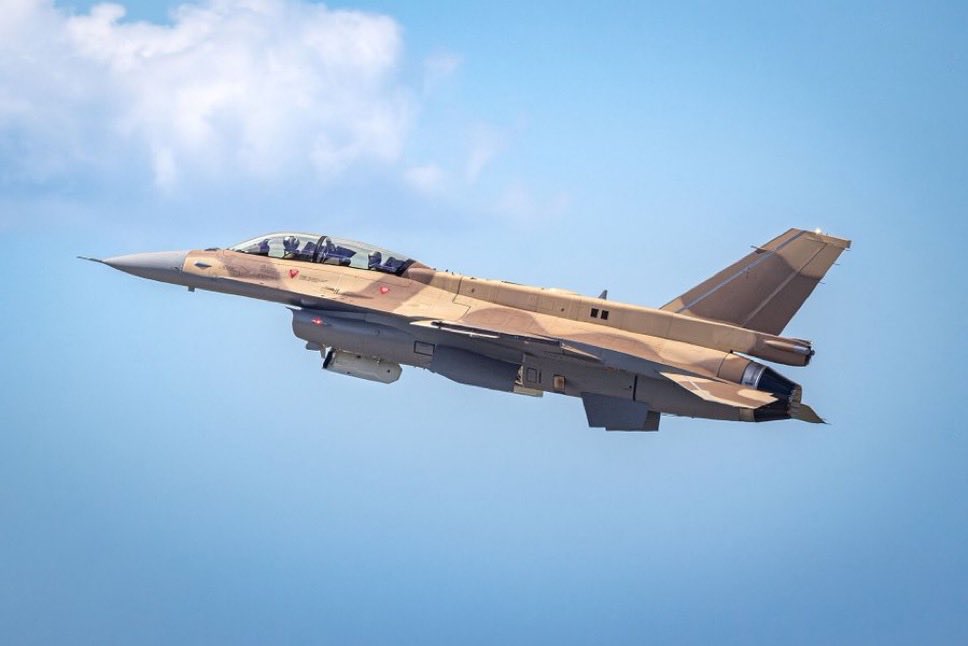
Few fighter aircraft have had a career as long, successful, and evolutionary as the F-16 Fighting Falcon. Conceived in an era when lightweight fighters were still a relatively radical idea, the F-16 has evolved through decades of technological, operational, and structural upgrades into the latest F-16 Block 70/72, commonly known as the F-16V Viper.
The aircraft flying today shares the same basic configuration as the fighter that first took to the skies in the 1970s, yet internally the difference is enormous. The story of the F-16 is therefore not simply one of longevity—it is a story of continuous transformation.
The origins of the F-16 can be traced to the Vietnam War and the debates that followed about the future of air combat.
American fighter development had increasingly focused on large, sophisticated aircraft capable of performing multiple missions. However, a group of U.S. Air Force officers and defense analysts argued that the next generation of fighters should also emphasize low weight, high maneuverability, simplicity, and affordability.
This thinking contributed to the Lightweight Fighter (LWF) program, launched in the early 1970s.
Two aircraft were selected for the technology demonstration phase: the YF-16, developed by General Dynamics, and the YF-17, developed by Northrop.
The YF-16 made its first flight in January 1974. Its combination of high thrust-to-weight ratio, relaxed static stability and advanced flight-control technology demonstrated the potential of a new generation of lightweight fighters.
In January 1975, the U.S. Air Force selected the YF-16 for further development.
The Fighting Falcon was born.
The production F-16 introduced several important features that would become fundamental to its identity.
Its side-mounted control stick, rather than a traditional center-mounted stick, was designed to make aircraft control easier under high-G conditions. The pilot also benefited from an unusually unobstructed view through the large canopy.
Perhaps most importantly, the F-16 incorporated a fly-by-wire flight-control system.
Instead of relying entirely on mechanical connections between the pilot's controls and the flight-control surfaces, electronic signals commanded the aircraft's movements.
The F-16 was deliberately designed with relaxed stability to improve maneuverability. The computer-controlled flight-control system made such an inherently unstable configuration practical.
This combination gave the F-16 an extraordinary level of agility.
The first production F-16s were designated Block 1 and Block 5, followed by progressively improved Block 10 and Block 15 aircraft.
These early fighters established the basic F-16 architecture, but the aircraft was never intended to remain frozen in its original configuration.
The Block 15, introduced in the early 1980s, represented a significant improvement. Larger horizontal stabilizers increased control authority, while avionics and mission capabilities continued to evolve.
The F-16 was also increasingly adapted for missions beyond traditional air combat.
It became a multirole fighter capable of performing air-to-air combat, precision strike, close air support, reconnaissance and other missions.
That flexibility would become one of the aircraft's greatest strengths.
One of the most important developments in F-16 history was its international expansion.
The aircraft became a major export fighter for the United States and was adopted by air forces across Europe, Asia, the Middle East and elsewhere.
International production and industrial participation also helped create a large global support network.
The F-16's relatively manageable operating requirements, multirole capability and enormous weapons ecosystem made it attractive to countries seeking a modern fighter without moving into the much larger and more expensive heavy-fighter category.
Over time, the F-16 became one of the most widely operated fighter aircraft in the world.
The evolutionary approach continued.
Block 25 introduced improved avionics and expanded combat capability.
The Block 30/32 series introduced further engine and avionics changes, with different engine families used between the two sub-blocks.
The Block 40/42, commonly associated with the F-16C/D Night Falcon, brought significant improvements for night and adverse-weather operations.
These aircraft incorporated advanced navigation and targeting technologies, allowing the F-16 to increasingly exploit precision-guided weapons.
The result was a fighter that was becoming less dependent on simple visual-range maneuvering and increasingly capable of conducting sophisticated precision-strike missions.
The Block 50/52 represented another major step.
These aircraft introduced more powerful computing and avionics, improved weapons integration and enhanced capabilities for modern combat operations.
They were also associated with the ability to employ advanced precision weapons and, in specialized configurations, electronic warfare equipment.
The F-16 had now evolved into much more than the lightweight dogfighter originally envisioned.
It had become a mature multirole combat system.
As warfare became increasingly network-centric, another transformation began.
The fighter's effectiveness was no longer determined solely by speed, maneuverability or weapons.
Sensors, data links, electronic warfare systems, mission computers and the ability to share information with other aircraft and ground systems became increasingly important.
This led to successive modernization programs for existing F-16 fleets.
Older aircraft received structural upgrades, modern mission computers, improved cockpit displays, new navigation systems, electronic warfare improvements and compatibility with modern weapons.
The basic F-16 airframe therefore became a platform capable of absorbing multiple generations of technology.
The next major evolutionary step was the F-16V, developed around the Viper configuration.
Externally, it remains unmistakably an F-16.
Internally, however, it represents a dramatic technological transformation.
One of its most important features is the AN/APG-83 SABR AESA radar.
Unlike traditional mechanically scanned radars, an active electronically scanned array can rapidly steer its radar beam electronically. This provides significant improvements in detection, tracking, reliability and the ability to manage multiple targets.
The cockpit has also been transformed.
The large Center Pedestal Display (CPD) provides pilots with a modern digital interface for tactical information, while upgraded mission computers and avionics allow the aircraft to process and present far more information than earlier F-16s could handle.
The Viper also incorporates modern data links, electronic warfare improvements, precision-navigation capabilities and compatibility with contemporary weapons.
Technology is only useful if the aircraft carrying it can remain in service.
For many F-16 operators, the age of their airframes became an increasingly important issue.
Modernization programs therefore went beyond avionics.
Structural refurbishment and life-extension work have been used to keep older F-16s flying safely while allowing them to receive modern systems.
For new-build Block 70/72 aircraft, the design life is extended to approximately 12,000 flight hours, compared with the 8,000-hour baseline associated with earlier F-16s.
Optional conformal fuel tanks can also provide additional fuel capacity while reducing the aerodynamic penalties associated with some external fuel-tank configurations.
Another example of how far the F-16 has evolved is the Automatic Ground Collision Avoidance System (Auto GCAS).
Originally, the F-16 relied heavily on the pilot to recognize and recover from an impending controlled flight into terrain.
Auto GCAS adds an automated safety layer.
If the system determines that an aircraft is on a trajectory toward the ground and the pilot does not respond appropriately, it can initiate an automatic recovery maneuver.
This represents a fundamental shift in fighter design: advanced computing is not only increasing combat capability—it is also helping protect the pilot.
The F-16's evolution is remarkable because its basic philosophy has remained recognizable even as its technology has changed dramatically.
The aircraft began as a relatively lightweight, maneuverable fighter designed around simplicity and affordability.
Decades later, the latest F-16s incorporate:
The aircraft's external appearance may still recall the original Fighting Falcon, but its internal architecture belongs to a completely different technological era.
The F-16's longevity cannot be attributed to a single feature.
Its success comes from the combination of a fundamentally adaptable airframe, a huge international user base, a mature logistics ecosystem and decades of continuous modernization.
Every generation of upgrades has allowed operators to extract more capability from the same basic design.
That adaptability has become perhaps the F-16's greatest strength.
From the YF-16 prototype of 1974 to the F-16 Block 70/72 Viper, more than half a century of development separates the two aircraft.
Yet the lineage is unmistakable.
The F-16 did not survive by remaining the same aircraft.
It survived by continually becoming a different aircraft while retaining the qualities that made the original design successful.
And that may be the most remarkable chapter in the story of the Fighting Falcon: after more than five decades, the F-16 is still evolving.

.jpg)