
Brakes Activated During Takeoff Roll: Flight Data Recorder (FDR) analysis shows the left brake pedal was activated shortly after acceleration began, followed by subsequent braking inputs during the high-speed roll.
18-Second Speed Stagnation: Indicated airspeed (IAS) stalled around 168 knots (~311 km/h) for roughly 18 seconds due to the braking drag. Acceleration resumed only after the co-pilot manually increased engine thrust near the end of the runway.
Premature Rotation & Overrun: Facing the end of Munich’s 4,000-meter runway, the crew initiated rotation at 163 knots—12 knots below the planned $V_r$ of 175 knots. Tire marks extended 240 meters past the paved threshold into the grass.
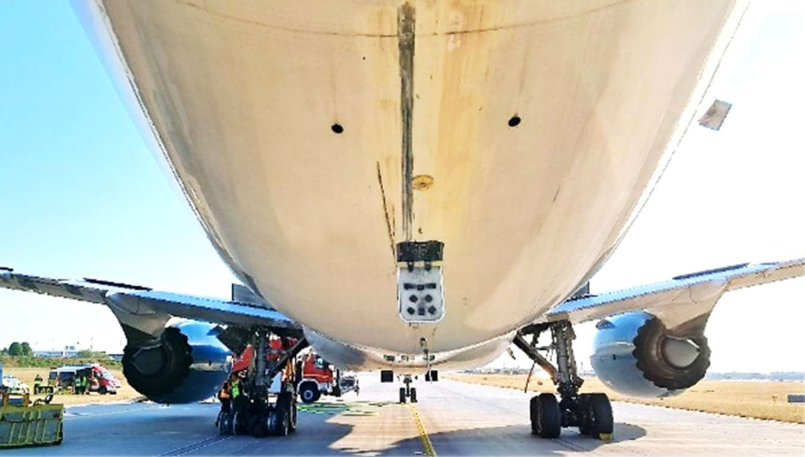
Impact & Damage: During liftoff, the aircraft’s tail struck the ground (tailstrike) and the landing gear hit 20 approach/threshold light fixtures. Four tires on the left main landing gear were damaged.
2-Hour Holding & Safe Landing: The crew jettisoned 62 metric tons of fuel and performed two low-pass approaches over the runway for ground-based visual damage inspections before touching down safely on their third attempt. None of the 271 passengers or 16 crew members were injured.
Crew Roles & Audio Loss: A 64-year-old captain with over 27,000 flight hours was the pilot flying (left seat) during takeoff. The designated pilot-in-command (sitting in the jump seat) took control once airborne. The Cockpit Voice Recorder (CVR) audio from takeoff was overwritten due to its 2-hour loop limit.
Central Unanswered Question: The BFU has seized electro-hydraulic brake components to determine whether the braking inputs resulted from mechanical/software failure or unintentional pilot pedal contact. Weight and balance calculations were verified to be correct.
A Preliminary Report published by Germany's Federal Bureau of Aircraft Accident Investigation (BFU) has shed light on a serious incident involving a Vietnam Airlines Boeing 787-9 at Munich Airport (MUC).
On August 15, the widebody aircraft carrying 271 passengers bound for Hanoi exceeded the paved runway surface during takeoff, lifting off from the grass strip beyond the runway end and colliding with approach lighting infrastructure. Flight recorders reveal an unexpected sequence of events: active brake application during the high-speed takeoff roll.
The BFU's preliminary assessment highlights several critical anomalies recorded by the aircraft’s Flight Data Recorder (FDR) and Cockpit Voice Recorder (CVR):
Brake Application During Takeoff: Shortly after initiating the takeoff roll on Munich's 4,000-meter (13,123 ft) runway, the FDR recorded activation of the left brake pedal, followed by subsequent braking inputs.
Airspeed Stagnation: Indicated Airspeed (IAS) exhibited abnormal behavior, stalling around 168 knots (~311 km/h) for approximately 18 seconds, with temporary drops in airspeed recorded during full engine thrust application.
Premature Rotation: The flight crew initiated rotation at 163 knots—12 knots below the calculated rotation speed ($V_r$) of 175 knots—as the aircraft ran out of paved runway.
Ground Impact & Overrun Track: Tire tracks extended up to 240 meters into the grass past the runway threshold. During the forced liftoff, the aircraft suffered a tailstrike and impacted 20 runway end and approach lights.
Following the overrun, the flight crew aborted the long-haul flight to Hanoi and entered a holding pattern near Munich to manage the emergency:
00:00
The Boeing 787-9 lifts off from the grass past the runway end, striking approach lights and suffering tail and main landing gear damage.
+ 30 min
The crew executes a fuel dump, releasing approximately 62 metric tons of Jet A-1 to reach an acceptable maximum landing weight (MLW).
+ 75 min
The aircraft performs two low approaches over Munich Airport with gear extended, allowing ground personnel and tower controllers to visually assess structural and gear damage. Both approaches end in go-arounds.
+ 120 min
The aircraft lands safely on its third approach attempt, roughly two hours after initial departure. No injuries are reported among the 271 passengers or crew.
Ground inspections confirmed significant physical damage to the aircraft and airport infrastructure:
| Affected Area | Extent of Damage |
| Landing Gear | Four tires on the left main landing gear assembly blown/damaged |
| Fuselage | Tailcone abrasion and lower aft fuselage damage from tailstrike |
| Airport Infrastructure | 20 runway end and threshold light fixtures destroyed |
| Passenger / Crew Safety | Zero injuries reported |
While initial reports by industry outlets such as aeroTELEGRAPH confirmed the aircraft was loaded correctly within weight and balance envelopes, the primary root cause remains undetermined.
The BFU has seized key electro-hydraulic brake controls and pedal assembly components for laboratory examination. Investigators are focusing on whether the recorded braking inputs stemmed from uncommanded mechanical/hydraulic system anomalies, software signal faults within the brake control system, or unintentional pilot pedal input during the takeoff run.

.jpg)