
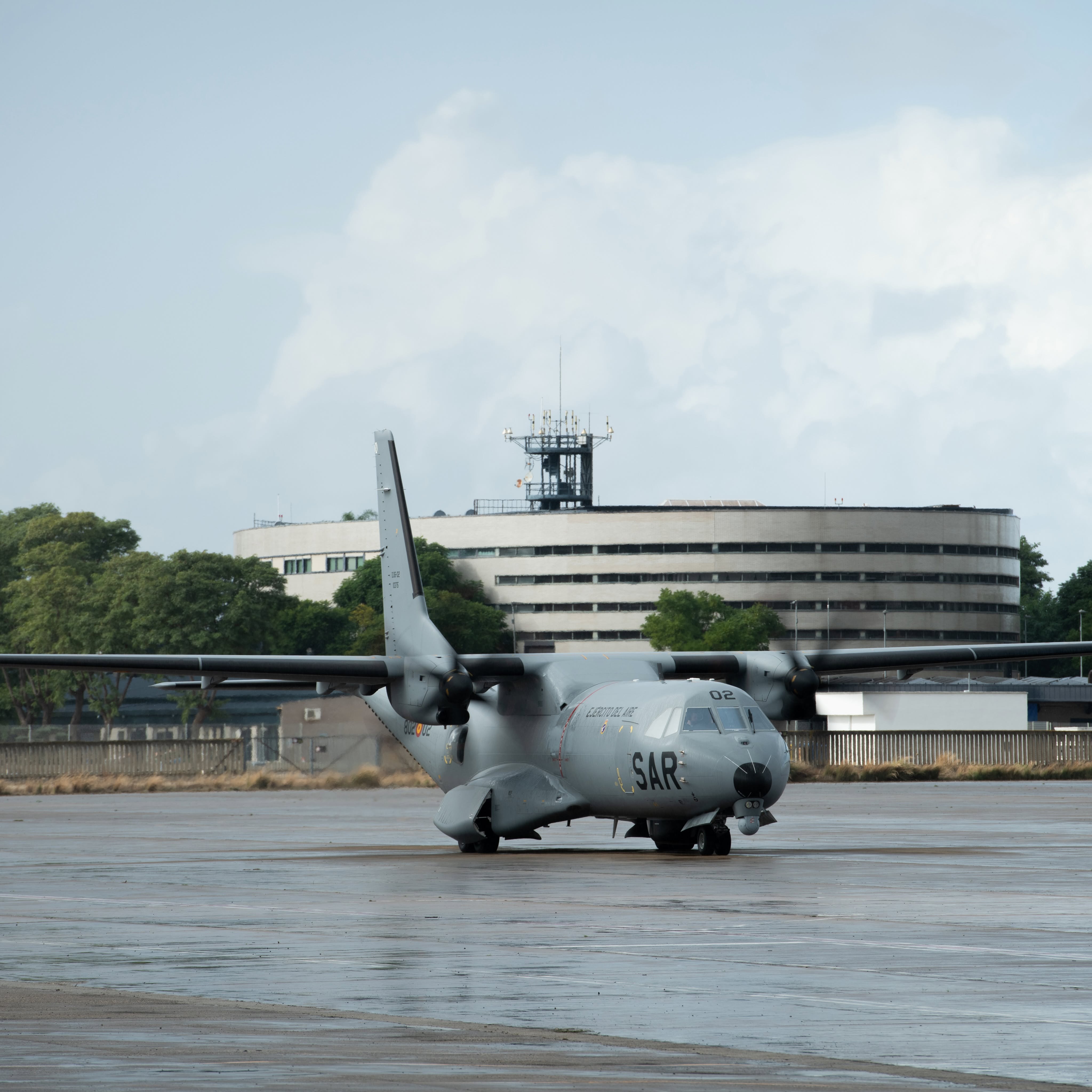
Airbus strengthens Spain's maritime surveillance and rescue capabilities, but the transition from the ageing CN235 fleet and the delayed restoration of dedicated maritime patrol capabilities remain important challenges.
Airbus Defence and Space has confirmed the delivery of the second C295 in Search and Rescue (SAR) configuration to the Spanish Air and Space Force, marking another step in Spain's long-term effort to modernise its maritime surveillance and search-and-rescue aviation capabilities.
The aircraft is destined for Wing 46 at Gando Air Base in Gran Canaria, a strategically important location for operations over the Atlantic Ocean and the surrounding Canary Islands search-and-rescue region.
The new aircraft will progressively replace the ageing CN235 VIGMA fleet, which has performed maritime surveillance and search-and-rescue duties for the Spanish Air and Space Force since 2008.
Spain's modernisation effort dates back to 2023, when the Ministry of Defence ordered 16 Airbus C295 aircraft under a €1.695 billion programme.
The order was divided into two mission configurations:
|
Configuration |
Aircraft |
Primary mission |
|---|---|---|
|
C295 SAR/MSA |
8 |
Search and rescue, maritime surveillance |
|
C295 MPA |
8 |
Maritime patrol, anti-submarine warfare and intelligence |
The programme was designed to address two separate capability requirements:
Replace the ageing CN235 VIGMA fleet, which has served in maritime surveillance and SAR missions since 2008.
Restore Spain's dedicated maritime patrol and anti-submarine warfare capability following the retirement of its P-3 Orion fleet at the end of 2022.
June 2023 – Programme groundwork
Spain advanced the funding and acquisition framework for new maritime patrol and surveillance aircraft, with the objective of maintaining national maritime security and SAR commitments.
20 December 2023 – Contract signed
Spain ordered 16 C295 aircraft worth €1.695 billion, comprising eight MSA/SAR and eight MPA aircraft.
12 November 2025 – First SAR aircraft flies
The first Spanish C295 SAR completed its initial flight from Airbus's San Pablo facility in Seville, beginning its flight-test campaign.
May 2026 – Production milestone
Airbus completed the first three aircraft of the new maritime surveillance configuration, according to the reported programme update.
24 June 2026 – First aircraft delivered
The Spanish Air and Space Force officially received its first C295 SAR in Seville. The aircraft was assigned to Wing 46 at Gando Air Base, Gran Canaria. The delivery took place approximately two and a half years after the original contract.
November 2026 – Second SAR aircraft
Airbus has announced the second aircraft's delivery, continuing the introduction of the new generation of SAR platforms. The latest aircraft is intended to strengthen operations at Gando.
The C295 offers several operational advantages over the older CN235 platform.
Mission endurance: The aircraft's long endurance allows crews to remain on station for extended maritime surveillance and search operations. Spanish aviation reporting indicates more than 11 hours of surveillance capability for the new configuration.
Advanced mission systems: Airbus's Fully Integrated Tactical System (FITS) combines information from surveillance sensors and mission equipment, helping crews build a comprehensive maritime picture.
Search-and-rescue equipment: Large observation windows improve visual searches, while the rear cargo ramp facilitates deployment of emergency equipment, including inflatable life rafts.
Operational flexibility: The aircraft can support maritime surveillance, overland monitoring, anti-smuggling operations and national or international SAR missions.
Despite the latest deliveries, several important challenges remain.
One of Spain's most significant challenges is the retirement of its P-3 Orion fleet at the end of 2022.
The C295 MPA is intended to restore dedicated maritime patrol and anti-submarine warfare capabilities, including:
Anti-submarine warfare (ASW).
Anti-surface warfare (ASuW).
Intelligence, surveillance and reconnaissance (ISR).
Maritime situational awareness and command-and-control missions.
However, the MPA variant is considerably more complex than the SAR/MSA aircraft. Its development involves integrating advanced maritime sensors, sonobuoys, electronic support measures and other mission equipment.
The first C295 MPA delivery is planned for 2028, leaving a substantial interval between the P-3 retirement and the arrival of its replacement.
The eight new SAR/MSA aircraft are intended to replace the existing CN235 VIGMA fleet progressively.
Until sufficient C295 aircraft are delivered, integrated and operationally available, Spain must manage the transition while maintaining existing surveillance and rescue commitments.
This requires continued maintenance, spare-parts availability, crew training and operational coordination across the legacy and new fleets.
The C295 MPA is not simply a transport aircraft fitted with additional equipment.
Integrating its maritime radar, electro-optical sensors, acoustic systems, mission computers and weapons capabilities requires extensive development and testing.
This is one reason why the MPA variant has a later delivery schedule than the SAR/MSA aircraft.
Airbus is also managing a growing C295 order book.
In 2026 reporting, the company was increasing the production rate at its Seville final assembly line from approximately 10 to 13 aircraft annually to accommodate demand.
The Spanish programmes alone involve 34 newly ordered C295s across different configurations, making delivery sequencing, supplier capacity and mission-system integration important considerations.
Spain's commitment to the C295 expanded further in December 2025, when the Ministry of Defence ordered another 18 transport-configured C295 aircraft.
These aircraft are intended to replace older CN235 and C212 platforms used for military transport, pilot training and paratrooper training.
The new order is divided into two batches:
First batch: 18 aircraft for transport and training-related requirements, with deliveries scheduled from 2026 through 2028.
Second batch: aircraft for paratrooper and cargo-drop training, with deliveries scheduled between 2030 and 2032.
The combined acquisition of 34 new C295s, together with the 12 already operated in transport configuration, will bring Spain's planned fleet to 46 C295 aircraft.
The delivery of the second C295 SAR aircraft is an important step in Spain's effort to renew its maritime surveillance and rescue fleet, particularly around the Canary Islands and the eastern Atlantic.
However, the broader modernisation programme should be judged on more than aircraft deliveries.
The immediate priority is to replace the ageing CN235 fleet without disrupting ongoing SAR and maritime surveillance operations. The longer-term challenge is the introduction of the more sophisticated C295 MPA, which is intended to restore the dedicated maritime patrol and anti-submarine warfare capabilities lost following the P-3 Orion retirement.
Spain is therefore pursuing two parallel objectives: maintaining immediate operational readiness while rebuilding its longer-term maritime patrol capabilities.
The C295 SAR is arriving now, but the real strategic milestone will be the introduction of the C295 MPA from 2028.