
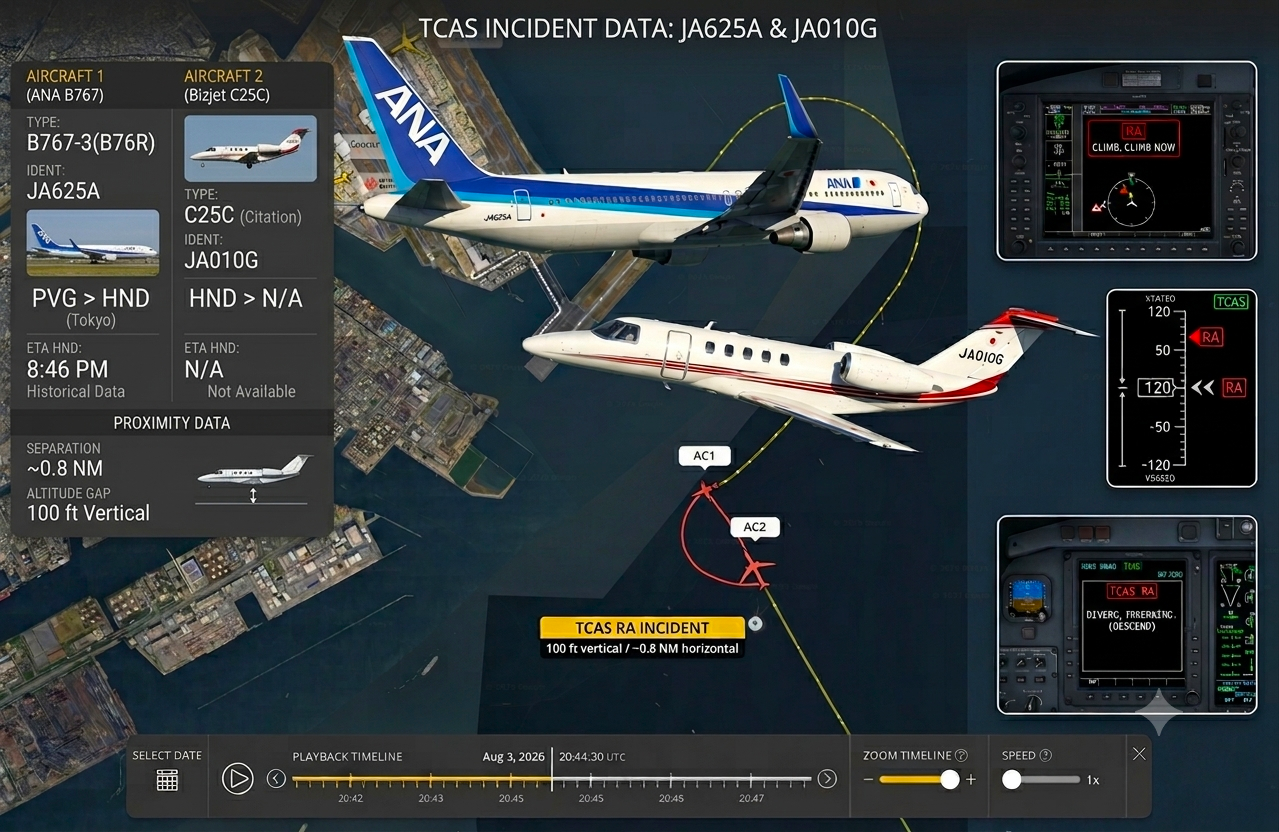
Severe Airspace Conflict: An All Nippon Airways (ANA) Boeing 767-300 (Flight NH968) arriving from Shanghai and a Japan Civil Aviation Bureau (JCAB) Cessna Citation CJ4 inspection jet experienced a dangerous near-miss over Tokyo Bay on final approach.
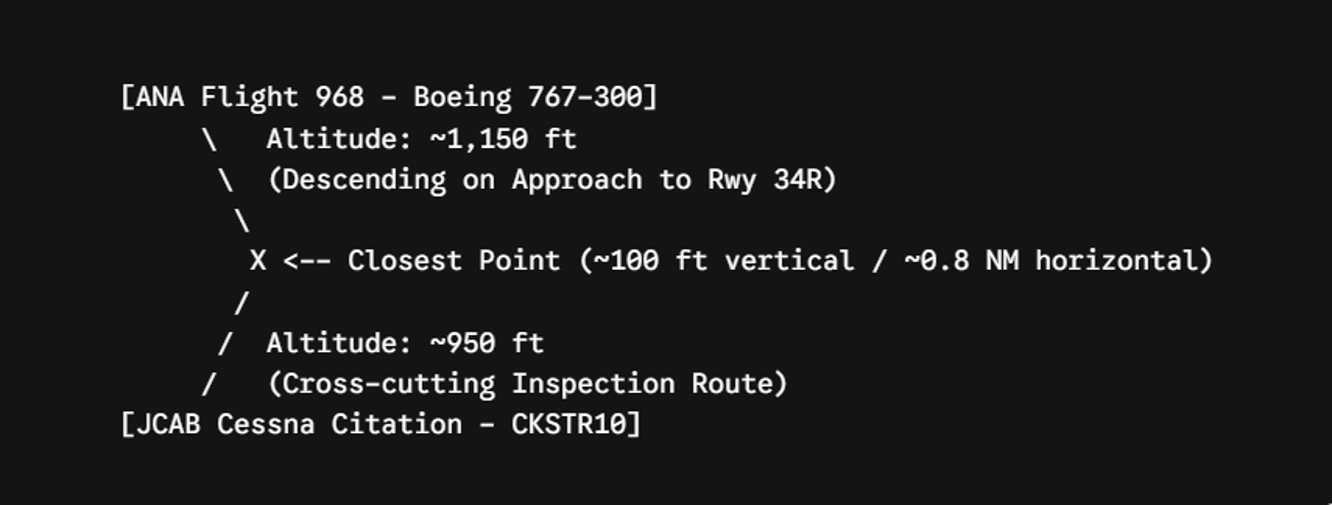
Critical Proximity Metrics: Flight tracking data revealed the two aircraft converged to within approximately 100 feet (30.5 meters) vertically and 0.7 to 1.0 nautical mile horizontally of each other.
Automated TCAS Resolution Advisory: The Boeing 767’s onboard Traffic Collision Avoidance System (TCAS) triggered an emergency Resolution Advisory (RA), commanding the flight crew to override ground traffic controls and execute an immediate evasive climb.
Safe Landing & Zero Casualties: The ANA crew successfully executed a go-around maneuver and landed safely shortly after, with no injuries reported among the 197 passengers and crew on board.
Intersecting Flight Paths: The JCAB inspection aircraft (callsign CKSTR10) was performing low-altitude flight inspections and navigation aid calibration following takeoff when its trajectory crossed directly into the active arrival corridor for Runway 34R.
Official Safety Investigation: Japan’s Ministry of Land, Infrastructure, Transport and Tourism (MLIT) has launched a formal investigation into the loss of separation, drawing renewed scrutiny to Haneda’s airspace management following the fatal January 2024 runway collision.
In the early morning hours of August 4, 2026, air traffic safety mechanisms were put to an urgent real-world test over Tokyo Bay. At approximately 5:44 a.m. local time, All Nippon Airways (ANA) Flight 968—a Boeing 767-300 carrying 197 passengers and crew from Shanghai’s Pudong International Airport—was descending on final approach toward Runway 34R (Runway C) at Tokyo Haneda Airport (HND).
Simultaneously, a Japan Civil Aviation Bureau (JCAB) Cessna Citation CJ4 inspection aircraft (callsign CKSTR10), which had departed from Haneda's Runway D on a northeasterly vector to calibrate navigation aids, crossed directly into the arrival corridor.
As the two aircraft rapidly converged on intersecting trajectories, automated safety technology stepped in where human perception and radio traffic management lapsed.
Less than three years after the fatal January 2024 runway collision involving a Japan Airlines A350, Tokyo’s Haneda Airport came dangerously close to another major disaster in the early hours of August 4, 2026.
At approximately 5:44 a.m. local time, All Nippon Airways (ANA) Flight 968—a Boeing 767-300 arriving from Shanghai with 197 passengers and crew on board—was flying northwest over Tokyo Bay on final approach to Runway 34R (Runway C).
At the same time, a Japan Civil Aviation Bureau (JCAB) Cessna Citation inspection aircraft (callsign CKSTR10)—conducting navigation aid and calibration operations after departing Runway D—crossed directly into the arrival path.
Here is what unfolded in the air:
TCAS Activation: The Boeing 767’s onboard Traffic Collision Avoidance System (TCAS) triggered a Resolution Advisory (RA), alerting the flight crew to perform an immediate emergency climb and go-around.
Close Proximity: Flight tracking data indicates the two aircraft converged within approximately 100 feet vertically and 0.7 to 1.0 nautical mile horizontally at their closest point.
Safe Outcome: The ANA crew executed the go-around maneuver and landed safely following the incident. No injuries were reported.
Investigation: Japan’s Ministry of Land, Infrastructure, Transport and Tourism (MLIT) has launched a formal investigation to determine whether the event officially constitutes a near-miss and how the separation was lost in one of the world's busiest airspaces.
This close call highlights the lifesaving role of TCAS automation and pilot adherence to resolution advisories, especially as aviation authorities remain hyper-vigilant over runway and airspace safety protocols around Haneda.
Flight tracking metrics revealed that at their closest point of approach, the Boeing 767 and the Cessna Citation were separated by approximately 100 feet vertically and 0.7 to 1.0 nautical mile horizontally. At jet transport velocities, such separation represents a fraction of a second from collision.
The imminent threat triggered a Resolution Advisory (RA) from the Boeing 767’s Traffic Collision Avoidance System (TCAS). In accordance with strict international aviation protocols, the ANA flight crew prioritized the automated TCAS vocalized command over ground controller instructions, executing an aggressive go-around climb to clear the conflicting airspace.
The aircraft landed safely on a subsequent approach, with no injuries reported among the 197 occupants. Japan’s Ministry of Land, Infrastructure, Transport and Tourism (MLIT) along with the Japan Transport Safety Board (JTSB) immediately initiated a formal investigation into the loss of separation.
The August 4 incident sent immediate ripples through the international aviation community, evoking memory of prior runway and airspace conflicts in Japanese airspace.
This near-miss occurred in the shadow of the catastrophic collision on January 2, 2024, when Japan Airlines Flight 516 (an Airbus A350-900) collided on Runway 34R with a Japan Coast Guard De Havilland Canada Dash 8 (JA722A). That disaster resulted in five fatalities aboard the Coast Guard aircraft, though all 379 passengers and crew aboard the JAL A350 evacuated safely. JTSB investigations later identified missed ground occupancy alerts, misread air traffic control clearances, and communication breakdowns during high-density operational conditions as primary factors.
Japan’s aviation safety architecture was previously reshaped by the 2001 Japan Airlines mid-air incident over Shizuoka/Suruga Bay. In that event, two JAL widebody jets (a Boeing 747 and a DC-10) came within 35 to 100 feet of a mid-air collision after a controller’s instruction conflicted with the onboard TCAS RA. The conflicting maneuvers caused severe injuries to over 100 passengers and led to a global mandate reinforcing that pilots must always obey TCAS Resolution Advisories over air traffic control instructions when a conflict occurs.
The primary defense mechanism in the August 4 near-miss was TCAS II (v7.1). Independent of ground radar and voice communication, TCAS functions through continuous interrogation of transponders on surrounding aircraft:
Traffic Advisory (TA): Warns pilots of nearby traffic approximately 20 to 48 seconds prior to the point of closest approach.
Resolution Advisory (RA): Commands precise vertical escape maneuvers (e.g., "CLIMB, CLIMB NOW" or "DESCEND, DESCEND") approximately 15 to 35 seconds prior to potential impact.
| System Component | Role in Conflict Resolution |
| Ground ATC Surveillance | Provides macro-level separation and sequencing across flight paths. |
| Onboard Transponders | Broadcast pressure altitude and identity parameters to surrounding aircraft. |
| TCAS Computer | Predicts closing speed and calculates vertical escape paths independently. |
| Flight Crew Action | Mandated to follow TCAS vertical commands immediately, overriding ATC instructions. |
When mixed-use airspace involves specialized operations—such as calibration flights, search-and-rescue sorties, and heavy commercial transport traffic—automated fail-safes serve as the last line of defense against human error or communication gaps.
Investigators will examine flight recorder logs, air traffic audio recordings, and radar data to understand how the flight path of inspection aircraft CKSTR10 intersected with an active arrival route.
You may like to read.........

.jpg)