
In an effort to deregulate the Air Commercial Policy, the Argentine government has eliminated the requirement for private aviation to submit flight plans within the country , a measure expected to simplify procedures and reducing bureaucratic burdens in the commercial aviation sector.
The regulations modify rules that for decades have limited private aviation, non-scheduled aviation, and commercial air transport. The aim is to streamline operations, lower costs, and expand flight options for Argentinians.
The decision was formalized by the National Civil Aviation Administration (ANAC) through a resolution (Resolution 957/25 from ANAC Argentina) signed by its head, Oscar Alfredo Villabona , and published this Monday in the Official Gazette .
The initiative was welcomed by the Minister of Deregulation and State Transformation, Federico Sturzenegger , who maintained that the amendments included in the resolution will have a high impact on general and non-scheduled aviation .
“ The requirement to submit a flight plan within the country is being eliminated for all private aviation —just as you don't have to submit a travel plan to the government when you get in your car to go to Mar del Plata. This change implies a significant reduction in time and paperwork , which affected any citizen who wanted to board a plane, start it up, and take off. Now the government will no longer ask you where you are going ,” the official stated.
In a post on his X account, Sturzenegger explained that the measure is not an isolated innovation , but rather a common practice in other countries:
“ It’s not reinventing the wheel: this is how things are done in the United States and in European countries .” The central argument in the resolution published in the Official Gazette is the need to “simplify the operational burden in general aviation operations . ”
Within the framework of the fight against drug trafficking , one of the main priorities of former Security Minister Patricia Bullrich , the minister clarified that the deregulation includes an exception .
“ The only exception is that Argentina has a high-security air surveillance zone above the 29th parallel south due to drug trafficking . In that zone, to avoid having to file a flight plan, an ADS -B system will be required , which allows for real-time aircraft tracking ,” he explained.
The regulations also introduced significant operational changes. For one, the nationwide ban on night time visual flight has been eliminated .
“ In Argentina, if you wanted to fly an aircraft under visual flight conditions at night, it was prohibited; now it's permitted. The State was a machine for obstruction ,” Sturzenegger remarked.
The authorization of night visual flight expands operational possibilities for pilots, flying clubs, and private operators . Furthermore, it improves the flexibility of the air transport system, especially in areas with limited connectivity.
For all air commercial transport, the requirement for the now-repealed 1st class commercial license (some unnecessary requirements that had been put in place to give work to flight instructors) has been eliminated, which will translate into a greater supply of commercial pilots, essential in a growing market like Argentina's. VLLC!
Furthermore, for non-scheduled aviation companies , equipment requirements, manuals, and procedures were simplified , and the possibility of flying with a single pilot was enabled under certain conditions , such as having a three-axis autopilot . According to the minister, these modifications could drastically reduce the operating costs of small airlines .
On the side of non-scheduled aviation companies, equipment requirements, manuals, and procedures have been simplified, and flying with a single pilot is now allowed under certain conditions (having a 3-axis autopilot), which would drastically lower costs for small airlines.
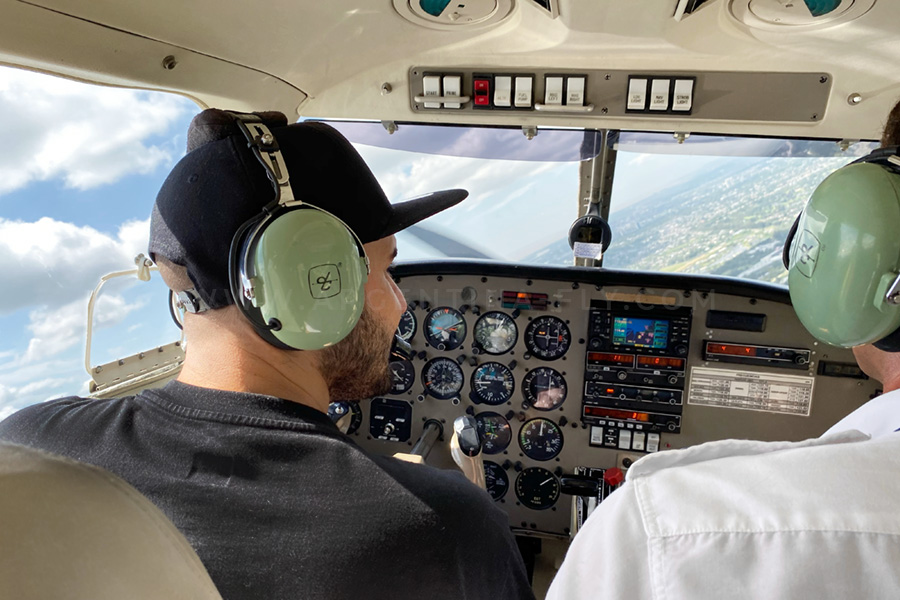
Display Picture Courtesy: argentina-fly.com