

Critical 2025–2027 Execution Window: Following 2025 mandate implementations, offtake agreements signed and Final Investment Decisions (FIDs) reached in this 3-year window will determine whether aviation meets its 2030 decarbonization targets.
100-Fold Market Growth Projection: The global Sustainable Aviation Fuel market is projected to expand from $1.29 billion in 2023 to $131.12 billion by 2033.
Transition from Voluntary to Mandatory Adoption: Regulatory frameworks like ReFuelEU Aviation, the UK SAF Mandate, Singapore's SAF Levy, and the U.S. IRA are establishing binding long-term demand and investor certainty.
Necessity of Bankable Offtakes: Non-binding letters of intent are no longer sufficient; developers need long-term, legally binding airline commitments to unlock institutional project financing.
Shift to Next-Generation SAF Technologies: As Generation 2 HEFA fuels encounter feedstock limits, focus is pivoting toward scaling Generation 3 synthetic e-fuels (eSAF) and waste-to-fuel pathways.
Global Ecosystem Collaboration: Senior leaders across policymakers, energy producers, airlines, finance, and OEMs are aligning to build green trade corridors and connected supply hubs.
The global aviation industry has entered a decisive decade. For years, Sustainable Aviation Fuel (SAF) remained a promising solution discussed in boardrooms, research laboratories, and climate forums. Today, it has become the aviation sector's most critical decarbonization strategy, supported by binding regulations, multi-billion-dollar investments, and an expanding global supply chain.
The year 2025 marked a watershed moment. Mandatory SAF blending requirements began taking effect across major aviation markets, transforming sustainable fuel from a voluntary corporate initiative into an operational necessity. Airlines, fuel producers, airports, investors, and governments now face a common challenge—not whether Sustainable Aviation Fuel should be adopted, but how rapidly the industry can scale production to satisfy unprecedented demand.
Against this backdrop, the SAF Global Summit 2026 (#SAFGlobal26), taking place in London on 22–23 September 2026, arrives at one of the most consequential moments in commercial aviation's history. Bringing together more than 1,000 aviation and energy executives, including over 150 industry speakers and 85+ sponsors and partners, the summit represents far more than another conference—it is rapidly becoming the industry's principal execution platform for achieving Net Zero aviation.
Only a decade ago, commercial SAF production was measured in thousands of tonnes rather than millions. Demonstration flights by airlines such as KLM, Lufthansa, United Airlines, Qantas, Air France-KLM, and Virgin Atlantic proved the technical feasibility of sustainable fuels, but commercial deployment remained constrained by cost, feedstock availability, and limited policy support.
The turning point began in the early 2020s.
In 2021, the International Air Transport Association (IATA) committed the airline industry to achieving Net Zero carbon emissions by 2050, placing SAF at the centre of aviation's decarbonization roadmap.
The following years witnessed unprecedented momentum.
The United States introduced powerful production incentives through the Inflation Reduction Act (IRA) and subsequently the Sustainable Aviation Fuel tax credit. Europe implemented ReFuelEU Aviation, requiring progressively increasing SAF blending mandates across European airports beginning in 2025. The United Kingdom launched its own SAF mandate and revenue certainty mechanisms designed to stimulate domestic production, while Singapore became the first country in Asia to introduce a national SAF levy to support sustainable fuel deployment.
Meanwhile, aircraft manufacturers demonstrated increasing confidence in higher blend capabilities. Airbus and Boeing expanded testing programmes aimed at enabling aircraft to operate with 100% SAF, while engine manufacturers including Rolls-Royce, GE Aerospace and Pratt & Whitney validated engine performance using unblended sustainable fuel under controlled testing environments.
Collectively, these developments transformed SAF from an environmental aspiration into a commercially strategic aviation fuel.
The implementation of SAF mandates during 2025 fundamentally altered market dynamics.
Before mandates, airlines primarily purchased SAF to satisfy voluntary Environmental, Social and Governance (ESG) commitments or corporate Scope 3 emissions targets.
Today, demand is increasingly policy-driven.
Mandatory blending obligations have shifted procurement strategies across airlines, airports and fuel suppliers. Sustainable fuel has become an operational compliance requirement rather than a discretionary sustainability initiative.
Yet this success has exposed the industry's next major obstacle.
Global production capacity continues to lag behind projected demand.
The International Energy Agency (IEA), IATA and the International Civil Aviation Organization (ICAO) have consistently highlighted that SAF production must increase several-fold before 2030 if aviation is to remain on a credible pathway toward Net Zero emissions.
Consequently, the period between 2025 and 2027 is widely viewed as the defining investment window.
The Final Investment Decisions (FIDs), financing arrangements and long-term offtake agreements concluded during these years will determine whether enough production facilities become operational before the end of the decade.

This makes the SAF Global Summit 2026 uniquely significant.
Rather than focusing solely on policy ambitions, this year's discussions centre on implementation.
The summit brings together every critical stakeholder across the SAF value chain:
With 80% of attendees holding Director-level positions or above, decision-making—not simply dialogue—defines the event's value.
Large-scale SAF facilities require investments measured in hundreds of millions—and often billions—of dollars.
Such projects cannot proceed without predictable regulatory environments.
Long-term mandates, transparent certification systems, carbon pricing mechanisms and international policy harmonization remain essential for reducing investment risk.
Government policy has evolved from environmental regulation into industrial policy, providing the confidence required for private capital deployment.
One of the industry's most important lessons is that Memoranda of Understanding alone do not finance production plants.
Developers increasingly require legally binding, long-term purchase agreements before lenders approve financing.
These bankable contracts provide revenue certainty, enabling projects to reach Final Investment Decision.
Across Europe and North America, airlines are increasingly entering multi-year agreements with SAF producers, signalling growing commercial maturity.
Current commercial SAF production relies predominantly on Hydroprocessed Esters and Fatty Acids (HEFA), using waste oils and fats as feedstocks.
Although commercially successful, HEFA faces inherent feedstock limitations.
Future growth therefore depends upon expanding alternative production pathways including:
Equally important is developing international logistics networks capable of transporting sustainable fuels efficiently between production hubs and major aviation markets.
Emerging "green corridors" linking producers with international airports are expected to become increasingly important throughout the remainder of the decade.
Generation 3 sustainable fuels represent perhaps the industry's greatest long-term opportunity.
Synthetic e-fuels produced from renewable electricity, captured carbon dioxide and green hydrogen offer potentially near-unlimited scalability while dramatically reducing lifecycle emissions.
Although production costs remain high, continued investment and technological improvements are expected to reduce costs significantly over the coming decade.
Several demonstration plants across Europe, North America and Asia have already begun validating commercial pathways.
The commercial opportunity surrounding SAF is equally remarkable.
Industry market analyses project global Sustainable Aviation Fuel markets expanding from approximately US$1.29 billion in 2023 to over US$131 billion by 2033.
Such growth represents nearly a 100-fold expansion within a single decade.
Beyond emissions reduction, SAF is becoming a catalyst for broader economic transformation by:
For governments, SAF represents both climate policy and industrial competitiveness.
For investors, it is rapidly becoming one of the fastest-growing segments of the global energy transition.
Despite encouraging momentum, significant barriers remain.
SAF continues to command a substantial price premium over conventional Jet A-1 fuel.
Commercial airlines, operating on narrow profit margins, cannot absorb these costs indefinitely without supportive policy frameworks and financial incentives.
The industry must therefore continue advancing:
The success of aviation's energy transition will depend upon coordinated execution rather than isolated initiatives.
Momentum is no longer confined to Europe and North America.
Major SAF investments are emerging across Asia-Pacific, Latin America, Africa and the Middle East, reflecting aviation's increasingly global approach to decarbonization.
This geographic diversification creates enormous opportunities—but also increases the need for international policy alignment, standardized sustainability criteria and coordinated investment strategies.
That is precisely where the SAF Global Summit 2026 assumes global importance.
The conversations taking place in London this September will influence infrastructure investments, fuel production, airline procurement strategies and regulatory frameworks well beyond 2030.
The industry has already demonstrated that Sustainable Aviation Fuel works.
It has proven that governments can create effective market incentives. It has shown that investors are willing to commit capital. The remaining challenge is execution at industrial scale.
As aviation moves beyond mandates toward large-scale implementation, SAF Global Summit 2026 stands poised to become the forum where the industry's next decade is shaped—not through aspiration, but through action.
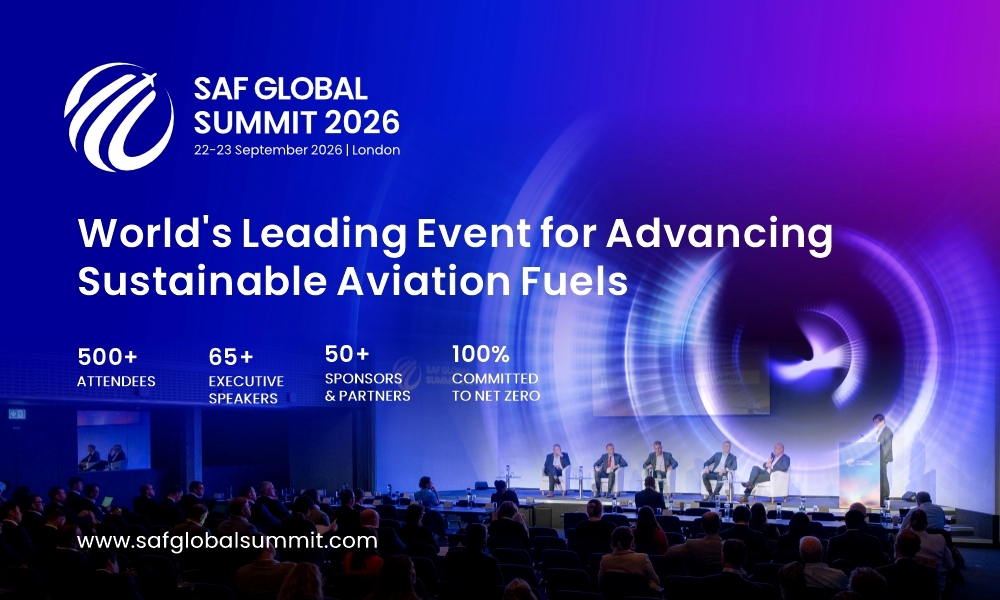
Dates: 22–23 September 2026
Location: London, United Kingdom
Attendance: 1,000+ delegates
Speakers: 150+ executive speakers
Sponsors & Partners: 85+
Audience Profile: 80% Director-level and above
Focus: Scaling Sustainable Aviation Fuel, investment, policy implementation, production technologies, supply chains and achieving Net Zero aviation.
Display Picture Credit: SAF Global Summit 2026
You may like to read.......