
Key Highlights
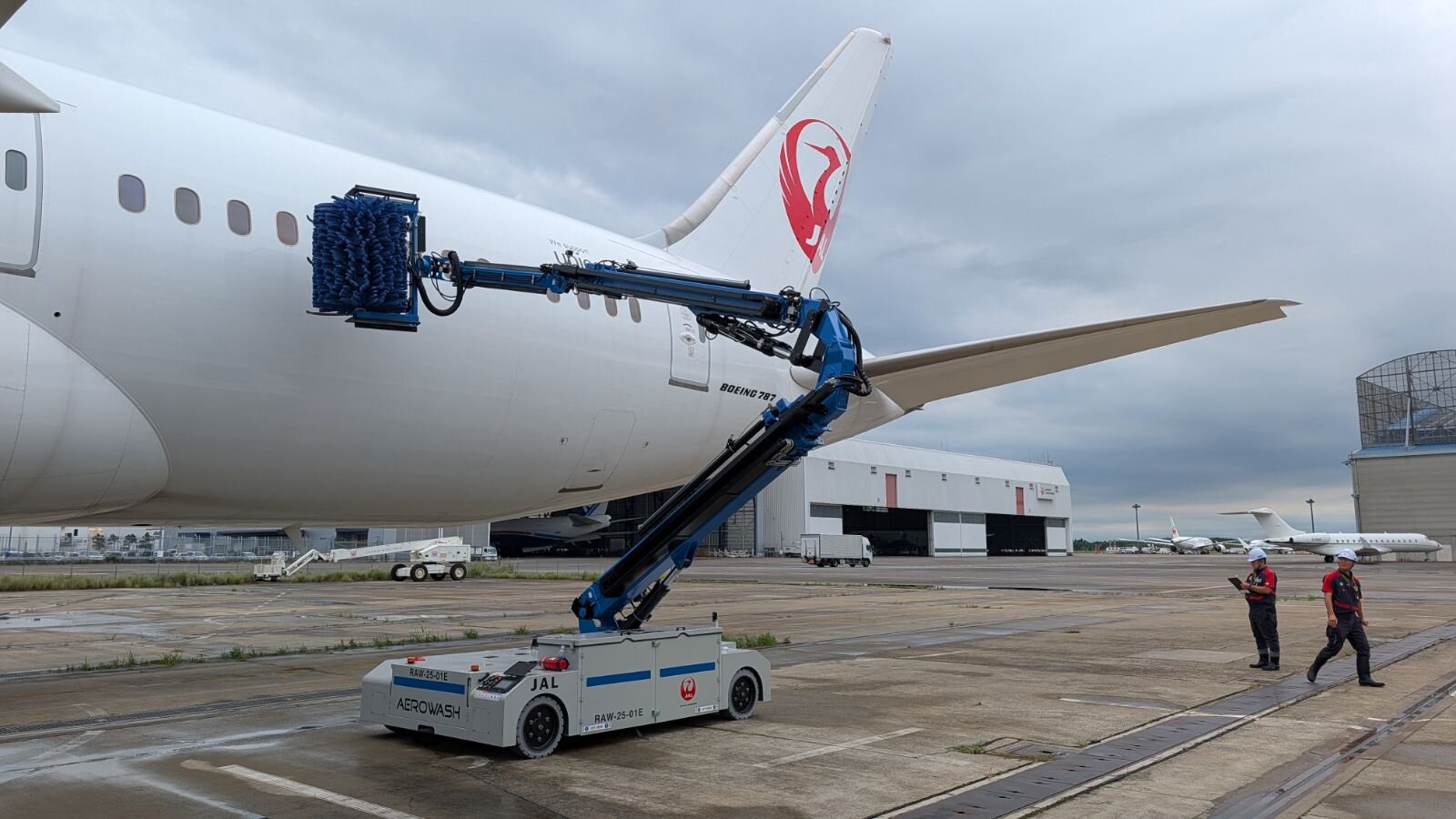
Japan Airlines (JAL) is taking another step toward digital transformation of airport ground handling with the introduction of an Aerowash AW3 aircraft-washing robot at Narita International Airport. The system represents JAL’s first deployment of a collaborative aircraft exterior-washing robot with programmed approach functions and multi-axis control, according to the airline’s own research.
Following operator training and operational validation, full-scale implementation is planned for 2026.
Aircraft exterior washing is an important ground-handling activity. Dirt, dust, exhaust residues, insects and other contaminants accumulate on fuselage and wing surfaces during normal operation. Regular cleaning helps maintain the aircraft's exterior condition and can support aerodynamic cleanliness and the overall presentation of the aircraft.
Traditionally, exterior washing has been a labor-intensive operation, requiring ground personnel to work around the aircraft using long-handled brushes, mops and cleaning agents. Working around elevated fuselage sections can also involve awkward postures, repetitive movements and exposure to cleaning chemicals.
JAL previously experimented with a wired remote-controlled aircraft-washing system approximately three decades ago, but technical limitations prevented sustained operational deployment. The AW3 represents a substantially more sophisticated approach, combining programmed movement with direct operator intervention.
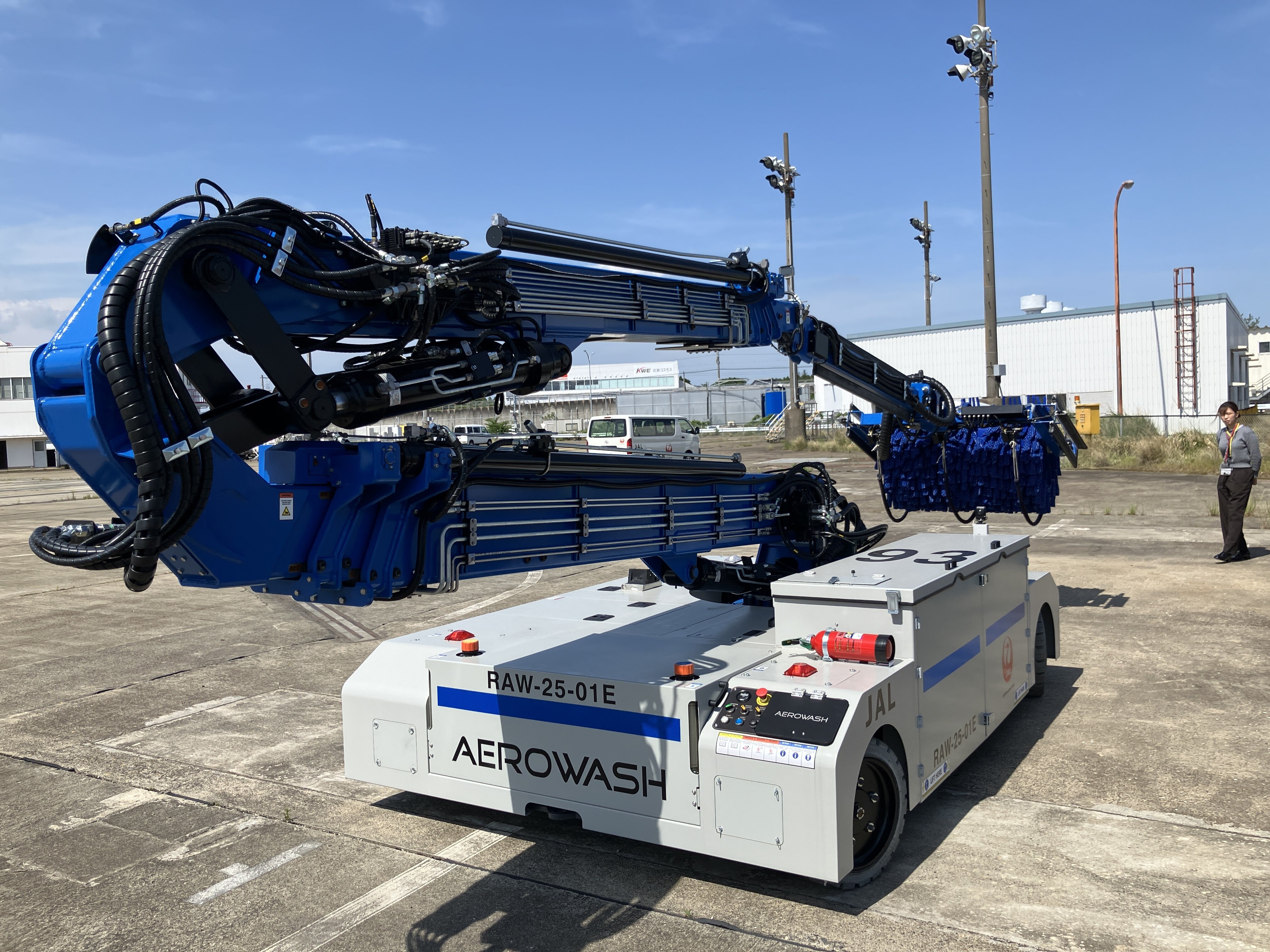
The Aerowash AW3 is essentially a mobile robotic washing platform with a telescopic multi-axis arm and specialized aircraft-cleaning brush.
Aerowash says the system incorporates:
The automatic distance and angle functions are particularly important from an aircraft-maintenance perspective. Aircraft fuselages are not flat surfaces: curvature changes significantly between the crown, sidewalls, lower fuselage and nose/tail areas. Maintaining controlled brush geometry helps achieve consistent cleaning while reducing the possibility of excessive mechanical loading on the aircraft skin.
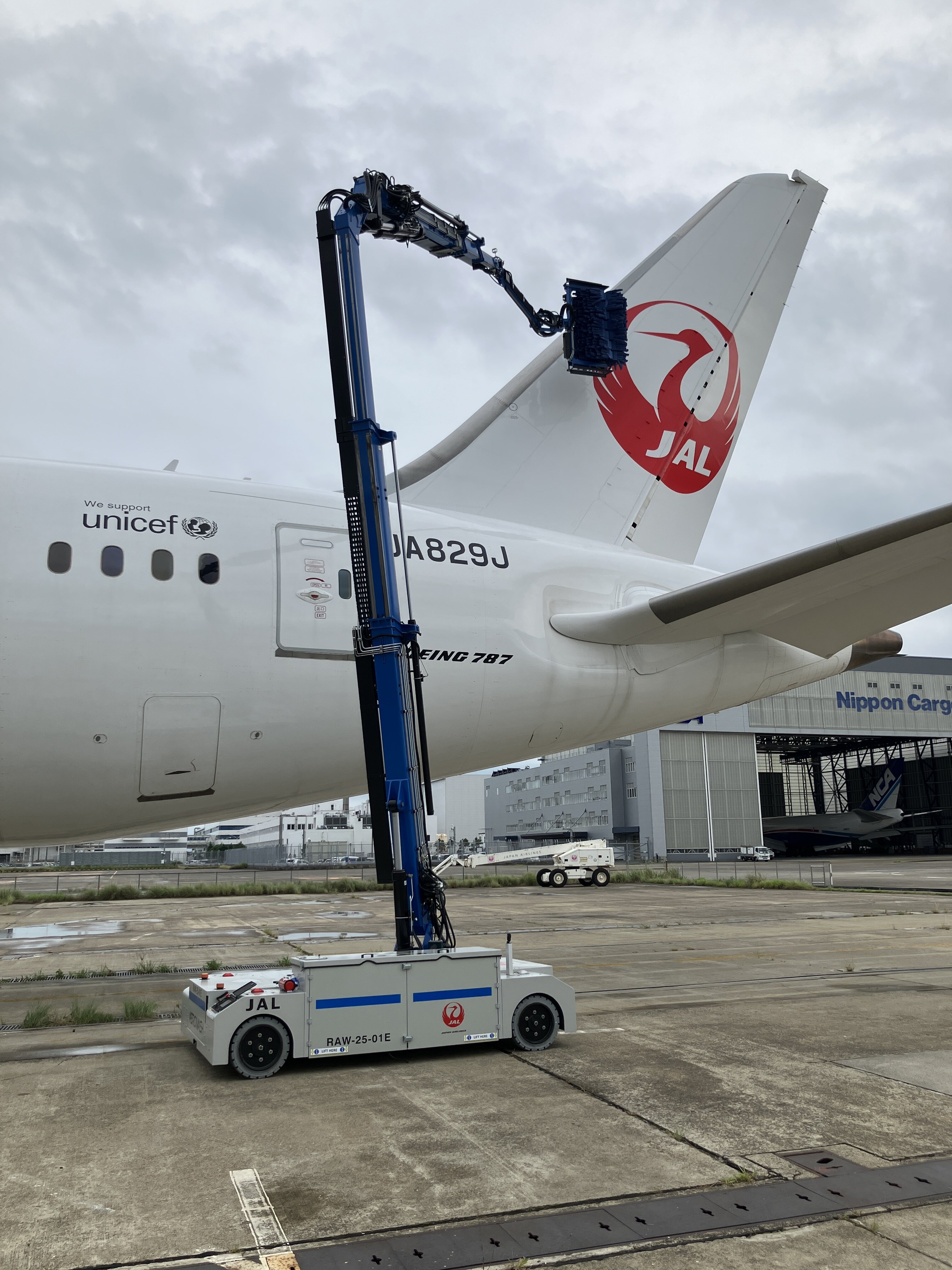
An important distinction is that the JAL system is not simply an autonomous robot operating without human supervision.
The AW3 uses programmed coordinates to guide the washing arm toward predetermined aircraft areas. As the equipment approaches the aircraft, the operator can make fine positioning adjustments through the handheld controller.
This creates a human-machine collaborative operating model: automation handles repeatable positioning and movement, while a trained operator retains direct control over critical interactions with the aircraft.
That approach is particularly relevant around areas where aircraft geometry changes rapidly or where sensitive external components are installed.
The system's four-wheel-steering configuration also improves maneuverability around the aircraft, allowing the washing unit to be positioned more precisely in confined ramp environments.
Aircraft cleaning is not merely cosmetic.
Contamination on external surfaces can affect surface condition and aerodynamic cleanliness. Maintaining a clean exterior is particularly relevant for high-frequency aircraft operations, where repeated exposure to environmental contaminants occurs between maintenance visits.
The broader sustainability connection is also significant. JAL already identifies cleaning-related activities as part of its efforts to improve operational efficiency and resource consumption. Separately, the airline reports that regular engine internal washing can recover approximately 1% of fuel efficiency, illustrating how contamination management can have an operational impact beyond appearance.
However, exterior washing should not be confused with engine washing. The AW3 is intended for aircraft exterior cleaning rather than compressor or turbine-engine cleaning.
According to figures supplied by Aerowash, the system can reduce aircraft washing time by up to 40% compared with conventional manual methods. JAL is treating this as a manufacturer-stated performance figure and plans to validate the actual improvement under Narita operating conditions.
That distinction is important because real-world productivity depends on several variables, including:
Aerowash's own published material describes the AW3 as suitable for both narrow- and wide-body aircraft, including aircraft such as the Airbus A350 and Boeing 787.
For JAL, this is particularly relevant because its fleet includes A350-900/-1000 and Boeing 787-8/-9 aircraft, alongside Boeing 777-300ER, 767-300ER and 737-800 aircraft.
JAL says the technology could reduce water consumption by up to 50% per aircraft, based on Aerowash catalogue figures.
The environmental potential becomes even more interesting when dry-wash processes are considered. Aerowash states that its AW3 can be used with a dry-wash concept and reports that its recommended Socomore cleaning solution can achieve up to 99% water savings compared with conventional high-pressure washing under the relevant dry-wash methodology.
These figures should not be directly conflated: JAL's 50% figure relates to the system's stated potential water reduction, while the 99% figure is an Aerowash claim for its specific dry-wash process compared with high-pressure cleaning. Actual savings will depend on the washing procedure adopted at Narita.
The AW3's electric battery-powered configuration also eliminates local exhaust emissions from the washing vehicle during operation, potentially improving the working environment around aircraft.
One of the most important advantages may be less visible than the robot itself: reducing the physical workload placed on ground personnel.
Manual aircraft washing can require operators to repeatedly extend long-handled equipment, work around elevated fuselage sections and maintain uncomfortable positions for extended periods.
By moving the washing arm mechanically, the AW3 can take over much of this repetitive physical work while the operator remains responsible for supervision and precision control.
Aerowash specifically identifies reduced man-hours, reduced washing time, reduced accident risk and improved ergonomics among the system's intended benefits.
JAL's project reflects a broader transformation occurring across airport ground operations.
Automation is increasingly being applied to repetitive activities such as:
Aircraft towing → baggage movement → inspection → cleaning → cargo handling → turnaround coordination
JAL has previously deployed automated ground equipment at Narita, including an autonomous baggage towing tractor. In that project, the airline described operation equivalent to Level 3 automated driving, with a safety operator aboard.
The AW3 follows a similar philosophy: automation does not necessarily mean removing humans from the process. Instead, it can move the human operator away from physically demanding tasks and toward supervision, decision-making and precision control.
JAL plans to begin with Narita Airport and use operational experience to evaluate whether the technology can subsequently be introduced at other domestic airports.
The implementation will therefore provide an opportunity to measure more than simply washing time. Relevant operational metrics are likely to include:
These data points will determine whether the technology can deliver its expected productivity improvements in actual airline operations.
JAL's AW3 deployment is significant because it represents program-controlled automation entering one of the most traditional areas of aircraft ground servicing: exterior washing.
Rather than attempting to remove the operator completely, the concept combines robotic precision with human oversight. The approach could be particularly valuable in an aviation environment where aircraft surfaces contain sensitive components and where uncontrolled contact cannot be tolerated.
If the Narita trial delivers the expected reductions in labor, washing time and water consumption, aircraft-washing robots could become an increasingly important component of next-generation digital ground handling.
For JAL, the project is ultimately about more than cleaning aircraft. It is an attempt to make a repetitive, physically demanding operation safer, more efficient, more consistent and more sustainable—while keeping the human operator at the center of the process.
Source note: The JAL-specific deployment details and the 40%/50% performance figures are based on the information supplied by JAL; the AW3's technical characteristics were cross-checked against Aerowash's published product information.
Performance figures are manufacturer claims and should be treated as indicative until validated under JAL's actual Narita operating conditions.
You may like to read......