
The United States has dramatically expanded its sanctions campaign against Iran's aviation industry, designating virtually the country's remaining commercial airlines while targeting foreign intermediaries, cargo companies and aviation-service providers accused of helping Iran obtain aircraft, parts, and other aviation technology.
The action announced by the U.S. Department of the Treasury on September 8 represents one of the broadest U.S. sanctions measures directed at Iran's civil aviation sector. Under Operation Economic Outcast, the Treasury's Office of Foreign Assets Control (OFAC) designated 36 targets across multiple jurisdictions and simultaneously moved to restrict previously authorized aviation-related transactions. The Financial Crimes Enforcement Network (FinCEN) also issued a financial-intelligence alert warning banks and other institutions about Iranian aircraft and aircraft-parts procurement networks.
The measures mark a significant escalation from the U.S. government's longstanding focus on individual Iranian carriers—particularly Mahan Air—to a strategy aimed at isolating the wider Iranian aviation ecosystem.
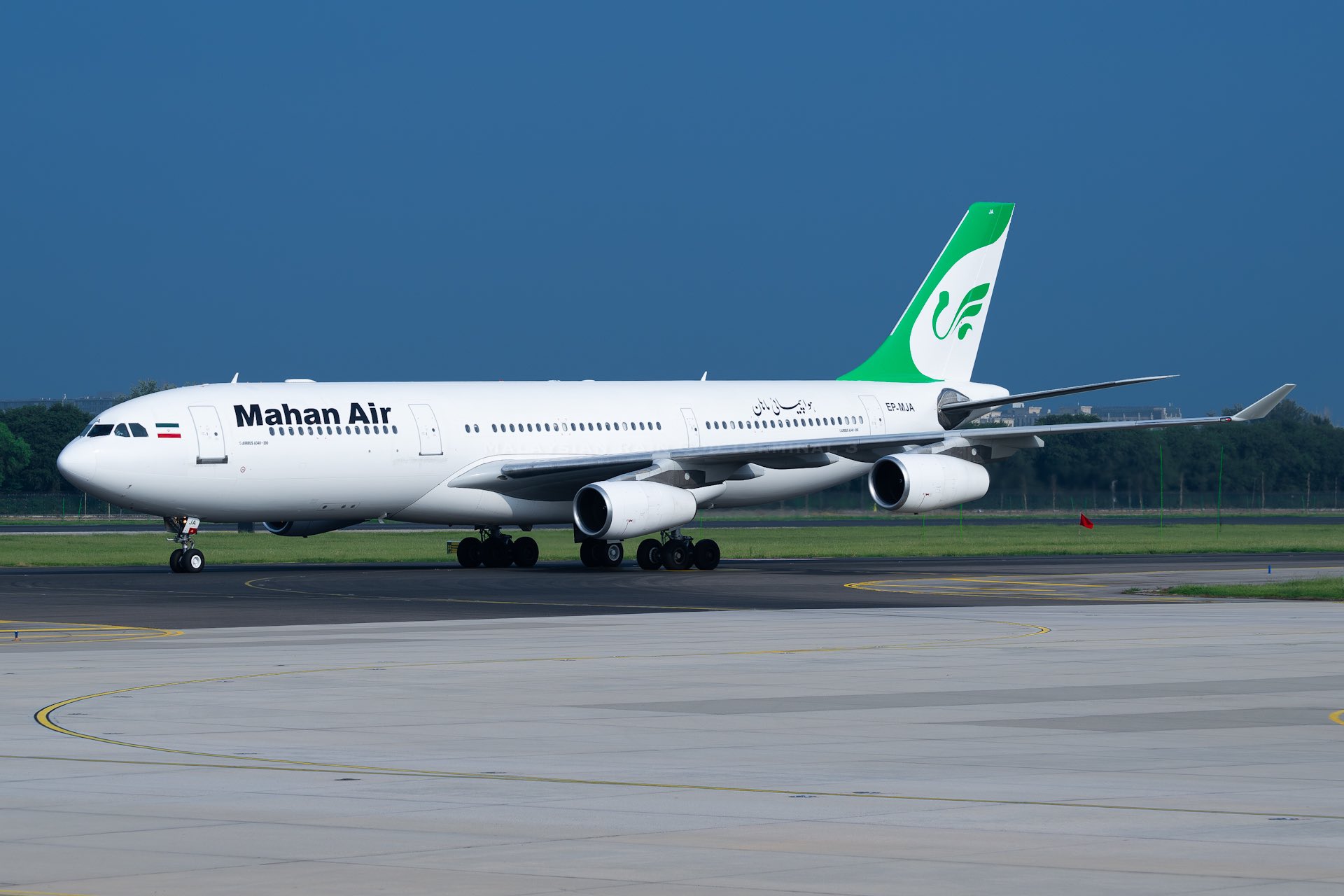
Iranian aviation has operated under U.S. sanctions for years, with Mahan Air at the center of Washington's enforcement efforts.
OFAC designated Mahan Air in October 2011 under Executive Order 13224, accusing the carrier of providing financial, material, and technological support to Iran's Islamic Revolutionary Guard Corps-Qods Force (IRGC-QF). The State Department subsequently designated Mahan Air under Executive Order 13382 in December 2019, placing the airline within the U.S. non-proliferation sanctions framework.
The United States has repeatedly followed those designations with measures against Mahan Air's aircraft, suppliers, agents, logistics companies, and other facilitators. Earlier sanctions actions also identified aircraft operated by Mahan Air and companies involved in providing aviation and logistical support to the carrier.
The enforcement strategy intensified during 2026. OFAC announced further measures against networks supporting Mahan Air in April and July, while the July 2026 action specifically targeted international facilitators connected to the carrier and the IRGC.
By September, Washington had moved beyond Mahan Air.
The latest action designates 27 Iranian airlines under Executive Order 13902, following the U.S. government's August 24 determination that aviation is a targeted sector of the Iranian economy.
The designated carriers include:
OFAC's September 8 action confirms that these carriers have been added to the U.S. sanctions framework under the Iranian aviation-sector determination.
For the Iranian airline industry, the practical significance is substantial. The measure potentially complicates access to international banking, aircraft leasing and financing, insurance, maintenance, spare parts, technical services, aviation software, and other internationally sourced resources.
The latest U.S. action is not limited to airlines themselves.
Washington is increasingly focused on how Iranian carriers obtain aircraft and aviation equipment despite sanctions.
According to Treasury, Iranian entities have used front companies, intermediaries, and transshipment routes in third countries to obscure the ultimate Iranian end-user of aircraft and aviation-related goods.
The September action specifically identifies companies in the United Arab Emirates, the United Kingdom, Türkiye, Malaysia, and Kazakhstan that Treasury says have supported Mahan Air or participated in related procurement and logistics activities.
Among those designated are ECT Aviation Support UAE, ECT Aviation Support UK, Türkiye-based Sky Phoenix, Malaysia-based Icargo, Türkiye-based S Sistem and Mes Cargo, and Kazakhstan-based Tour Invest.
Treasury says these networks were involved in aircraft transfers, cargo services, general sales-agent activities, or other forms of support for Mahan Air.
The action illustrates a key feature of modern aviation sanctions enforcement: an aircraft does not necessarily need to fly directly from the United States to Iran for regulators to consider the transaction problematic.
Instead, authorities are examining the entire chain—from aircraft ownership and registration to leasing, maintenance, ferrying, cargo handling, insurance, sales representation, and ultimate operation.
One of the most significant elements of the September announcement concerns the acquisition of Boeing 777 aircraft by Mahan Air.
Treasury alleges that during summer 2026, Mahan Air received at least three 777 aircraft that were routed through the United Arab Emirates and Oman. According to the U.S. government, UAE-based ECT Aviation Support and Türkiye-based Sky Phoenix acted as intermediaries in transfers involving U.S.-origin aircraft.
Treasury says the aircraft originated from retired fleets before passing through intermediary ownership and receiving temporary registrations.
The alleged transactions are significant because they illustrate the type of sanctions-evasion structure that U.S. authorities have increasingly sought to disrupt: an aircraft can move through several jurisdictions and corporate entities while the eventual Iranian operator remains obscured.
The enforcement message to aircraft owners, lessors, brokers, and operators is therefore becoming increasingly direct: understanding the ultimate beneficial owner and end-user is no longer sufficient only at the point of sale; the entire aircraft lifecycle and operating chain can carry sanctions exposure.
Alongside OFAC's designations, FinCEN issued an alert on September 8 warning financial institutions about Iranian procurement efforts involving commercial aircraft and aircraft parts.
The alert identifies potential red flags associated with front companies and third-country intermediaries that may appear to be legitimate aviation, technology, or logistics businesses.
FinCEN says Iranian procurement networks have used companies in Europe, the Middle East, Africa, and Asia to obtain aircraft, aircraft components and dual-use goods from the United States and other Western countries before ultimately transferring them to Iran.
For banks, the implications extend beyond checking whether an Iranian airline is explicitly named in a transaction.
Financial institutions are being encouraged to examine the broader commercial structure surrounding payments, counterparties, aircraft ownership, shipment routes, and the identities of ultimate beneficiaries.
That makes the financial sector an increasingly important enforcement layer in aviation sanctions.
The September action follows a critical decision announced on August 24, 2026, when OFAC determined that aviation, among other sectors, would be subject to additional sanctions under Executive Order 13902.
OFAC's Iran sanctions framework now identifies the August 24 determination covering aviation, digital assets, gold, shipping, and technology sectors of the Iranian economy.
That decision changed the character of the aviation sanctions campaign.
Previously, sanctions frequently focused on airlines, aircraft, executives, suppliers, or transactions. The new approach gives Washington a broader sectoral basis for targeting Iranian aviation companies.
The September 8 designations are the first major implementation of that aviation-sector determination.
The latest action also affects transactions that had previously benefited from U.S. authorizations.
OFAC announced the suspension of Iran General License J-1, which had authorized certain transactions involving the reexportation of civil aircraft to Iran on temporary sojourn and related activities.
OFAC also issued Iran General License DD, providing a wind-down period for certain civil aviation-related and other transactions that had previously been authorized.
The policy does, however, recognize aviation-safety considerations. Treasury said aviation safety-related requests will be considered on a case-by-case basis.
For airlines, aircraft owners, and maintenance organizations, that distinction may become important where grounding an aircraft, withdrawing a critical component, or terminating a technical service could itself create safety concerns.
The consequences extend well beyond the Iranian airlines named by OFAC.
Under U.S. sanctions rules, property, and interests in property of designated persons that are in the United States—or within the possession or control of U.S. persons—are generally blocked.
The so-called 50 Percent Rule can also apply to entities owned, directly or indirectly, 50 percent or more by blocked persons.
U.S. persons are generally prohibited from conducting transactions involving blocked property unless authorized or exempt.
The exposure can also extend to non-U.S. companies.
Foreign financial institutions may face secondary sanctions risks for certain significant transactions involving designated persons. Companies that knowingly facilitate sanctions evasion or cause U.S. persons to violate sanctions can also face enforcement consequences.
For aviation businesses, that creates several areas of heightened concern:
The result is a sanctions environment in which the nationality of the airline alone is no longer an adequate compliance test.
The September 2026 action is the latest stage in a sanctions campaign that has developed over many years.
Mahan Air became a particularly important target because of U.S. allegations concerning its relationship with the IRGC and its use in transporting personnel and material.
OFAC has subsequently targeted companies associated with Mahan Air across the aviation supply chain, including logistics companies, general sales agents, and aircraft themselves.
In previous enforcement actions, the United States has also designated individual aircraft operated by Iranian airlines. The approach effectively treats aircraft as identifiable sanctions-relevant assets rather than simply as equipment belonging to a sanctioned airline.
That precedent matters today because the latest measures focus heavily on aircraft procurement and transfer mechanisms.
The aviation crackdown is part of a much wider campaign.
Treasury announced Operation Economic Outcast on August 24, describing it as a sustained effort to cut off the financial channels supporting the Iranian regime and the IRGC.
The campaign targets networks involved in sanctions evasion, illicit oil trade, money laundering, and other sources of revenue.
Aviation has now become one of the central pieces of that strategy because aircraft provide both commercial connectivity and, according to U.S. authorities, a means of moving personnel, weapons, and other sensitive cargo.
Treasury's September action therefore represents more than another round of airline designations. It is an attempt to make the international aviation ecosystem increasingly difficult for sanctioned Iranian carriers to access.
The immediate question is not simply whether Iranian airlines can continue flying.
The larger question is whether they can maintain and renew their fleets in an increasingly restricted international market.
Iran has already operated under severe restrictions on access to Western aircraft, engines, components, and technical services for years. The latest measures could further complicate the procurement of aircraft, spare parts, and maintenance support through third countries.
The impact will likely vary between carriers. Airlines with stronger domestic infrastructure or access to alternative suppliers may be better positioned than operators heavily dependent on foreign aircraft, parts, or financial services.
But the cumulative effect could be significant.
The U.S. government's strategy is increasingly aimed at the intermediaries that make international aviation possible: aircraft owners, brokers, lessors, logistics companies, general sales agents, banks, and maintenance providers.
For the international aviation industry, the September 8 sanctions provide another warning that sanctions compliance is becoming increasingly intertwined with aircraft lifecycle management.
A transaction involving an apparently independent company in Dubai, Türkiye, Malaysia, Kazakhstan, or Europe may still attract scrutiny if the underlying aircraft, cargo, financing, or end-user ultimately connects to a sanctioned Iranian carrier.
The challenge for aviation companies is therefore no longer simply identifying names on a sanctions list.
It is identifying ownership, control, beneficial interests, end users, aircraft history, routing, counterparties, and the economic purpose of a transaction.
Treasury's latest action makes clear that companies providing what might appear to be ordinary commercial aviation services can become sanctions targets if U.S. authorities determine that those services support a designated Iranian airline.
The September 8 sanctions mark a major escalation in the U.S. campaign against Iran's aviation sector.
Washington has moved from targeting individual airlines and facilitators to systematically pressuring the wider commercial aviation network on which Iran depends.
With 27 Iranian airlines designated, foreign intermediaries targeted, aircraft-procurement networks under scrutiny and financial institutions receiving new procurement warnings, the consequences will extend across the aviation supply chain.
For Iranian carriers, the challenge is increasingly one of access: access to aircraft, parts, maintenance, finance, insurance, and international commercial partners.
For the global aviation industry, the message is equally clear: any company facilitating aircraft transfers, cargo operations, sales representation, or procurement connected to sanctioned Iranian airlines now faces substantially greater sanctions-compliance risk.