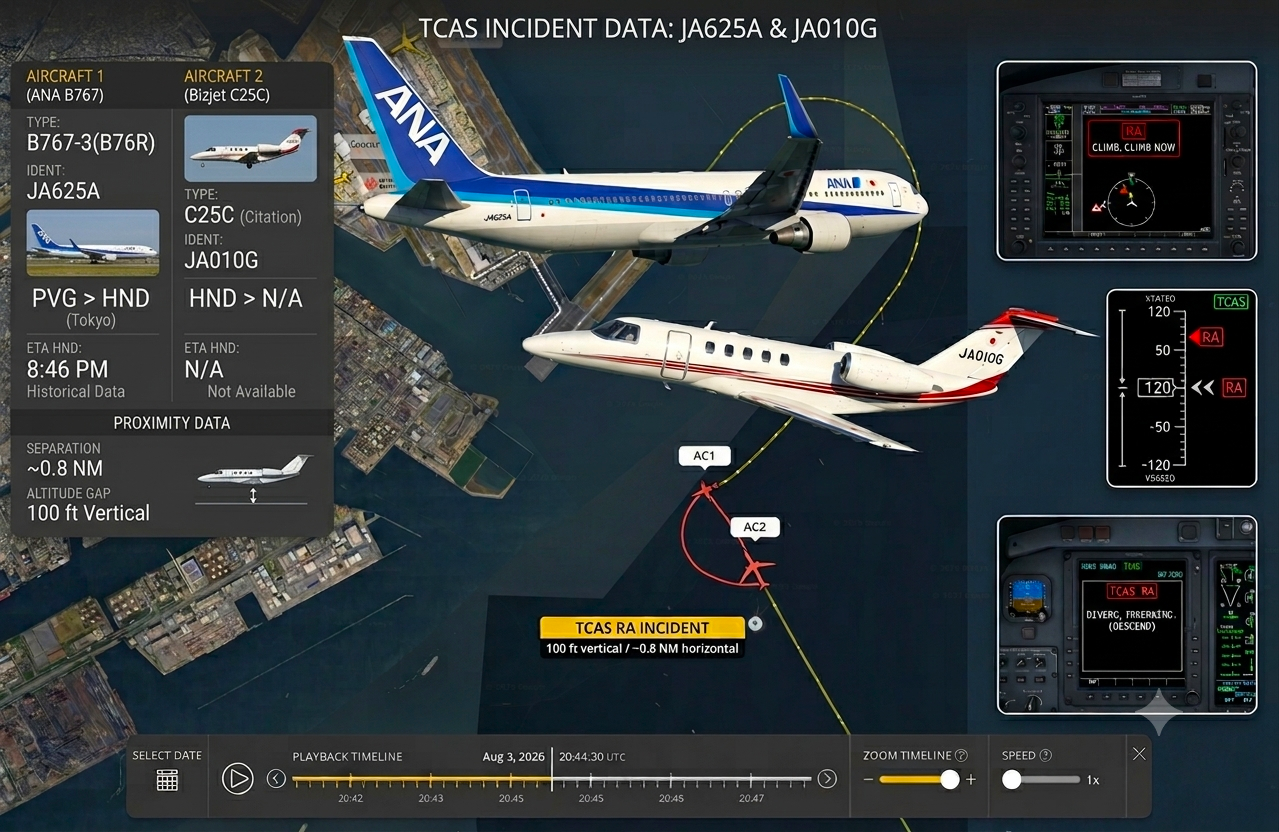
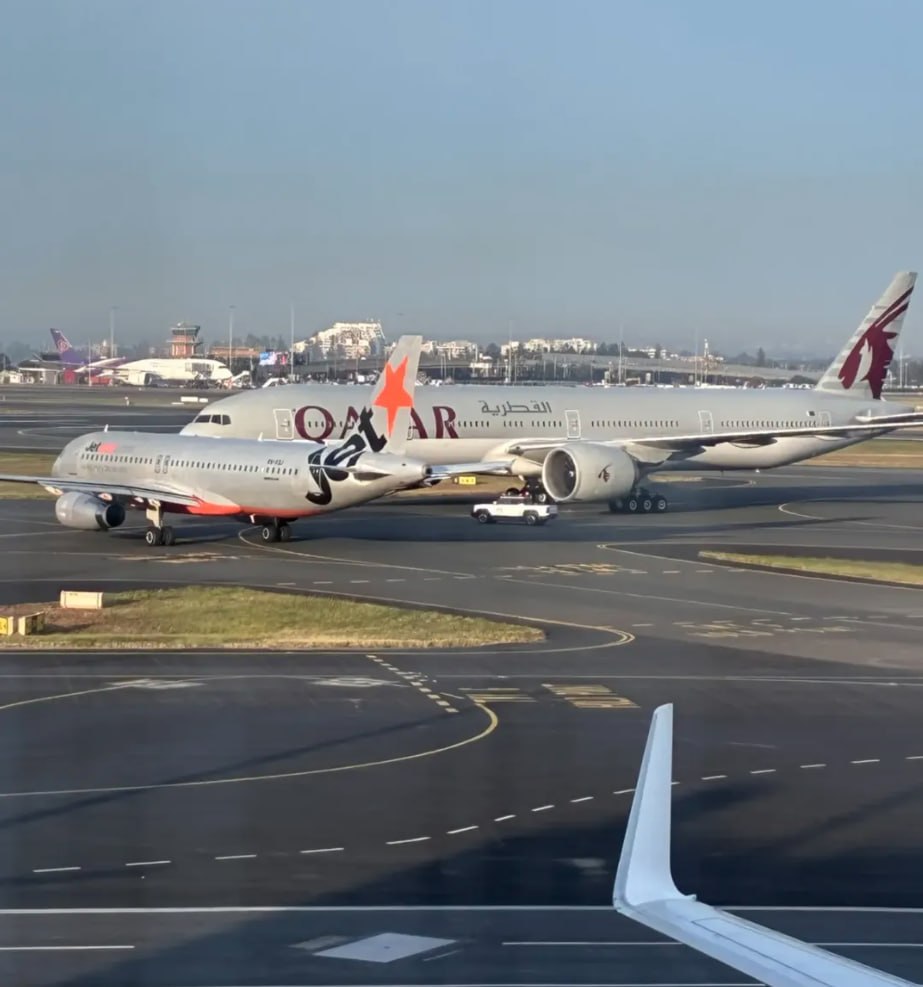
- ANA Flight NH968 received a TCAS Resolution Advisory (RA) during its approach to Tokyo Haneda after a close encounter with a JCAB flight inspection aircraft.
- The closest separation was 1,106 meters horizontally and 46 meters (150 feet) vertically, according to Japan's Civil Aviation Bureau.
- Both flight crews reported having the other aircraft in sight, and investigators found no imminent risk of collision.
- Japan's Civil Aviation Bureau ruled the event was not a "serious incident" under the Aviation Act, despite the TCAS RA being triggered.
Japan's Civil Aviation Bureau (JCAB) of the Ministry of Land, Infrastructure, Transport and Tourism has concluded that a close airspace encounter involving an All Nippon Airways (ANA) Boeing 767 and a government flight inspection aircraft near Tokyo Haneda Airport does not qualify as a "serious incident" under the country's Aviation Act, despite the activation of the airliner's Traffic Collision Avoidance System (TCAS).
The event occurred at approximately 5:44 a.m. JST on August 4, when a JCAB-operated Cessna Citation CJ4 (registration JA010G) departed Haneda's Runway D (RWY05) before turning toward the Miura Peninsula. At the same time, ANA Flight NH968, a Boeing 767-300ER (JA626A) arriving from Shanghai Pudong, was descending to land on Runway C (RWY34R).
The report describes an event that appears serious operationally, but Japan's aviation regulator concluded it does not legally qualify as a "serious incident" under the country's Aviation Act.
The Incident Breakdown
- Date and time: Around 5:44 a.m. JST on August 4.
- Aircraft involved:
- A Japan Civil Aviation Bureau (JCAB) flight inspection aircraft, a Cessna Citation CJ4 (JA010G).
- ANA Flight NH968, a Boeing 767-300ER (JA626A) arriving from Shanghai Pudong to Tokyo Haneda.
- What happened:
- The inspection aircraft departed Haneda's Runway D and turned right after takeoff.
- ANA Flight NH968 was on approach to land on Runway C.
- The inspection aircraft crossed in front of and below the ANA aircraft.
- The closest reported separation was:
- Horizontal: 1,106 meters (about 0.6 nautical miles)
- Vertical: 46 meters (about 150 feet)
One notable aspect is that TCAS (Traffic Collision Avoidance System) on the ANA Boeing 767 issued a Resolution Advisory (RA). An RA is more serious than a Traffic Advisory (TA) because it instructs pilots to take immediate action—such as climbing or descending—to maintain safe separation.
Despite the RA, the JCAB said the event did not meet the legal definition of a serious incident because:
- Both flight crews reported that they had the other aircraft in sight.
- Investigators concluded neither crew believed there was an imminent risk of collision.
- Based on interviews and the circumstances, the regulator determined there was no "serious danger" as defined in the Aviation Act.
Why this has attracted attention
In many aviation systems, the issuance of a TCAS Resolution Advisory is treated as a significant safety event and often triggers a detailed investigation. However, an RA does not automatically mean a collision was imminent or that an accident nearly occurred. It indicates that the onboard collision-avoidance logic determined that immediate maneuvering was the safest course based on the aircrafts' predicted trajectories.
So there are two different perspectives:
- Operationally: An RA is a noteworthy event and is analyzed carefully because it indicates reduced separation.
- Legally (in Japan): The JCAB determined the event did not satisfy the statutory criteria for a "serious incident" requiring a formal accident-level investigation.
"serious incident" under the Japanese Civil Aeronautics Act (Aviation Act)
In Japan, a "serious incident" (重大インシデント, jūdai inshident) under the Civil Aeronautics Act (Aviation Act) is generally an occurrence that could have led to an aviation accident if circumstances had been slightly different. It does not require actual damage, injuries, or a near-collision; the key question is whether the event represented a significant risk to flight safety.
The classification is determined by the Japan Transport Safety Board (JTSB) and the Japan Civil Aviation Bureau (JCAB) based on categories defined in Japanese aviation regulations.
Typical conditions that may qualify as a serious incident include:
1. Near collision or dangerous proximity between aircraft
- An aircraft comes dangerously close to another aircraft.
- A TCAS Resolution Advisory (RA) occurs with a significant risk of collision.
- The aircraft separation is considered insufficient considering altitude, speed, flight paths, and crew response.
2. Runway incursion with serious risk
- An aircraft, vehicle, or person enters an active runway and creates a serious risk of collision with an aircraft taking off or landing.
3. Loss of control or serious flight abnormality
Examples include:
- A serious malfunction of flight controls.
- Loss of important navigation or communication capability.
- Situations where the aircraft's ability to continue safe flight is significantly compromised.
4. Engine, structural, or system failures that could endanger flight
Examples:
- Major engine failure.
- Significant damage to aircraft structure.
- Failures requiring emergency action or diversion.
5. Serious operational errors
Examples:
- Incorrect takeoff or landing clearance.
- Wrong runway use.
- Air traffic control errors that create a substantial collision risk.
Related news.......