
By FL360Aero | Aviation Safety & Human Factors
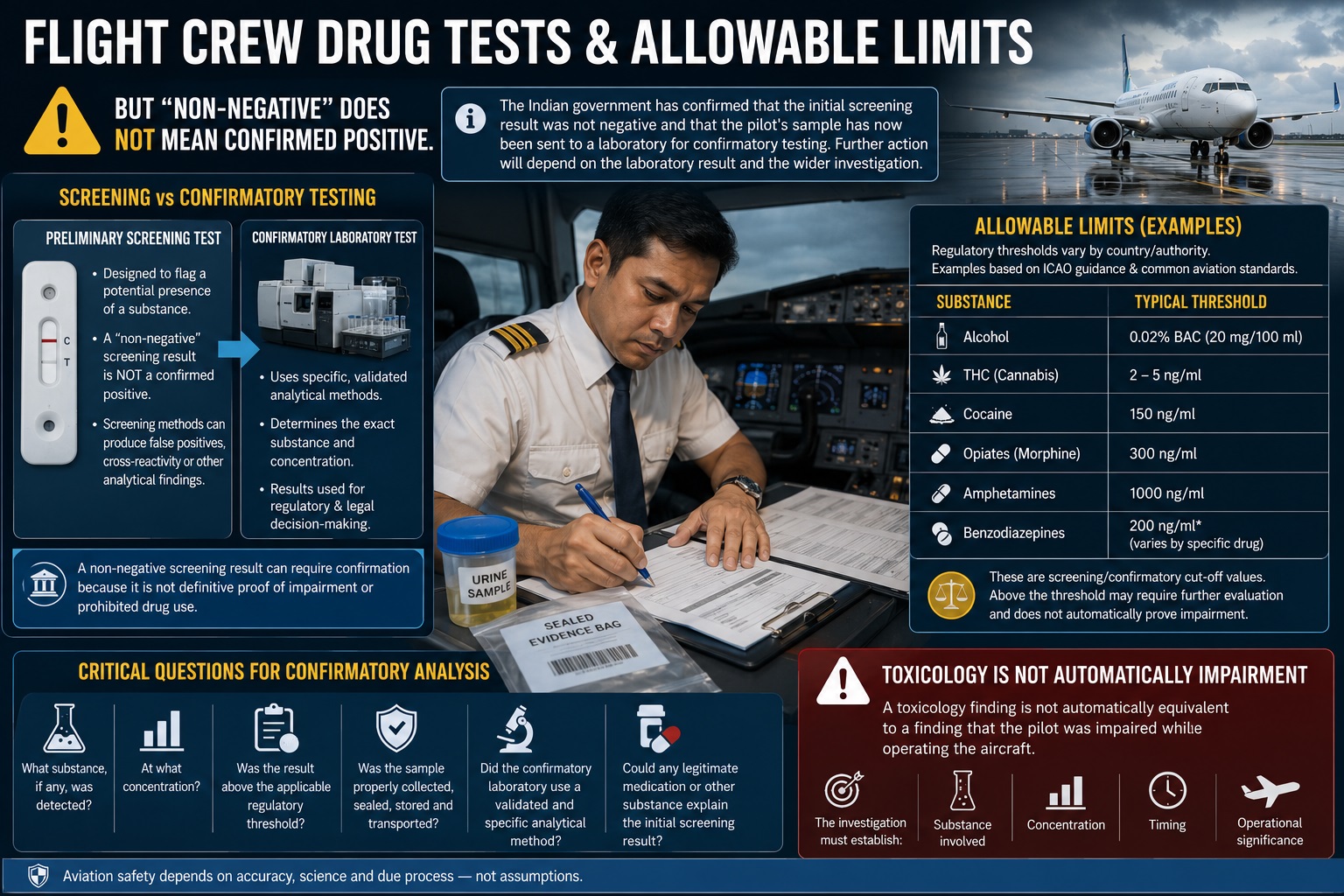
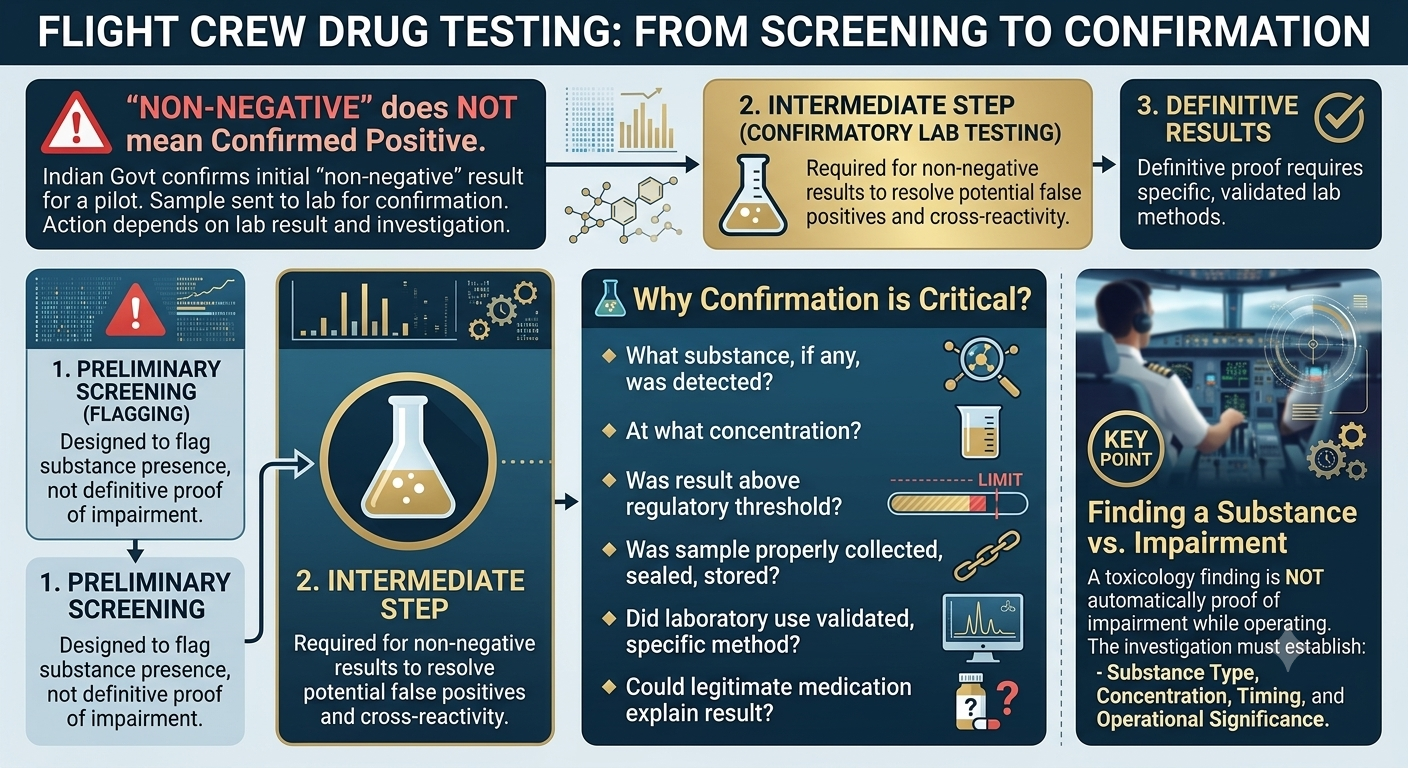
Distinction Between Screening & Confirmation (Non-Negative is not equal to Confirmed Positive): Initial screenings flag potential substances, but a "non-negative" result is not a confirmed positive. Confirmatory laboratory testing is required to verify the specific substance, concentration, threshold, and sample integrity before drawing conclusions, as demonstrated in the pending August 2026 Air India case.
Detection Does Not Equal Impairment: Toxicological presence of a drug does not automatically prove pilot impairment during flight. For example, in the Australian Sea World Helicopters case, low levels of cocaine metabolites indicated past usage but were ruled unlikely to have impaired performance at the time of operation.
Alcohol Accounts for the Most Visible Operational Violations: Most documented global incidents involve alcohol rather than illicit drugs, ranging from slight threshold exceedances to extreme levels—such as a JAL first officer testing at nearly 10 times the UK limit (189 mg/100 ml) in 2018 and a United flight attendant testing at 216 mg/100 ml in 2025.
U.S. Civil Aviation Fatal Accident Trends (NTSB Data): A 2026 NTSB study of fatally injured U.S. pilots from 2018–2022 revealed that 52.8% had at least one drug detected and 28.6% tested positive for potentially impairing substances, though the study explicitly clarifies that drug presence does not inherently prove operational impairment.
Context Matters in High-Profile Cases: Major incidents must be categorized properly rather than treated as simple workplace test failures. The July 2026 Malaysia Airlines case involved a pilot arrested off-duty in a major drug-smuggling scheme (26 kg of MDMA), meaning the aircraft itself was not operated under the influence.
Four-Tiered Framework for Aviation Testing Classification: To ensure accurate, responsible aviation reporting, test findings should be categorized into four distinct statuses: Confirmed Positive (lab verified), Non-Negative / Pending (unconfirmed screening), Confirmed Alcohol Violation (objective breath/blood exceedance), and Post-Accident Toxicology (substance detected post-crash without automatic proof of causation).
Alcohol and psychoactive-substance findings involving flight crew are relatively rare compared with the enormous number of commercial flights operated worldwide, but when they occur they can have significant consequences: flights are cancelled or delayed, crews are removed from duty, licences can be suspended or revoked, and in serious cases criminal proceedings follow.
The cases below illustrate another important point: a preliminary screening result is not necessarily a confirmed positive, and detection of a substance is not automatically proof of impairment. Testing methodology, confirmation, concentration, timing, sample integrity and the circumstances of the operation all matter.
A 2026 NTSB study provides an important statistical backdrop. Among fatally injured pilots in U.S. civil aviation accidents from 2018–2022, 52.8% had at least one drug detected and 27.7% had two or more drugs detected. However, the NTSB explicitly cautions that its study does not infer impairment from drug presence. Potentially impairing drugs were detected in 28.6%, while illicit drugs were detected in 7.4%.
Global regulations governing drug and alcohol limits for flight crew members are established by international bodies like the International Civil Aviation Organization (ICAO) and enforced by national civil aviation authorities.
While procedures vary by jurisdiction, the legal thresholds and testing frameworks share core similarities worldwide:
Aviation alcohol regulations are defined by two key factors: Blood Alcohol Concentration (BAC) limits and mandatory time periods between drinking and flight duty (commonly referred to as "Bottle-to-Throttle" rules).
United States (FAA): Maximum BAC of 0.04% ($0.4 \text{ g/L}$ or $40 \text{ mg/100 mL}$).
Note: If a pilot tests between 0.02% and 0.039%, they are legally prohibited from performing flight duties until their BAC drops below 0.02%.
European Union (EASA) & United Kingdom (CAA): Strict limit of 20 mg of alcohol per 100 mL of blood (equivalent to 0.02% BAC).
India (DGCA): Zero Tolerance Policy (0.00% BAC). Pilots and cabin crew undergo pre-flight breathalyzer checks; any positive reading results in immediate grounding.
Japan (JCAB): 0.00% BAC for flight crew across all domestic and international operations.
FAA Requirement: Minimum 8 hours between alcohol consumption and acting as a crew member.
Airline Rules: Most major commercial airlines (e.g., United, Delta, British Airways) enforce stricter internal rules requiring 12 to 24 hours of abstinence before reporting for duty.
Global aviation drug testing follows strict laboratory screening and confirmatory processes. In the U.S. and many aligned jurisdictions, mandatory testing covers the standard DOT 5-Panel Test.
To distinguish between active usage and trace exposure, regulators use specific cutoff concentrations measured in nanograms per milliliter ($\text{ng/mL}$):
| Substance Category | Initial Screening Cutoff | Confirmatory Laboratory Cutoff |
| Marijuana Metabolites (THC) | $50 \text{ ng/mL}$ | $15 \text{ ng/mL}$ |
| Cocaine Metabolites | $150 \text{ ng/mL}$ | $100 \text{ ng/mL}$ |
| Opioids (Morphine, Codeine, Heroin, Oxycodone) | $2,000 \text{ ng/mL}$ | $2,000 \text{ ng/mL}$ |
| Amphetamines / Methamphetamines / MDMA | $500 \text{ ng/mL}$ | $250 \text{ ng/mL}$ |
| Phencyclidine (PCP) | $25 \text{ ng/mL}$ | $25 \text{ ng/mL}$ |
Zero Tolerance for Illicit Drugs: Confirmed presence at or above the confirmatory threshold constitutes an immediate medical disqualification and violation, regardless of state or local legalization laws (e.g., recreational cannabis remain strictly prohibited under federal aviation rules globally).
"Potentially Impairing" Medications: Drugs that cause drowsiness, altered reaction times, or cognitive degradation (e.g., sedating antihistamines like diphenhydramine, sleep aids, benzodiazepines, or strong painkillers) are banned during or immediately preceding flight duty.
Medical Review Officer (MRO) Evaluation: Any positive test result undergoes review by an MRO. Even if a medication is legally prescribed, the pilot must hold a valid Medical Certificate approving that specific medication for flight duty; otherwise, it is treated as an operational safety violation.
| # | Year | Country | Airline / operator | Crew member / role | Substance / finding | Aircraft / flight | Regulatory / operational action | Source |
|---|---|---|---|---|---|---|---|---|
| 1 | 2002 | USA | Delta Air Lines | Pilot | BAC 0.07%; failed two breath tests | Delta passenger flight, Norfolk | Removed from aircraft; FAA rules prohibited operation at ≥0.04% BAC or within 8 hours of drinking. | Washington Post |
| 2 | 2002 | USA | Mesa Airlines | Pilot Peter Treanor | BAC 0.06% and 0.05% on two tests | Scheduled flight from Little Rock | Fired; first officer suspended and flight attendant resigned despite negative test | CBS/AP |
| 3 | 2004 | USA | Virgin Atlantic | Captain Richard Harwell | Alcohol suspected; smelled of alcohol and slurred speech | Boeing 747, Dulles–Heathrow | Removed from cockpit minutes before departure; pleaded guilty; resigned | Washington Post |
| 4 | 2004 | Finland / UK | Finnair | Captain Heikki Tallila | 49 mg/100 ml blood; UK aviation limit 20 mg | Boeing 757, Manchester–Turkey | Removed, dismissed by Finnair; sentenced to 6 months' imprisonment | The Guardian |
| 5 | 2006 | USA | Sky King Airlines | First officer Scott Marvin Russell | BAC 0.083%; FAA limit 0.04% | Boeing 737 charter, 57 passengers | Removed himself before takeoff; resigned; FAA revoked licence; later jailed | DOT OIG |
| 6 | 2008 | USA / UK | United Airlines | First officer | Breath alcohol above UK aviation limit; exact result not publicly reported in source | Flight UA955, Heathrow–San Francisco | Arrested before departure; removed from service; airline investigation | CBS/AP |
| 7 | 2009 | USA | Shuttle America / United Express | First officer Aaron Cope | Blood testing established alcohol impairment; exact BAC not stated in cited government release | United Express, Austin–Denver, 48 passengers | Terminated; FAA emergency revocation of pilot licence/medical; later convicted and sentenced to 6 months imprisonment | U.S. DOT OIG |
| 8 | 2014 | USA | Alaska Airlines | Captain David Hans Arntson | 0.134% and 0.142% BAC on successive tests | Alaska Flights 573/580; San Diego–Portland–Santa Ana | Removed; charged federally; later pleaded guilty | U.S. DOT OIG |
| 9 | 2015 | USA | JetBlue | First officer Dennis Murphy | 0.111% BAC | B6 583/584, JFK–Orlando–JFK | Arrested/charged; removed from service; federal investigation | U.S. DOT OIG |
| 10 | 2016 | USA / UK | United Airlines | First officer Carlos Roberto Licona | Alcohol above UK aviation limit | UA162, Glasgow–Newark, Boeing 757 | Arrested; removed from service; 10-month prison sentence | The Guardian / Scottish reporting |
| 11 | 2016 | USA / UK | United Airlines | First officer Paul Grebenc | 42 mg/100 ml blood, more than twice UK limit | UA162, Glasgow–Newark, Boeing 757 | Arrested; pleaded guilty; 10-month prison sentence; rehabilitation programme | The Guardian |
| 12 | 2016 | USA | SkyWest Airlines / Delta Connection | Pilot Russel Duszak | Field breath test reportedly 0.046%, above 0.04%; later blood test 0.015% | Flight 4574, Rapid City–Salt Lake City | Removed before departure and arrested; later charges were dropped | Rapid City reporting |
| 13 | 2018 | Japan / UK | Japan Airlines | First officer Katsutoshi Jitsukawa | 189 mg/100 ml blood; nearly 10× the 20 mg UK aviation limit | JL44, London Heathrow–Tokyo Haneda, Boeing 777 | Arrested; pleaded guilty; flight delayed; subsequent JAL alcohol-control reforms | JAL / Euronews |
| 14 | 2018 | Japan | Japan Airlines | Cabin attendant | Alcohol detected while on duty; JAL concluded alcohol was consumed during flight | JL786, Narita–Honolulu | JAL investigated and reported incident to MLIT; strengthened alcohol management | JAL |
| 15 | 2018 | UK | British Airways | Pilot Julian Monaghan | 86 mg/100 ml blood vs 20 mg aviation limit | Boeing 777 scheduled Gatwick–Mauritius | Arrested before departure; pleaded guilty; dismissed by BA; faced imprisonment | Sky News / ITV |
| 16 | 2019 | USA / UK | United Airlines | Two pilots | Both arrested after allegedly failing alcohol breath tests; one subsequently released without charge | UA162, Glasgow–Newark | Flight cancelled; both removed from service; one pilot faced court proceedings | RTE / TIME |
| 17 | 2022 | USA | JetBlue | Pilot James Clifton | 0.17% BAC, over four times FAA's 0.04% limit | Scheduled Buffalo–Fort Lauderdale flight | Removed from cockpit and arrested; flight delayed more than four hours | CBS Miami |
| 18 | 2022 | India | Multiple Indian airlines | Four pilots | Confirmed positive for psychoactive substances under DGCA testing programme; substances/details not publicly disclosed | Various airline operations | Fourth pilot removed from duty; DGCA regime provided rehabilitation after first confirmed positive, licence suspension after second and cancellation after third | DGCA reporting / PTI |
| 19 | 2023 | UK / South Africa | British Airways | First officer Mike Beaton | Cocaine use during Johannesburg layover; subsequently drug-tested | BA56, Johannesburg–London, Airbus A380 | Flight cancelled; pilot dismissed by BA; later permitted to return to flying after meeting CAA requirements | Aerotime / later reporting |
| 20 | 2023 | USA / UK | Delta Air Lines | Captain Lawrence Russell Jr. | 49 mg/100 ml blood, over UK 20 mg limit | Boeing 767, Edinburgh–New York JFK | Removed before departure; pleaded guilty; 10 months' imprisonment in 2024 | Crown Office & Procurator Fiscal Service |
| 21 | 2023 | USA / France | United Airlines | Captain | Breath alcohol 0.59 and 0.56 mg/L; French aviation limit cited as 0.10 mg/L | Boeing 777 scheduled from Paris CDG to USA | Six-month suspended prison sentence, €4,500 fine and one-year flying ban | French court/prosecutor reporting |
| 22 | 2024 | Australia | Sea World Helicopters | Pilot Ashley Jenkinson | Cocaine metabolites detected; very low concentrations | EC130B4, Gold Coast helicopter operation | ATSB assessment said concentrations indicated use within previous days and were unlikely to have caused impairment | ATSB investigation |
| 23 | 2025 | India / Canada | Air India | Captain | Canadian authorities said two breathalyser tests confirmed alcohol and pilot was unfit for duty | AI186, Vancouver–Vienna–Delhi, Boeing 777 | Removed before departure; RCMP intervention; Transport Canada warned Air India and sought investigation | Transport Canada reporting |
| 24 | 2025 | USA / UK | United Airlines | Flight attendant Margit Lake | 216 mg/100 ml blood, more than 10× UK's 20 mg aviation limit | Boeing 777, San Francisco–London Heathrow | Treated by paramedics; admitted offence; resigned after 26 years; fined | The Independent |
| 25 | 2026 | Malaysia / Indonesia | Malaysia Airlines | Pilot | Indonesian authorities reported urine findings indicating cocaine and methamphetamine use; pilot was also arrested in a major drug-smuggling case | MH727, Kuala Lumpur–Jakarta | Arrested in Indonesia; Malaysia Aviation Group introduced mandatory drug screening for its pilots | Reuters |
Data on flight crew drug and alcohol testing comes primarily from regulatory bodies like the U.S. Federal Aviation Administration (FAA) and investigative agencies like the National Transportation Safety Board (NTSB).
The data highlights several key historical trends regarding random workplace screening, accident toxicology, and common substances found:
Under mandatory Department of Transportation (DOT) and FAA regulations, safety-sensitive aviation employees (including pilots, flight attendants, and dispatchers) are subjected to routine random testing.
Random Drug Test Positive Rate: Historically, the commercial aviation industry maintains extremely low positive rates on random drug screens.
In 2024, the reported industry-wide random drug test positive rate was 0.816%.
Because this rate remains well below the 1.0% threshold, the FAA maintains its minimum annual random drug testing rate at 25% of safety-sensitive personnel.
Random Alcohol Violation Rate:
In 2024, the random alcohol test violation rate (confirmed Breath Alcohol Concentration $\ge 0.04$) was 0.131%.
Because this rate remains below 0.50%, the FAA maintains the minimum annual random alcohol testing requirement at 10%.
The NTSB periodically publishes comprehensive toxicology research examining pilot fatal accident trends over multi-year periods (1990–2012, 2013–2017, and 2018–2022).
According to NTSB findings:
Overall Drug Detection: Between 2018 and 2022, toxicology testing of fatally injured civil aviation pilots revealed that 52.8% tested positive for at least one drug of any type (including legal over-the-counter and prescription medications), with 27.7% testing positive for two or more drugs.
Potentially Impairing Drugs: 28.6% of tested pilots had substances classified as potentially impairing in their system.
Most Commonly Detected Impairing Drug: Diphenhydramine (a sedating, over-the-counter antihistamine common in allergy and sleep aids) has consistently remained the most frequently detected potentially impairing drug across multi-decade NTSB studies.
Illicit Drug Trends: Detection of illicit substances rose to 7.4% in recent years, primarily driven by increases in delta-9-THC (marijuana).
Historical data demonstrates clear operational differences across pilot categories:
Commercial vs. General Aviation: Drug detection rates are significantly lower among Part 121 (commercial airlines) and Part 135 (charter/commuter) pilots holding Airline Transport Pilot (ATP) or Commercial certificates compared to Private, General Aviation, or uncertificated pilots.
Medical Certification Status: Pilots maintaining active Class 1 or Class 2 medical certificates show markedly lower positive toxicology rates than pilots operating without an active medical certificate.
Detection vs. Impairment: Regulatory and scientific agencies emphasize that toxicology detection does not automatically equate to impairment or cause of accident. Determining operational impact requires establishing specific concentration levels, timing, and metabolic active/inactive status.
This is an exceptionally serious criminal case, but it should not be presented as an ordinary airline drug-test failure.
Indonesian authorities detained a 39-year-old Malaysia Airlines pilot after discovering approximately 26 kg of MDMA in his baggage following arrival in Jakarta from Kuala Lumpur. Reuters reported that urine testing also indicated cocaine and methamphetamine use. Malaysia Aviation Group subsequently announced mandatory drug testing for its pilots.
The distinction is important: the airline said the pilot was not operating the aircraft at the time of his arrest, so this should not be described as evidence that a Malaysia Airlines aircraft was operated under the influence.
This is perhaps the most relevant case for the current discussion because the result is not yet confirmed.
On August 4, an Air India flight from Phuket to Delhi experienced a sudden altitude loss. After arrival, the pilot underwent psychoactive-substance screening. The Indian government subsequently described the initial result as “not negative” and said the sample had been sent for confirmatory laboratory testing. Both pilots were removed from flying duties while the investigation continued.
No substance or concentration has been publicly disclosed in the official reporting available at the time of writing.
Therefore:
NON-NEGATIVE SCREEN ≠ CONFIRMED POSITIVE
The case should remain in a “pending confirmation” category until the laboratory result is known.
Many of the best-documented cases involve alcohol rather than illicit drugs. The cases range from marginal exceedances to extremely high concentrations.
Some of the most striking measurements include:
These figures should not be compared directly without accounting for jurisdiction and measurement units, because different countries use blood, breath or other testing methods and have different legal thresholds.
The Sea World Helicopters case is a particularly useful example.
The ATSB found cocaine metabolites in the pilot, but the concentrations were very low. A forensic pharmacologist concluded that the results indicated cocaine use within the preceding few days but that use was unlikely to have occurred within 24 hours and was unlikely to have impaired psychomotor performance.
This demonstrates why:
“Drug detected” does not automatically equal “pilot impaired.”
India's 2022 programme provides a useful regulatory example. By August 2022, DGCA said four pilots and one ATC had tested positive for psychoactive substances. The fourth pilot had a positive confirmatory report and was removed from flight duty.
That is fundamentally different from the 2026 Air India case, where the initial result was described as “not negative” and confirmation was still pending.
The strongest recent dataset comes from the U.S. NTSB.
Its 2026 research examined toxicology results from fatally injured pilots in U.S. civil aviation accidents from 2018–2022:
| Finding | 2018–2022 |
|---|---|
| At least one drug detected | 52.8% |
| Two or more drugs detected | 27.7% |
| Potentially impairing drugs | 28.6% |
| Illicit drugs | 7.4% |
| Drugs indicating potentially impairing conditions | 13.5% |
| Controlled substances | 6.9% |
The NTSB explicitly warns that these figures describe drug presence in fatally injured pilots, not drug impairment. Changes in testing sensitivity and protocols may also have contributed to some of the observed increases.
This distinction is crucial for responsible aviation reporting.
For an aviation-safety infographic, I recommend using four categories rather than simply calling every case a "failed drug test":
A specific laboratory/confirmatory test establishes the substance.
Example: India's confirmed 2022 DGCA cases.
Initial screening indicates a possible substance, but confirmation is outstanding.
Example: Air India Phuket–Delhi, August 2026.
Objective breath/blood testing establishes a level above the applicable aviation limit.
Examples: JAL 2018, JetBlue 2022, Delta 2023.
A substance is detected after an accident, but that does not automatically establish impairment or causation.
Example: Sea World Helicopters, Australia.