
- Second NATS technical disruption in two weeks: A new connectivity problem at Prestwick affected flights across parts of the UK on 21 September 2026.
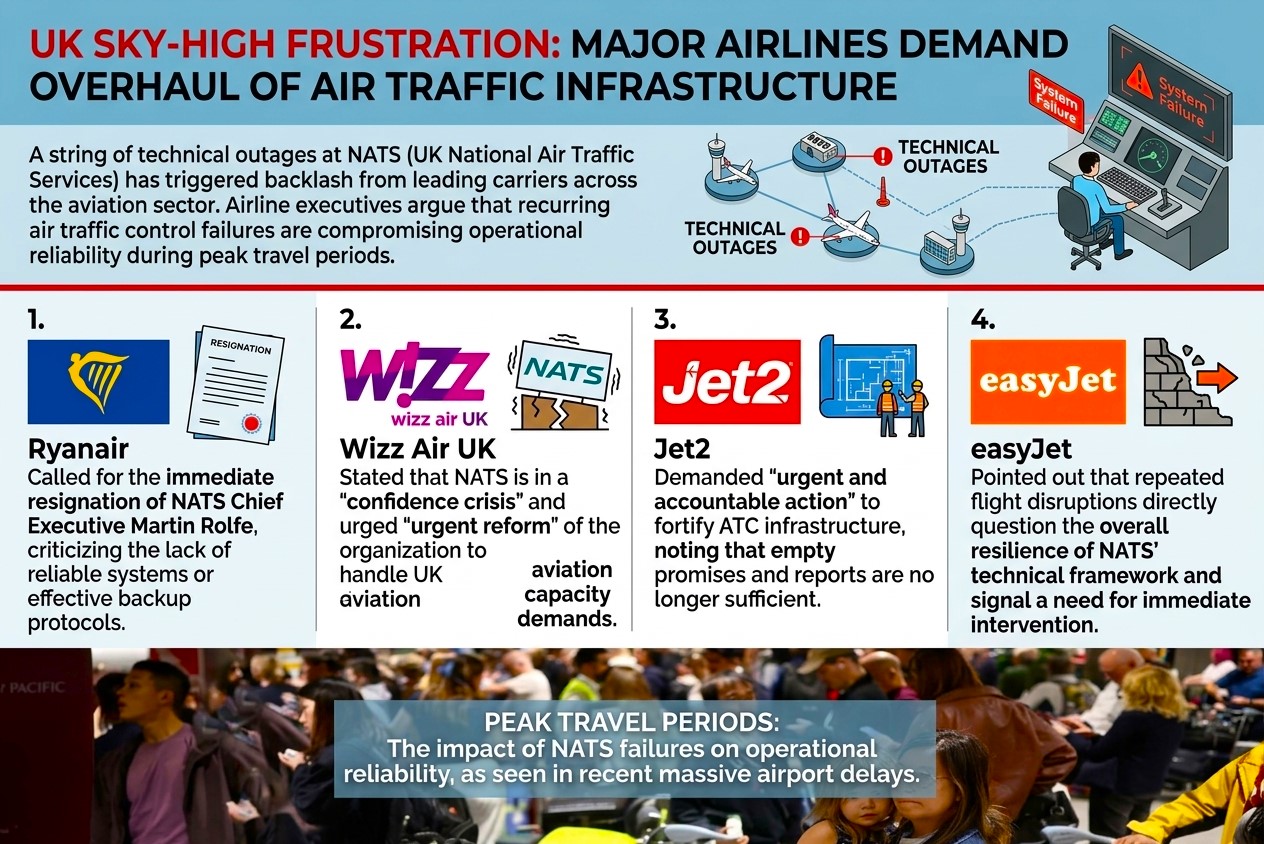
- Wizz Air UK: Described a “confidence crisis” in NATS and called for urgent reform.
- Jet2: Demanded “urgent and accountable” action to strengthen UK air traffic control infrastructure.
- Ryanair: Called for NATS chief executive Martin Rolfe to resign, citing a lack of reliability and effective backup systems.
- easyJet: Questioned the resilience of NATS’ systems and called for firm action.
- Earlier outage: A software defect on 8 September reportedly caused more than 2,000 flight cancellations.
- Government scrutiny: Transport Secretary Heidi Alexander called for an independent review following the earlier outage.
- Key concern: Whether NATS can maintain reliable air traffic control services when technical systems fail.
Major airlines operating in the UK have renewed calls for reform and greater accountability at National Air Traffic Services (NATS), following a second technical disruption in less than two weeks. The latest incident has intensified scrutiny of the resilience of the UK's air traffic control infrastructure and the organisation's ability to maintain operations when technical systems fail.
The disruption on Monday, 21 September, affected flights across Scotland, Northern Ireland and northern England, with airports including Manchester, Glasgow and Belfast reporting problems. London Gatwick and London City also experienced some disruption.
The latest incident has prompted criticism from several major carriers, with airlines questioning the reliability of the systems on which their operations depend.
Wizz Air UK
The airline has described the situation as a “confidence crisis” in NATS and called for “urgent reform” of the organisation.
Jet2
Jet2 has called for “urgent and accountable” action to strengthen the UK's air traffic control infrastructure.
Ryanair
Ryanair has called for NATS chief executive Martin Rolfe to resign, arguing that the organisation has failed to provide “either a reliable system or an effective back-up”.
easyJet
easyJet said the disruption “calls into question the resilience of NATS' systems” and “demonstrates the need for firm actions”.
The airline statements above are reproduced from the material supplied for this article. Independent verification of each full statement was not available in the retrieved reporting.
The latest technical problem was reported at NATS' Prestwick control centre in Scotland. The issue was described as a connectivity problem and was resolved later that morning, according to reports citing Transport Secretary Heidi Alexander and NATS.
Although the technical fault was resolved, the operational consequences continued as airlines and airports worked to recover their schedules.
The disruption affected flights serving several regions of the UK, highlighting the potential for problems at a major air traffic control facility to affect operations well beyond its immediate location.
NATS said the September 21 incident was unrelated to the software defect responsible for the earlier disruption in September.
The latest incident follows a major NATS outage on September 8, which resulted in widespread disruption and more than 2,000 flight cancellations, according to reports published following the incident.
In a preliminary explanation reported on September 18, NATS chief executive Martin Rolfe attributed the outage to a software defect in a specific part of the flight data system.
The defect reportedly involved a high-priority request interrupting the normal processing of an aircraft identification code. This triggered backup procedures and reduced the system's operating capacity.
NATS said the incident did not compromise flight safety. However, the loss of system capacity created significant operational challenges, leading to widespread cancellations and delays.
The company said temporary mitigation measures had been introduced while work continued on a permanent fix. Transport Secretary Heidi Alexander called for an independent review of the incident and NATS' findings.
The latest failures come against a background of previous technical problems involving the UK's air traffic control infrastructure.
London airspace computer failure
A failure involving a flight data computer at NATS' London area control centre led to restrictions on traffic across London airspace on December 12. NATS attributed the incident to a faulty line of software code.
Major flight plan processing failure
On August 28, 2023, a technical incident at NATS caused widespread disruption. Around 1,575 flights were cancelled on the day, with further cancellations the following day. The disruption affected passengers across the UK and overseas.
Radar-related disruption
A radar failure on July 30, 2025, caused further disruption to UK air traffic. The incident added to concerns about the reliability of critical air traffic control technology.
Two technical incidents in September
The September 8 software defect and the September 21 connectivity problem have brought renewed attention to the resilience of NATS' systems and contingency arrangements. NATS has said the two incidents were unrelated.
NATS provides essential air traffic control services across UK airspace. Its systems and controllers help maintain the safe and orderly movement of aircraft, managing traffic flows and coordinating aircraft movements through busy airspace.
When a technical problem reduces the capacity of an air traffic control system, the effects can extend beyond the location of the original fault.
Airlines may have to delay departures, cancel flights or adjust schedules to match the reduced capacity available. Aircraft and crew can end up out of position, creating knock-on disruption even after the initial technical problem has been resolved.
The September incidents have therefore raised two connected questions: how reliably NATS' systems can operate, and how effectively its backup arrangements can maintain capacity during a failure.
Following the September 8 outage, Transport Secretary Heidi Alexander called for an independent review of the incident. The review is intended to examine the circumstances of the failure and NATS' account of what happened.
The September 21 disruption has added to pressure on the organisation, with airlines seeking greater accountability and concrete measures to improve the reliability of the UK's air traffic control infrastructure.
NATS has maintained that the latest incident was separate from the earlier software defect. That distinction is important when assessing whether the events share a technical cause, even as both have raised broader questions about operational resilience.
The focus will now be on the findings of the independent review, the permanent technical fix being developed for the September 8 software defect, and the steps NATS takes to address the latest connectivity failure.
For airlines, the central issue is not simply whether a fault can be repaired, but whether air traffic control services can continue operating at an acceptable level when a system fails.
The recent incidents have placed that question firmly at the centre of the debate over the UK's aviation infrastructure.