
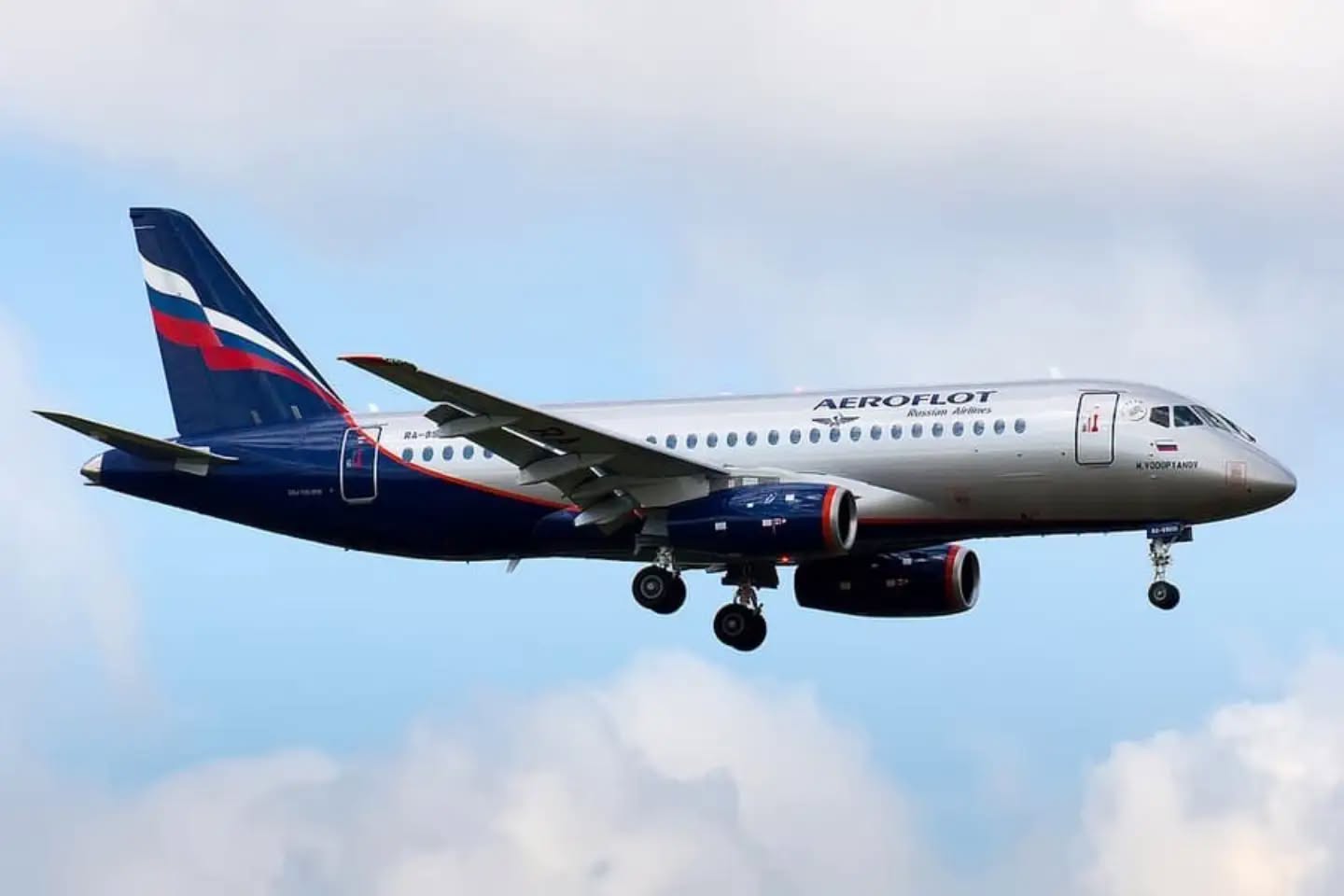
Russia’s civil aviation industry is entering a difficult phase as airlines confront the aging of the Sukhoi Superjet 100 fleet, shortages of Western components and the high cost of replacing foreign-made engines with Russian alternatives.
Aeroflot CEO Sergei Alexandrovsky has warned that Russian airlines could gradually lose much of their existing Sukhoi Superjet 100 (SSJ-100) fleets unless the government provides financial support for re-engining the aircraft.
Speaking to Kommersant, Alexandrovsky said that fitting Russian-made engines to the existing fleet would be possible only with “certain measures of state support.” Without subsidies for the conversion, he warned, the SSJ-100 fleet operated by Russian airlines would gradually decline. The comments were reported on September 7, 2026.
The problem illustrates a broader challenge that has confronted Russian commercial aviation since the imposition of Western sanctions in 2022: Russia is attempting to maintain an existing fleet that was developed with substantial foreign technology while simultaneously creating a largely domestic replacement industrial base.
The SSJ-100 was originally developed as an internationally integrated aircraft. One of its most important foreign-dependent components was the SaM146 turbofan, produced through PowerJet, a joint venture between France’s Safran Aircraft Engines and Russia’s UEC-Saturn.
Safran and UEC had jointly developed and supported the engine program, while Safran supplied important technology and components. Before the invasion of Ukraine, the SaM146 had accumulated more than two million flight hours in service.
That arrangement was severely disrupted in 2022. PowerJet suspended engine servicing, repairs, spare-parts deliveries and other contractual support after Western sanctions were imposed following Russia's invasion of Ukraine. Interfax reported in March 2022 that the suspension affected maintenance and repair of SaM146 engines as well as the supply of replacement parts.
The disruption exposed a fundamental weakness in Russia's civil-aircraft strategy. Although the SSJ-100 was a Russian-designed aircraft, it depended on an international supply chain for engines, avionics and other systems.
Russia had already been pursuing an import-substituted version of the aircraft before the war. The new version, subsequently known as the SJ-100, was designed to replace a large proportion of foreign equipment, including the SaM146 with the Russian PD-8 engine. The sanctions transformed that long-term localization program into an urgent requirement for maintaining the country's commercial fleet.
The proposed solution is not simply a matter of removing a SaM146 and installing a PD-8.
Russian industry sources cited by Kommersant put the indicative cost of converting an SSJ-100 at approximately 2.1–2.3 billion rubles per aircraft. Other industry participants have questioned whether that figure fully reflects the eventual cost, noting that the PD-8 itself was reported to have cost more than 1 billion rubles per engine in 2024, with costs subsequently rising.
The engineering work is substantial. The conversion involves changes to the engine installation, including new nacelles and modifications to pylons, the wing box, onboard wiring and auxiliary-power systems. Consequently, the project is effectively a major aircraft modification program rather than a conventional engine replacement.
There is also a production question. Even if Russian airlines can finance the conversions, the United Engine Corporation (UEC) must be able to manufacture enough PD-8 engines while simultaneously supporting the new SJ-100 production program.
That issue has become increasingly important because the existing SaM146 fleet has finite remaining service life.
The number of aircraft requiring conversion remains uncertain.
Russian industry discussions have produced different estimates. UAC chief Vadim Badekha said in July 2026 that approximately 50 to 100 SSJ-100s could require engine replacement because of the service-life limitations of their existing engines. He also argued that the conversion itself should be economically manageable for airlines and said UAC did not plan to use federal funds specifically to finance the engine-change procedure.
That position contrasts with Alexandrovsky's latest warning that airlines cannot economically undertake the work without government support.
Earlier industry assessments were more pessimistic. According to reporting cited by Kommersant, operator discussions at UAC indicated that it could make economic sense to convert only around 50 aircraft because other components on older aircraft also face severe life limitations. The difference between that assessment and Badekha's later 50–100-aircraft estimate demonstrates how unsettled the economics of the program remain.
Russia currently has approximately 160 SSJ-100 aircraft in operation, with about 78 operated by Rossiya Airlines, part of the Aeroflot Group.
For airlines, therefore, the issue is not simply whether an engine can technically be installed. It is whether the cost of the conversion makes economic sense on an airframe that may itself have limited remaining life.
The service-life issue has been developing for several years.
UEC has previously warned that the original SSJ-100 fleet could face extensive retirement by 2030 as the service lives of SaM146 engines expire. The current conversion program is intended to preserve at least part of that fleet while Russia transitions toward the fully import-substituted SJ-100.
The timing is critical. The SJ-100 itself has experienced delays in certification and serial production. In 2026, Russian officials continued to target completion of the aircraft's certification testing during the year, while reporting indicated that serial production schedules had repeatedly shifted.
The government therefore faces a difficult balancing act: keep existing SSJ-100s flying long enough to bridge the gap, convert economically viable aircraft to PD-8 power, and simultaneously bring the new SJ-100 and MS-21 into airline service.
The Superjet issue is part of a much broader deterioration in the operating environment for Russian commercial aviation since 2022.
Russia's State Aviation Supervision authority reported that more than 480 aircraft were grounded for varying periods between 2023 and 2025 because of identified technical and regulatory violations. The figure represented almost half of Russia's commercial fleet of roughly 1,135 aircraft.
However, the figure should not be interpreted as meaning that 480 aircraft were permanently withdrawn from service or that all were grounded specifically because of falsified maintenance records. The regulatory findings concerned technical malfunctions and airworthiness violations, while Russian aviation authorities have also warned about practices such as mass approval of aircraft with unresolved technical problems and inaccurate reporting. The aircraft could return to service after violations were addressed.
This distinction is important. The 480-aircraft figure demonstrates the scale of the airworthiness and maintenance pressure facing the sector, but it does not establish that nearly half of Russia's fleet was permanently lost.
The underlying problem is nevertheless significant. Sanctions have restricted Russian carriers' access to authorized maintenance, Western spare parts and original equipment manufacturers' technical support. Russian operators have consequently had to expand domestic repair capabilities, manufacture replacement components and extend the useful lives of aircraft and engines wherever possible.
The Superjet experience provides one of the clearest examples of that transition. By late 2022, for example, Yakutia Airlines had reportedly dismantled two of its four SSJ-100s to obtain parts, illustrating how operators were resorting to cannibalization when components became difficult to obtain.
Russia's long-term answer is not intended to be the perpetual conversion of old SSJ-100s.
The country is attempting to establish a new domestic civil-aircraft lineup led by the SJ-100, the MS-21 and other projects. The SJ-100 uses the PD-8, while the import-substituted MS-21 is intended to use the Russian PD-14.
The programs have made technical progress in 2026, including additional flight testing and natural-icing trials, but certification and industrial-scale production remain major challenges.
Aeroflot is preparing for the arrival of the new aircraft. The airline has said it intends to build a substantial future fleet around the Russian-built MS-21, with plans reported for as many as 200 aircraft by 2033.
For the immediate future, however, Russian airlines remain dependent on aircraft already in service. Alexandrovsky therefore said that if SSJ-100s have to be retired, airlines will have to redistribute flying across their remaining fleets and compensate for capacity losses through the arrival of new MS-21 aircraft.
That strategy assumes the new aircraft can enter service and be produced at sufficient rates—something Russia's aviation industry has struggled to achieve on its earlier timelines.
The consequences of sanctions extend beyond passenger aviation.
A prominent example is Volga-Dnepr Airlines' Antonov An-124-100, registration RA-82078, which has been stranded at Toronto Pearson Airport since February 27, 2022, after Canada closed its airspace to Russian aircraft. The aircraft had arrived to deliver COVID-19 rapid tests shortly before the airspace closure.
Canada formally ordered the seizure of the aircraft in June 2023 under its sanctions and asset-seizure legislation. Ottawa said that, if the aircraft were ultimately forfeited to the Crown, it could work with Ukraine on options for redistributing the asset to compensate victims, support international peace and security, or assist reconstruction.
The legal dispute continued into 2026. On August 11, Canada's Federal Court dismissed Volga-Dnepr Airlines' application for judicial review of the government's decision to maintain sanctions against the company. The court concluded that the minister had broad discretion under Canada's Russia sanctions regulations and that the airline had not demonstrated that the decision was unreasonable or procedurally unfair.
The ruling does not, by itself, constitute a final forfeiture of the An-124. The aircraft remains subject to Canada's seizure framework, while separate proceedings concerning its ultimate disposition continue. Canada's 2025 seizure order specifically identifies RA-82078 and provides for government possession and control of the aircraft.
The SSJ-100 engine problem is therefore more than an isolated fleet-maintenance issue.
Russia succeeded in creating a commercially viable regional jet through a development model that incorporated substantial international technology and industrial cooperation. The sanctions era has forced the country to attempt the reverse process: replacing foreign components, recreating supply chains, developing domestic engines and establishing independent maintenance capabilities.
That transition is proving expensive and time-consuming.
The immediate question is how many existing Superjets can economically be kept in service with PD-8 engines. The longer-term question is whether Russia can establish sufficiently high production rates for the SJ-100 and MS-21 to replace aging foreign-built aircraft and reduce dependence on sanctioned components.
Alexandrovsky's warning highlights the financial gap between those two objectives. If the government does not subsidize the conversion of older SSJ-100s, airlines may retire aircraft faster than the domestic replacement fleet can arrive.
For Russian civil aviation, that creates a difficult period through the end of the decade: maintain the existing fleet with increasingly scarce resources, finance costly engine conversions, or wait for a new generation of domestically produced aircraft whose industrial rollout has itself been delayed.
The outcome will help determine whether Russia's post-2022 strategy of technological sovereignty can move from emergency substitution to a sustainable civil-aviation manufacturing system.