
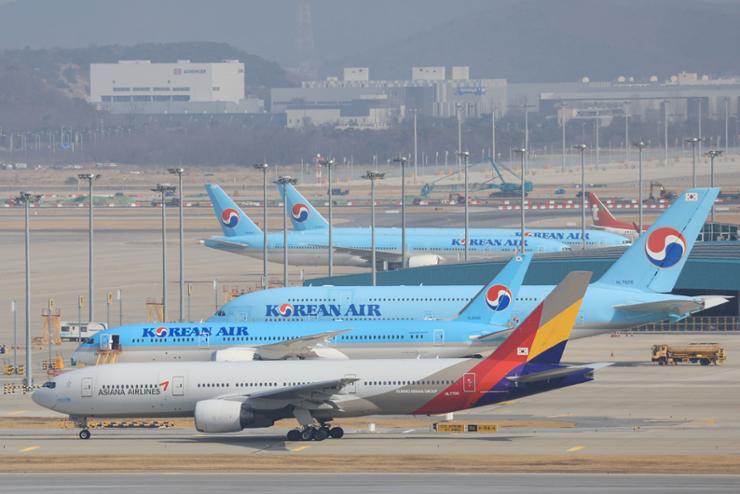
South Korea's flag carrier, Korean Air, will launch its integrated flag carrier on Dec. 17, after completing all legal procedures for its high-profile acquisition of Asiana Airlines, the boards of the two companies said Wednesday.
The final agreement follows the initial share subscription agreement signed in November 2020. With this, Korean Air will absorb all Asiana Airlines assets, liabilities, rights, obligations and personnel for the full-scale integration of the two carriers.
Under the merger terms, Korean Air will comprehensively inherit Asiana Airlines’ assets, liabilities, rights, obligations and workforce. The merger ratio was set at 1 to 0.2736432 for Korean Air and Asiana Airlines shares, respectively. Korean Air’s capital is expected to increase by approximately 101.7 billion won ($68.3 million) following the transaction.
Earlier, the Korean government and state-led creditors provided 3.6 trillion won ($2.42 billion) in liquidity support to cash-strapped Asiana following the outbreak of the COVID-19 pandemic.
Korean Air managed Asiana’s financial and operational restructuring during the acquisition process, which also included full public fund repayment.
Following Korean Air’s contract execution slated for Thursday, the carrier will submit a merger application to the Ministry of Land, Infrastructure and Transport.
Once domestic approvals are finalized, Korean Air will proceed with sequential regulatory filings with international aviation authorities to align safety management systems and operational protocols across the expanded global network.
“The integration will elevate Korean Air’s global market presence and establish Incheon International Airport as a dominant global hub through optimized network connectivity and increased transit efficiency,” a Korean Air official said.
The company is on track to finalize the consolidation of its loyalty programs, including the integration of mileage systems from both carriers, in coordination with the Fair Trade Commission and relevant authorities to ensure a seamless transition for passengers.
Upgraded services and facilities ahead of the launch of the integrated carrier.
Korean Air has upgraded its lounges at Incheon International Airport, while training flight crew members to ensure procedural consistency across both airlines. The company is also modernizing facilities, including cabin crew training centers, to manage increased volume following the integration.
Korean Air emphasized that the launch of the integrated airline will strengthen the country’s aviation industry, bolster Incheon Airport’s role as a global hub and create synergy in expanding global aviation networks.
You may like to read........

(1).jpg)