
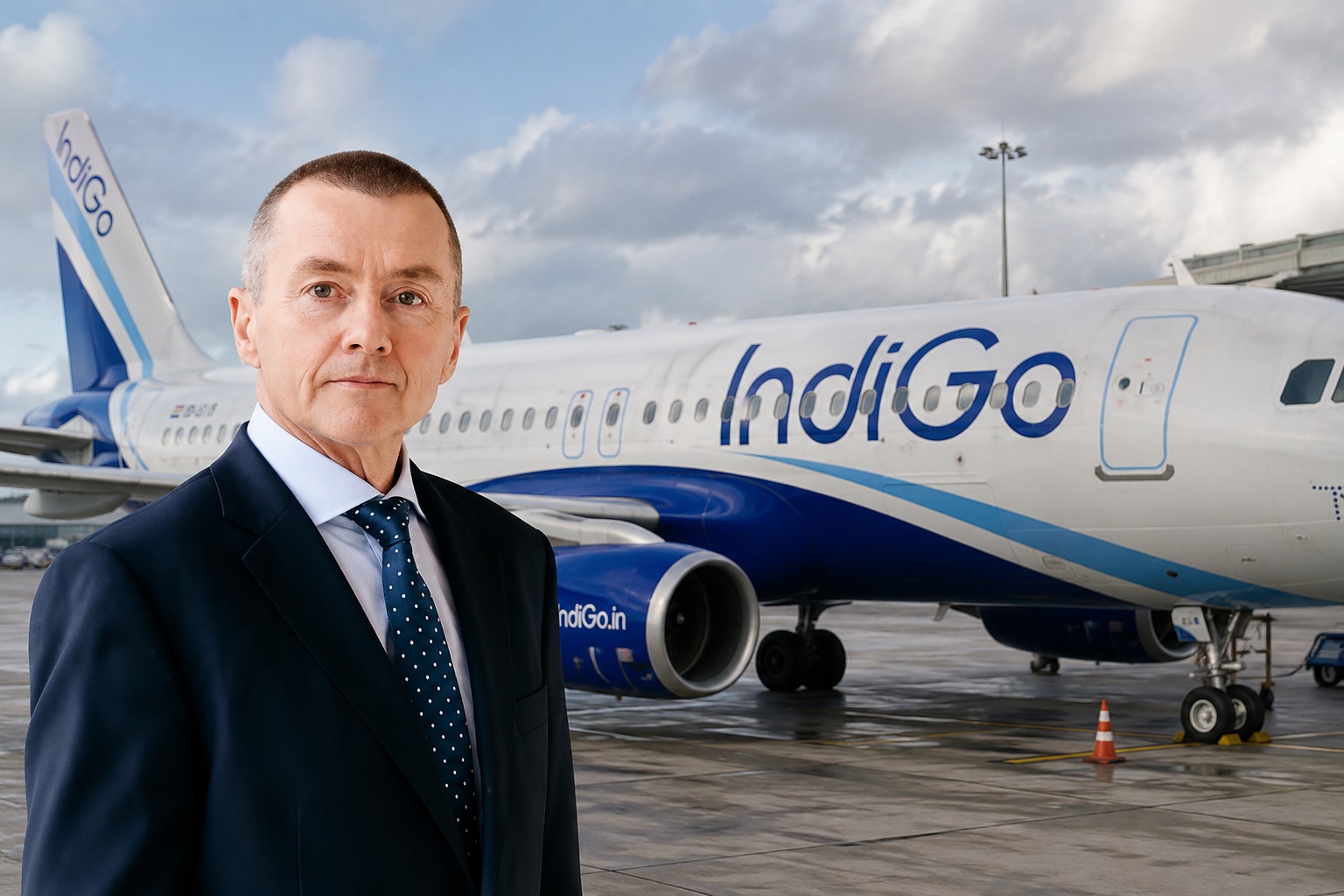
On August 3, 2026, Willie Walsh formally assumed the role of Chief Executive Officer of IndiGo, succeeding Pieter Elbers after one of the most transformative periods in the carrier's history. Walsh's appointment, first announced on March 31, follows the conclusion of his tenure as Director General of the International Air Transport Association (IATA) and brings one of the aviation industry's most influential executives to the helm of the world's fastest-growing major airline.
The leadership transition comes at a pivotal moment for IndiGo. Having established itself as India's dominant domestic carrier and one of the world's largest airlines by fleet size and passenger numbers, the airline is now shifting its focus from domestic leadership to becoming a truly global network airline.
Walsh arrives with more than four decades of aviation experience spanning nearly every level of the industry.
His career began as a cadet pilot with Aer Lingus before progressing into senior management, eventually leading the Irish flag carrier as Chief Executive Officer. He later headed British Airways between 2005 and 2011, overseeing the airline through the global financial crisis while implementing major restructuring initiatives.
In 2011, Walsh became the inaugural CEO of International Airlines Group (IAG), guiding British Airways, Iberia, Aer Lingus, Vueling and later LEVEL into one of Europe's largest airline groups. Following his retirement from IAG in 2020, he assumed leadership of IATA, where he became one of the industry's most outspoken voices on airline economics, sustainability, regulation and post-pandemic recovery.
His move from representing the global airline industry back into airline management marks one of the most significant executive appointments in recent aviation history.
Walsh succeeds Pieter Elbers, whose four-year tenure fundamentally reshaped IndiGo's ambitions.
When Elbers joined the airline in 2022 after leading KLM, IndiGo remained primarily a domestic low-cost carrier despite its enormous scale. Since then, the airline has undergone a remarkable transformation.
Among the most significant developments during Elbers' leadership were:
Today, IndiGo operates one of the world's largest Airbus fleets and serves well over 100 destinations, placing it among the fastest-growing airlines globally.
Walsh now inherits an airline with extraordinary momentum—but also unprecedented complexity.
While IndiGo remains financially strong and continues to benefit from India's booming aviation market, the airline's next phase of growth presents challenges very different from those that defined its first two decades.
IndiGo has one of the largest aircraft order books in aviation history.
Delivering, financing, integrating and efficiently deploying hundreds of additional Airbus aircraft over the coming decade will require exceptional operational discipline. Pilot recruitment, maintenance capacity, engineering resources and airport infrastructure must all expand in parallel with fleet growth.
Maintaining the airline's industry-leading cost structure while absorbing such rapid expansion will be among Walsh's biggest tests.
International expansion is no longer simply about adding destinations.
Operating Airbus A350s introduces an entirely different business model compared with IndiGo's traditional narrowbody operations. Long-haul flying demands premium cabins, sophisticated revenue management, global sales networks, enhanced customer service and complex fleet scheduling.
Success will depend not only on aircraft but also on creating a competitive international product capable of attracting business travelers alongside leisure passengers.
Like airlines worldwide, IndiGo continues to face aircraft delivery delays caused by supply chain disruptions affecting both Airbus and engine manufacturers.
Engine maintenance bottlenecks and spare parts shortages have periodically reduced fleet availability across the industry.
Managing growth despite these external constraints will remain a key operational challenge.
India's aviation market continues to grow faster than airport infrastructure in several metropolitan areas.
Slot constraints at Delhi, Mumbai and Bengaluru, together with airspace congestion and increasing passenger volumes, place additional pressure on operational reliability.
As IndiGo expands internationally, maintaining its historically strong on-time performance will become increasingly difficult.
Although IndiGo remains India's dominant carrier, competition is intensifying.
The Air India Group is investing heavily following its privatization, while Akasa Air continues expanding domestically. International airlines are also increasing capacity into India as demand accelerates.
Walsh will therefore oversee growth in an increasingly competitive marketplace rather than the relatively uncontested environment that helped fuel IndiGo's early expansion.
Welcoming Walsh to the airline, Managing Director Rahul Bhatia described the appointment as a defining moment in IndiGo's evolution.
"As IndiGo enters its third decade and stands poised for the next phase of its growth, I am delighted to officially welcome Willie as the airline's Chief Executive Officer. His extensive global experience in the aviation industry, combined with his operational and strategic expertise, will be instrumental as IndiGo accelerates its international expansion strategy."
Walsh echoed that optimism, describing IndiGo as one of aviation's great success stories.
"IndiGo has built a remarkable legacy over the last two decades, establishing itself among the largest airlines in the world in a short span. With India becoming one of the world's fastest-growing aviation markets, the opportunities ahead for IndiGo are immense. There could not be a more exciting and opportune time for me to join IndiGo."
As CEO, Walsh will oversee the airline's overall strategic direction, focusing on expanding its international network, strengthening commercial performance, enhancing operational excellence and improving the customer experience while working closely with the Board and executive leadership team.
Walsh's appointment represents more than a routine executive succession.
His predecessors built India's largest airline. His task is to transform it into one of the world's leading international carriers.
His experience leading British Airways, IAG and IATA uniquely positions him for that challenge. Few executives have managed global airline groups, negotiated with governments and regulators, overseen airline alliances and navigated industry crises on the scale Walsh has experienced.
Yet IndiGo also presents a unique management challenge. Unlike the mature European airlines Walsh previously led, IndiGo is still in an extraordinary phase of expansion, operating in an aviation market expected to become the world's third largest within the decade.
Success will depend on balancing aggressive international growth with the operational simplicity and cost discipline that made IndiGo successful in the first place.
The airline has already proven it can dominate India's domestic skies. Under Willie Walsh, the question is whether it can translate that success onto the global stage.
IndiGo also holds one of the largest aircraft order books in global aviation, with more than 900 aircraft yet to be delivered, primarily from the Airbus A320neo Family.
Major outstanding orders include:
The airline's long-term strategy is to use its massive order book to expand both domestically and internationally, while supporting the introduction of long-haul services with the Airbus A350 fleet. However, recent geopolitical and operating challenges have prompted IndiGo to phase out its damp-leased Boeing 787 operations ahead of the arrival of its own A350s.
As of March 31, 2026, IndiGo operated a fleet of 441 aircraft, making it one of the world's largest Airbus operators.

.jpg)