
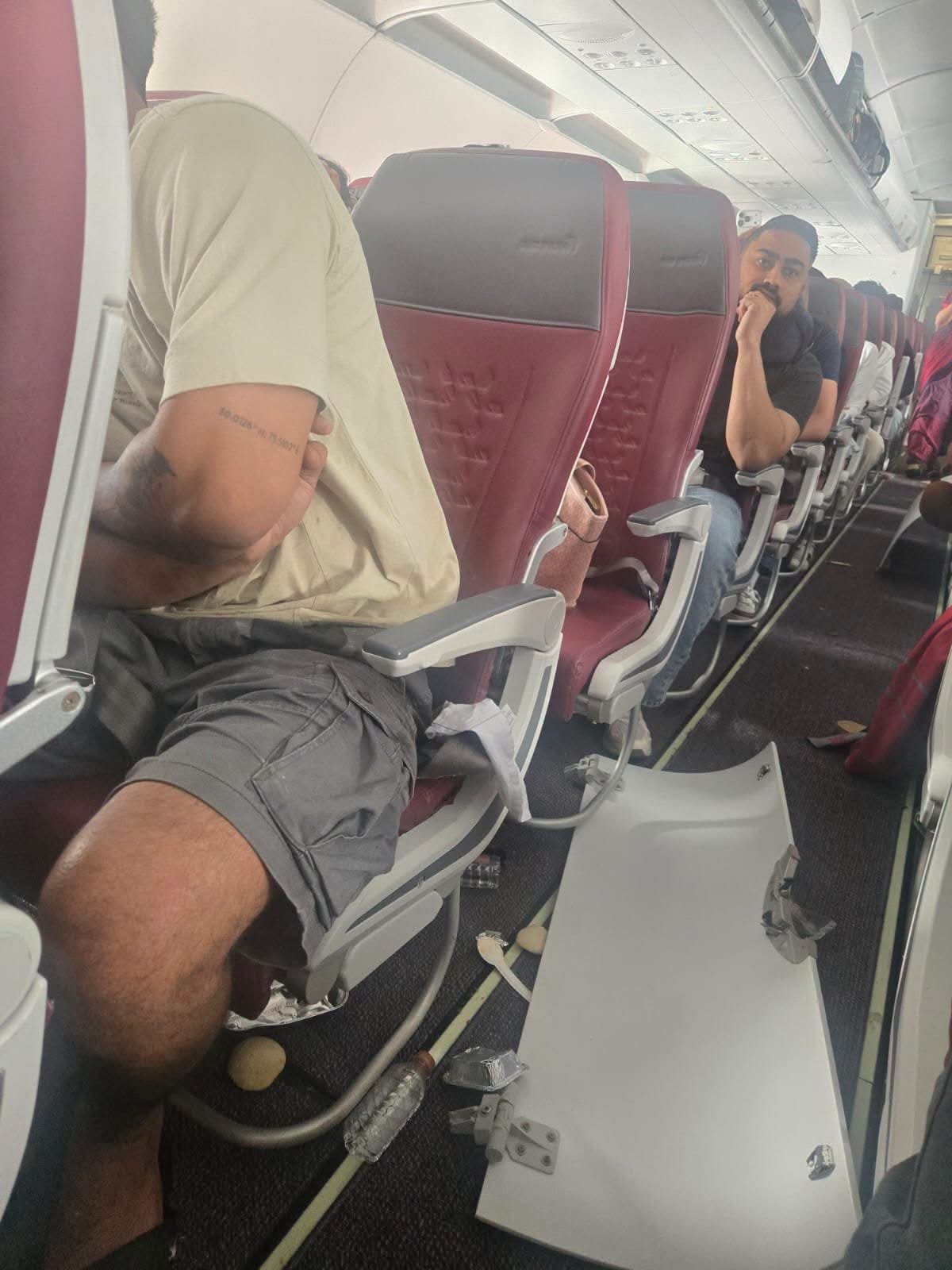
An Air India Airbus A320neo carrying 145 people experienced a sudden loss of altitude during cruise on Tuesday, injuring 17 occupants and once again drawing attention to the aviation industry's increasing concern over severe in-flight turbulence.
Flight AI2379, operating from Phuket to Delhi, encountered what the airline described as a "momentary event" after the aircraft unexpectedly descended approximately 300 feet while at cruising altitude. Despite the sudden altitude deviation, the crew stabilized the aircraft and continued the flight, landing safely at Delhi's Indira Gandhi International Airport at 11:07 a.m. IST.
The aircraft was carrying 137 passengers and eight crew members. According to Air India, 13 passengers and four cabin crew members sustained injuries and were transported to hospital for medical evaluation after landing.
By 6:50 p.m. on August 4, the airline confirmed that five passengers had been discharged, while the remaining injured continued receiving treatment and observation.
Medical teams met the aircraft immediately upon arrival as a precaution, with Air India emphasizing that passenger and crew welfare remained its highest priority.
Although sudden altitude deviations can appear dramatic, they are not uncommon during encounters with moderate or severe atmospheric turbulence.
Aircraft are designed to withstand forces well beyond those experienced during normal turbulence. In most cases, the greatest danger comes not from structural damage to the aircraft but from unsecured passengers and crew being thrown against cabin fixtures.
Cabin crew are particularly vulnerable because they are frequently standing or moving through the cabin while conducting inflight service.
Most serious turbulence injuries occur not because of structural damage to the aircraft, but because passengers or crew are not restrained when sudden vertical accelerations occur. Modern airliners are designed to withstand turbulence far beyond what passengers typically experience, making consistent seat belt use the most effective protection against injury.
The Air India incident joins several significant turbulence events that have attracted global attention over the past few years.
The most serious occurred in May 2024, when Singapore Airlines Flight SQ321, a Boeing 777-300ER operating from London to Singapore, encountered severe clear-air turbulence over Myanmar. One passenger died and more than 100 people were injured, making it one of the worst turbulence-related accidents in modern commercial aviation.
Just two months earlier, LATAM Flight LA800, a Boeing 787-9 flying between Sydney and Auckland, experienced a violent in-flight upset that injured around 50 passengers and crew. Investigators later examined an inadvertent cockpit seat movement as part of the investigation.
In July 2024, Air Europa Flight UX045 encountered severe turbulence while crossing the Atlantic Ocean en route from Madrid to Montevideo. More than 30 passengers were injured before the aircraft diverted safely to Natal, Brazil.
Earlier incidents include Hawaiian Airlines Flight HA35 in December 2022, which injured 36 people during approach to Honolulu, Lufthansa Flight LH469 in March 2023, which diverted after turbulence injured seven occupants, and Air Canada Flight AC19 in 2019, where severe turbulence over the Pacific resulted in 37 injuries and an emergency diversion to Honolulu.
Although each event involved different weather conditions and operational circumstances, investigators reached a remarkably consistent conclusion: most injuries occurred because passengers or cabin crew were not fully restrained at the time of the turbulence encounter.
A temporary loss of altitude during turbulence does not necessarily indicate that an aircraft is out of control.
Strong vertical air currents can momentarily lift or sink an aircraft despite continuous pilot inputs and the operation of sophisticated flight-control systems. Modern autopilots are designed to prioritize structural load protection during turbulence rather than maintaining an exact altitude at all costs.
For passengers, however, even a relatively small altitude change can feel dramatic, particularly when accompanied by abrupt vertical acceleration.
In the case of AI2379, the reported 300-foot altitude loss falls within the range of disturbances that aircraft can safely absorb, provided occupants remain secured.
One of aviation's most persistent challenges is clear-air turbulence (CAT)—powerful atmospheric disturbances that occur without visible storm clouds and are often undetectable by onboard weather radar.
Unlike thunderstorms, CAT is associated with jet streams and rapidly changing wind speeds at high altitude. Because it offers little visual warning, pilots often rely on forecasts, reports from other aircraft, and meteorological models to avoid affected airspace.
Several academic studies have suggested that climate change may increase both the frequency and intensity of clear-air turbulence in some regions by strengthening atmospheric wind shear. While research continues, airlines worldwide have invested heavily in improved turbulence forecasting, real-time data sharing, and enhanced flight planning tools.
Despite advances in weather forecasting and aircraft technology, turbulence cannot always be avoided.
That reality has reinforced one of aviation's simplest safety messages: keep the seat belt fastened whenever seated, even when the seat belt sign is switched off.
Data from accident investigations consistently show that unrestrained passengers account for the overwhelming majority of turbulence-related injuries.
Airlines have also introduced revised cabin procedures, allowing flight attendants to suspend service earlier when turbulence is anticipated and encouraging passengers to remain seated whenever possible.
The safe landing of Flight AI2379 demonstrates the resilience of modern commercial aviation.
The aircraft remained fully controllable throughout the event, the flight crew managed the situation in accordance with established procedures, and emergency medical teams were positioned immediately upon arrival.
Yet the incident also illustrates why turbulence continues to rank among the industry's most common causes of onboard injuries.
As airlines operate increasingly dense schedules across regions where atmospheric instability is becoming more difficult to predict, encounters with unexpected turbulence are likely to remain a routine operational challenge. Advances in forecasting and flight planning will reduce exposure, but they are unlikely to eliminate it entirely.
For passengers, the lesson remains unchanged. Severe turbulence may be unavoidable, but the injuries it causes are often preventable. In an era of increasingly sophisticated aircraft and flight management systems, the humble seat belt remains one of aviation's most effective safety devices.
You may like to read........

.jpg)