
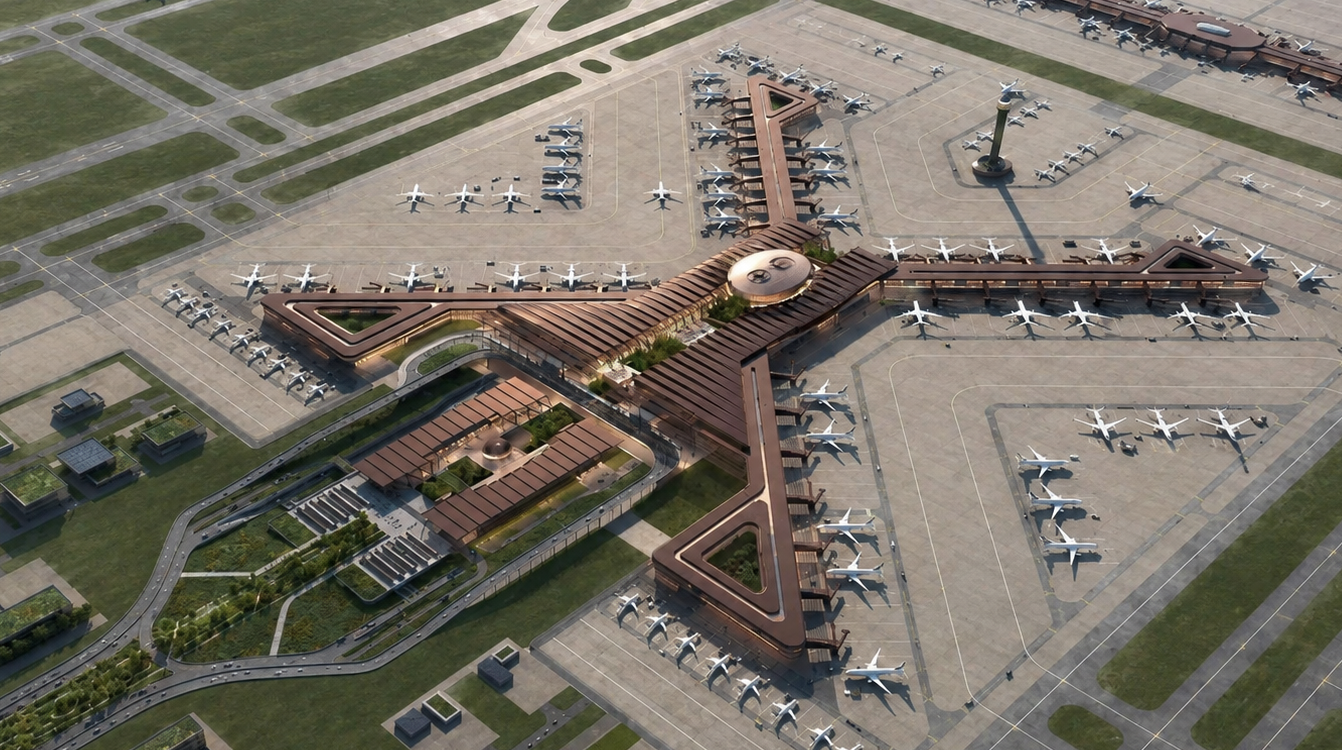
The United States is intensifying efforts to secure a significant role for American companies in the development of Ethiopian Airlines' US$12.5 billion Bishoftu International Airport (BIA), one of the most ambitious airport infrastructure projects ever undertaken in Africa.
Speaking during a virtual press briefing from the Africa Logistics and Communications Symposium in Addis Ababa, Mark Mitchell, U.S. Deputy Assistant Secretary of Commerce for the Middle East and Africa, said Washington is "closely engaged in pushing to secure U.S. participation" in the landmark airport development, according to a Reuters report.
Mitchell confirmed that he held discussions with Ethiopian Airlines executives during the symposium, underscoring the U.S. government's growing interest in expanding American commercial participation in one of Africa's largest aviation investments.
Although he did not specify which U.S. companies could ultimately participate, Mitchell indicated the project could generate additional opportunities for Boeing and GE Aerospace, potentially leading to further aircraft and engine orders as Ethiopian Airlines continues to expand its global network.
Washington's interest in the Bishoftu project reflects the increasing strategic competition among global powers—including China, Europe, and the United States—for infrastructure investment opportunities across Africa.
Beyond airport construction, Mitchell also revealed that the U.S. Commerce Department is pursuing closer cooperation with Ethiopia's Artificial Intelligence Institute as part of broader efforts to expand exports of American AI technologies to the region.
The renewed engagement follows Ethiopian Airlines' announcement in April that it had ordered six additional Boeing 787-9 Dreamliners, increasing its existing order book of 20 aircraft.
Earlier this year, Ethiopian Airlines Group Chief Executive Mesfin Tasew also confirmed that several U.S. financial institutions had expressed interest in participating in financing the airport project.
Construction of Bishoftu International Airport officially commenced in January 2026, when Ethiopian Prime Minister Abiy Ahmed Ali laid the foundation stone approximately 40 kilometres southeast of Addis Ababa.
Designed as the future home of Ethiopian Airlines, the airport is expected to become Africa's largest aviation hub, replacing Addis Ababa Bole International Airport, which is projected to reach its operational capacity within the next few years.
Once completed, Bishoftu International Airport will represent the largest aviation infrastructure project in African history.
The development carries an estimated investment of US$12.5 billion, with the African Development Bank already committing US$500 million while leading efforts to mobilize approximately US$8.7 billion in additional financing.
The airport has been designed to support Ethiopian Airlines' long-term Vision 2035 growth strategy.
The project will be delivered in multiple phases:
Upon full completion, Bishoftu International Airport will include:
The airport's scale is intended to position Ethiopia as the principal aviation gateway linking Africa with Europe, Asia, and the Middle East.
Government officials have described Bishoftu as a project that aims to become the "Dubai of Africa," reflecting ambitions to establish Ethiopia as the continent's premier international aviation hub.
The airport has been designed by the internationally renowned Zaha Hadid Architects, whose masterplan emphasizes efficient passenger transfers, sustainability, and operational excellence.
Up to 80% of passengers are expected to be transfer travelers, making connectivity a central design principle.
Among the planned passenger facilities are:
The terminal's architectural design draws inspiration from Ethiopia's geography, particularly the Great Rift Valley, with a central spine connecting all concourses to simplify passenger movement.
One of Bishoftu's major operational advantages is its location.
Situated approximately 400 metres lower in elevation than Addis Ababa Bole International Airport, the new airport will allow aircraft to depart with higher maximum take-off weights (MTOW), improving payload capability while reducing fuel burn.
Combined with longer runways, Ethiopian Airlines will be able to operate longer non-stop services carrying additional passengers and cargo, significantly strengthening the airline's competitiveness on long-haul international routes.
The airport has also been strategically located to allow 24-hour operations without curfew restrictions, supporting future network expansion.
Environmental sustainability forms a key component of the project.
The passenger terminal is being designed to achieve LEED Gold certification, incorporating:
The airport will also be connected to Addis Ababa and the existing Bole International Airport through a proposed high-speed rail network, creating an integrated regional transportation system.
Beyond serving as an airport, Bishoftu International Airport is planned as the centrepiece of a new Airport City, supporting commercial, logistics, hospitality, and mixed-use developments.
The project is expected to generate tens of thousands of jobs while supporting a surrounding population of approximately 80,000 people.
For Ethiopian Airlines, the investment represents the cornerstone of its Vision 2035 strategy to evolve into one of the world's leading aviation groups across passenger, cargo, maintenance, training, and aerospace services.
With construction underway and completion targeted for 2030, Bishoftu International Airport is poised to reshape Africa's aviation landscape.
As global interest from governments, financial institutions, aircraft manufacturers, and infrastructure companies continues to grow, the project is emerging as one of the world's most strategically significant airport developments.
For the United States, securing participation would strengthen American industry in one of Africa's fastest-growing aviation markets. For Ethiopian Airlines, Bishoftu represents the foundation for its next phase of global expansion—one designed to cement Ethiopia's position as the continent's leading aviation gateway for decades to come.