
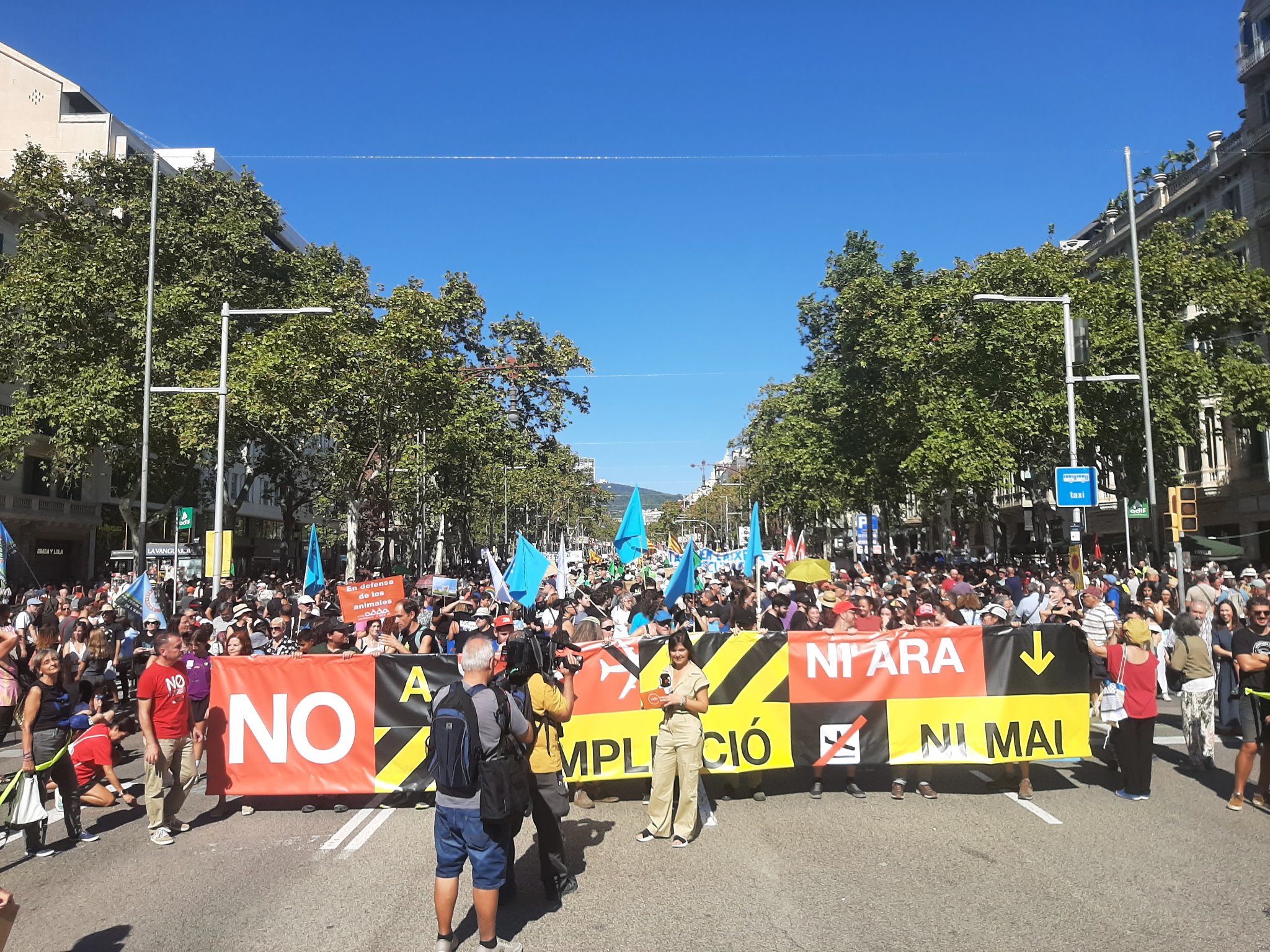
Thousands of people took to the streets of Barcelona on Sunday to protest plans to expand Josep Tarradellas Barcelona-El Prat Airport, reopening one of Spain’s most contentious aviation infrastructure debates five years after a previous expansion proposal was shelved.
The demonstration was organized by the Zeroport platform under the slogan “No to the expansion, not now nor ever” and brought together environmental, neighborhood, social, agricultural and trade-union organizations. Barcelona’s municipal police estimated the turnout at around 5,000–5,500 people, while organizers claimed a substantially higher figure. Current reporting confirms the demonstration took place peacefully through central Barcelona.
The march began around noon at the junction of Passeig de Gràcia and Carrer d’Aragó before continuing through the city centre toward Plaça de Sant Jaume. Demonstrators included cyclists and tractors from the surrounding agricultural areas of the Llobregat region. Slogans included calls for more rail transport and fewer flights, reflecting opposition to both airport expansion and Barcelona’s dependence on high-volume tourism.
The timing of the protest is significant. Just days earlier, Spain’s Council of Ministers approved DORA III, the Airport Regulation Document covering 2027–2031, which provides almost €13 billion in investment across Aena’s Spanish airport network. Barcelona-El Prat is allocated approximately €1.765 billion during the five-year period.
The scale of the investment has generated considerable attention, but the approved DORA III package does not authorize or finance the construction of the proposed extended runway during 2027–2031.
According to Transport Minister Óscar Puente, the €1.765 billion allocated to El Prat is predominantly directed toward upgrading existing infrastructure. The package includes approximately €459 million for the reconfiguration of Terminal 1, €91 million for Terminal 2, €158 million for airfield and apron improvements, €91 million for safety and facilities, and funding for sustainability, operational processes, communications, electrical systems and navigation aids.
A separate €191.25 million is reserved for preparatory actions associated with the potential future expansion. The government says this money is not for physically extending the runway. A significant portion would support environmental compensation measures and preparatory work associated with a future satellite terminal, subject to the required environmental approvals.
Consequently, the principal construction phase of the expansion has effectively been pushed beyond the current DORA III investment period.
The proposed expansion focuses on Runway 06R/24L, commonly referred to as the airport’s sea-side runway.
Aena's 2025 expansion plan proposed extending the runway by approximately 500 metres, taking it to about 3,160 metres. The objective is to increase airfield capability for long-haul and intercontinental operations while enabling the airport to accommodate additional traffic. The proposal also envisages a new satellite terminal to support the expanded operation.
The project is particularly sensitive because of the surrounding Llobregat Delta, including environmentally protected areas such as La Ricarda. The proposed development would therefore require extensive environmental assessment and compensation, with European environmental rules also relevant because affected areas include territory within the Natura 2000 network.
The Spanish government has emphasized that the runway extension itself is not part of DORA III and would only proceed if the required environmental conditions and approvals are met. If approved, the major construction expenditure would be expected to fall into a subsequent regulatory investment period.
The debate is not limited to the proposed runway extension. Aena is already undertaking substantial work to improve the airport's existing infrastructure.
In March 2026, Aena announced projects involving Runway 06R/24L, including pavement rehabilitation, new LED lighting, a new parallel taxiway known as Juliet and a new aircraft parking apron. Aena explicitly stated that these works are intended to improve operational efficiency and do not increase the airport's current operational capacity.
The Spanish aviation regulator, AESA, also opened the environmental-information process for these 06R/24L works earlier in 2026. The project includes runway rehabilitation, taxiway and apron works and associated airfield infrastructure.
Terminal infrastructure is also being upgraded. In July, Aena announced a major transformation of Terminal 2, with an investment exceeding €153 million, including improvements to passenger areas, technology, circulation and the terminal's external and internal spaces.
The expansion debate comes as Barcelona-El Prat continues to handle record traffic.
The airport processed 57,483,036 passengers in 2025, an increase of 4.4% compared with 2024. It also handled 360,786 aircraft movements and more than 200,000 tonnes of cargo, making 2025 another record year for the airport.
International traffic accounted for approximately 43.26 million passengers in 2025, compared with about 14.13 million domestic passengers.
Aena has previously argued that growth can continue in the short term through better use of available capacity during off-peak periods and by spreading traffic more evenly through the year. Longer-term growth, however, is tied to the airport's infrastructure and operating model.
The current controversy is closely connected to the expansion plan debated in 2021.
That earlier proposal also centred on extending the sea-side runway by approximately 500 metres and constructing a new satellite terminal. In September 2021, roughly 10,000 people according to Barcelona's Guardia Urbana demonstrated against the project, while organizers claimed a considerably larger attendance.
The 2021 project was subsequently shelved following disagreements over its environmental impact and political support.
Aena and Spanish and Catalan authorities returned to the expansion question in 2025. In June 2025, a technical committee involving the Spanish Ministry of Transport and the Generalitat de Catalunya gave the green light to a revised expansion concept, with Aena estimating total investment across the broader programme at approximately €3.2 billion.
The revised concept sought to increase intercontinental capability while reducing the project's environmental impact on La Ricarda compared with earlier proposals.
Zeroport and its supporting organizations argue that increasing airport capacity would generate additional aviation emissions and intensify pressure on Barcelona's housing market, public spaces and tourism infrastructure.
The platform also opposes further development affecting the Llobregat Delta and calls for greater investment in railways, public transport, agriculture and biodiversity instead of airport expansion. Its position is shared by a number of environmental and civic organizations, while political support for or against the expansion remains divided.
The claim that expansion would generate 10–15 million additional tourists annually, or increase airport-related emissions by 40%, should be treated as Zeroport's assessment rather than an established government or Aena forecast. Those figures are not independently verified capacity or emissions forecasts in the official DORA documentation.
Supporters of expansion have argued that Barcelona needs additional infrastructure to strengthen its international connectivity, long-haul network and economic competitiveness.
Aena's own 2025 expansion proposal was explicitly designed around the development of Barcelona as an intercontinental hub, with the runway extension intended to remove operational restrictions affecting certain long-haul aircraft and with a satellite terminal forming part of the longer-term concept.
Business organizations have also continued to support the project. Foment del Treball, for example, criticized the exclusion of the actual expansion works from DORA III and argued that the project should proceed in a later investment period.
The result is a continuing policy dispute involving three competing priorities: airport capacity and international connectivity, environmental protection, and the future economic model of Barcelona and the Llobregat Delta.
The immediate focus will be on the new Master Plan for Barcelona-El Prat, environmental assessments and the conditions required for any future runway extension.
The €1.765 billion DORA III investment will modernize significant parts of the existing airport between 2027 and 2031, but it does not itself deliver the proposed extended runway or satellite terminal. The €191.25 million preparatory allocation keeps the possibility of expansion alive while leaving the major construction decision for a later stage.
For aviation, the central technical question remains whether Barcelona can obtain additional long-haul capacity through changes to infrastructure and operations while meeting increasingly stringent environmental requirements.
For opponents, Sunday's demonstration shows that the environmental and social debate surrounding El Prat remains active five years after the previous project was halted.
For Aena and the Spanish and Catalan governments, the challenge is now to determine whether the proposed hub-development strategy can be reconciled with European environmental requirements and the protection of the Llobregat Delta.
The future of Barcelona-El Prat therefore remains unresolved: DORA III has funded a major modernization programme and preparatory work, but the decisive question — whether the sea-side runway will actually be extended — remains subject to further planning, environmental assessment and regulatory decisions.
You may like to read......