
Emirates’ long-term transition from Dubai International Airport (DXB) to Al Maktoum International Airport (DWC) is moving forward as Dubai accelerates development of a new aviation hub at Dubai South.
The transition is expected to take place in phases, with the first major phase of the expanded Al Maktoum International targeted for 2032. The development is designed to eventually replace DXB as Dubai’s principal passenger airport and provide substantially greater capacity for Emirates and other airlines.
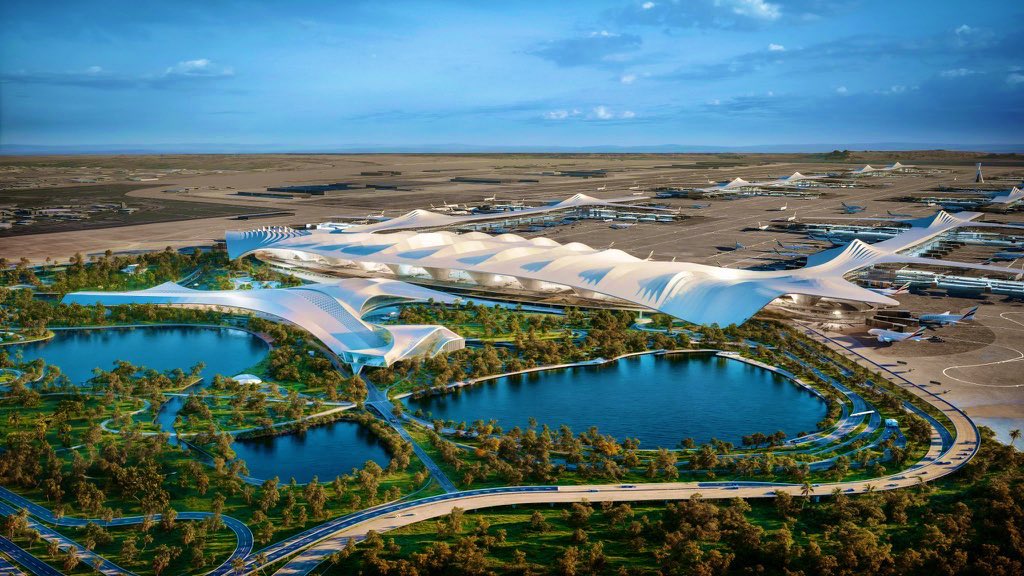
In April 2024, Dubai approved the designs for a new passenger terminal at Al Maktoum International at an estimated cost of AED 128 billion (approximately US$35 billion).
According to Dubai's official plans, the expanded airport will ultimately have capacity for up to 260 million passengers annually, making it one of the largest airport developments ever undertaken. The first phase is planned around a capacity of approximately 150 million passengers per year.
The full development is planned around five parallel runways, multiple concourses and a large-scale terminal complex. Dubai Airports says the airport's ultimate development will also provide capacity for approximately 12 million tonnes of cargo annually.
The scale of the project is intended not simply to add capacity, but to create a new integrated aviation and logistics hub around Dubai South.
Emirates currently operates its passenger network primarily from Terminal 3 at Dubai International Airport, which remains the airline's principal hub.
The move to DWC will therefore represent a major operational transformation rather than an overnight relocation. Dubai Airports has indicated that traffic will be migrated progressively as the new airport's infrastructure becomes operational.
The expanded DWC site is currently targeted to begin major operations in 2032, initially supporting approximately 150 million passengers annually before additional capacity is added.
The strategy allows Dubai to continue using DXB while the new airport is developed and commissioned, reducing the need for an immediate large-scale transfer of aircraft, passengers, employees and airport systems.
The airport transition is being accompanied by a substantial expansion of Emirates' own aviation infrastructure at Dubai South.
In May 2026, Emirates broke ground on a US$5.1 billion engineering complex adjacent to Al Maktoum International. The project covers approximately 1.1 million square metres and is planned as a major aircraft maintenance, repair and overhaul (MRO) centre.
The facility is expected to become capable of handling 28 wide-body aircraft simultaneously by 2030, significantly expanding Emirates' in-house engineering and maintenance capacity.
The location is strategically significant: Emirates' future engineering operation will sit alongside the airline's planned future passenger hub, creating a concentrated aviation ecosystem covering passenger operations, aircraft maintenance, logistics and associated services.
Al Maktoum International is being developed on a fundamentally different scale from the capacity-constrained DXB environment.
Dubai Airports says the first expansion phase will provide capacity for around 150 million passengers annually, with the ultimate design allowing expansion to 260 million passengers per year. The airport is also planned to accommodate five runways and significant cargo capacity.
The new airport is expected to use extensive automation and redesigned passenger-processing systems to increase throughput without relying solely on larger terminal buildings.
Dubai Airports CEO Paul Griffiths has also emphasized that the airport's design is being developed with resilience in mind. In September 2026, he said the long-term expansion strategy remains unchanged despite regional security challenges, although infrastructure such as fuel storage is being considered for additional protection and resilience.
Despite the long-term shift toward DWC, Dubai International remains a critical global aviation hub.
Dubai Airports expects DXB to handle approximately 70 million passengers in 2026, following significant disruption earlier in the year. The airport's recovery is continuing as airlines restore capacity and passenger demand rebounds.
Emirates said in September that it was operating at approximately 93% of its pre-disruption capacity and carried more than 8.6 million passengers during July and August 2026. The airline has also reported strong demand in markets including South Africa, Brazil, India and Egypt.
This continuing strength at DXB makes the phased approach particularly important: Emirates must expand its network while simultaneously preparing the infrastructure required for its eventual move south.
The DWC project represents more than an airport expansion. It is part of Dubai's wider strategy to shift the centre of its aviation economy toward Dubai South, an area being developed around aviation, logistics, commercial and residential activity.
For Emirates, the combination of the new passenger airport and the US$5.1 billion engineering complex creates the foundation for a future operating environment in which aircraft maintenance, passenger operations and aviation-support activities are concentrated around DWC.
The transition will also require the migration of a vast operational ecosystem, including aircraft, airport systems, employees, ground handling, catering, cargo, maintenance, passenger-processing infrastructure and supporting logistics.
With the first major DWC phase targeted for 2032, Dubai is now effectively managing two aviation strategies simultaneously: maintaining DXB as one of the world's major international hubs while building the infrastructure that will eventually support Emirates' next-generation global hub at Al Maktoum International.
The result will be one of the most significant airport and airline-hub transitions in modern aviation, with Emirates' future centred increasingly on Dubai South and Al Maktoum International.