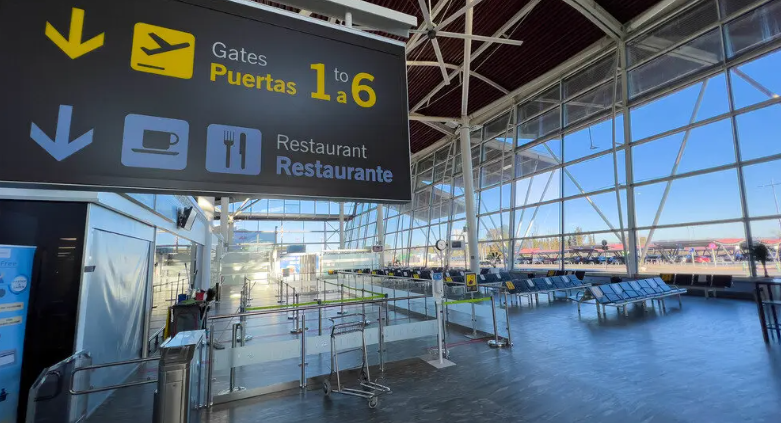


Air traffic at Marseille Provence Airport (MRS/LFML) was significantly disrupted on Saturday after a failure in a critical weather-data system used by air traffic control to provide atmospheric-pressure information for aircraft operations.
The malfunction was detected at approximately 06:00 local time at the airport in Marignane. Airport authorities described the affected system as critical to aircraft landings and, depending on the aircraft and airline, to departures as well. The airport said operations began progressively returning to normal at around 10:00, although delays continued to propagate through the day's schedule.
The failure occurred during a particularly busy Saturday morning operating period. Of 35 flights scheduled to depart between 06:00 and 10:00, 21 were able to depart, albeit with delays, while 14 were still awaiting departure at about 11:00, according to airport information reported by French media.
Two flights were cancelled, while several aircraft scheduled to arrive at Marseille were delayed or diverted to alternative airports, including Nice and Montpellier. Contemporary reporting identified services involving Air France and Transavia among the cancellations.
The operational impact was therefore broader than the departure board alone suggested. When arriving aircraft cannot be accepted normally, aircraft and crews already operating elsewhere may have to hold, divert or remain at their departure airport. Those disruptions can then affect the aircraft's next sectors, creating a cascading effect throughout an airline's network.
The failed system was associated with the provision of atmospheric-pressure data, an apparently simple measurement that has a fundamental role in aviation.
Aircraft equipped with conventional barometric altimeters determine altitude from static air pressure. Because atmospheric pressure decreases with height, the altimeter converts the measured pressure into an indicated altitude according to a selected pressure reference.
For an airport operation, one of the most important references is QNH. When the correct local QNH is set on the altimeter, the instrument indicates altitude above mean sea level when the aircraft is on the ground at the airport.
At Marseille, for example, an aviation weather observation around 08:30 UTC on August 22 reported a QNH of 1016 hPa, along with visibility greater than 10 km and CAVOK conditions.
This pressure reference is not merely informational. An error of only a few hectopascals can translate into a significant altitude indication error. As a rule of thumb near sea level, 1 hPa corresponds to roughly 27–30 feet of altitude. A 5-hPa discrepancy could therefore produce an indicated-altitude error on the order of 140 feet.
That matters particularly during an instrument approach, when an aircraft is descending toward terrain and runway elevation and the crew must maintain precisely defined vertical clearances.
It would be misleading to suggest that aircraft simply become incapable of landing whenever a weather sensor fails. Modern airliners have multiple sources of flight information, including inertial systems, satellite navigation, radio-navigation equipment and, on suitably equipped aircraft and approaches, radio-altimeter information.
The issue at Marseille was instead the availability and integrity of an approved pressure-data source within the airport's operational system.
Instrument flight procedures contain altitude constraints and minimum descent altitudes/heights that depend on reliable pressure information. Air traffic controllers also use pressure data when issuing altitude clearances and when establishing the vertical separation framework in the vicinity of the airport.
If the certified system supplying local pressure information to the tower is unavailable, controllers and operators cannot simply substitute an arbitrary pressure value. Depending on the applicable procedures, aircraft type, operator approvals and available backup systems, the failure can require restrictions on arrivals, departures or both until a valid source is restored.
This explains why the disruption could occur even though the underlying weather was apparently benign. The available meteorological observation for Marseille showed CAVOK conditions, meaning no significant cloud or visibility limitation was being reported at that time.
In other words, the problem was not that pilots could not see the runway. It was that an essential piece of certified atmospheric data used for safe and standardized flight operations was unavailable.
The episode illustrates an important characteristic of modern aviation: a relatively narrow failure in airport infrastructure can have consequences far beyond the equipment itself.
When arrivals are restricted, aircraft can be forced to divert or remain airborne longer. Departing aircraft may be held because their destination cannot reliably accept them, while airlines may have to reposition aircraft, reorganize crews and reaccommodate passengers.
The available flight data shows the operational effect. For example, an Air Algérie Boeing 737-800 operating from Constantine to Marseille on August 22 eventually landed at Marseille at 12:42 local time, after taking off at 09:28, with its approach reportedly affected by the disruption.
The airport's own passenger guidance emphasizes that, during traffic disruptions, travelers should obtain the latest information directly from their airline because the airport cannot always confirm in advance whether an individual flight will be cancelled.
Airport authorities said the weather-data problem had been repaired from approximately 09:55–10:00 local time, after which the flight program progressively resumed. The airport nevertheless warned that delays and cancellations could continue as airlines worked through the accumulated disruption.
By Sunday, August 23, available flight-status information indicated that Marseille's operation had substantially returned to normal, although individual flight schedules remained subject to routine airline changes.
The incident demonstrates why aviation treats meteorological data systems as safety-critical infrastructure. A pressure value transmitted to an aircraft may look like a single number on a cockpit display, but that number forms part of the altitude-reference chain connecting the airport's weather equipment, air traffic control, flight procedures and the aircraft's flight-management and instrumentation systems.
When the integrity of that chain cannot be guaranteed, delaying or diverting aircraft is not an overreaction—it is the safety system working as designed.