
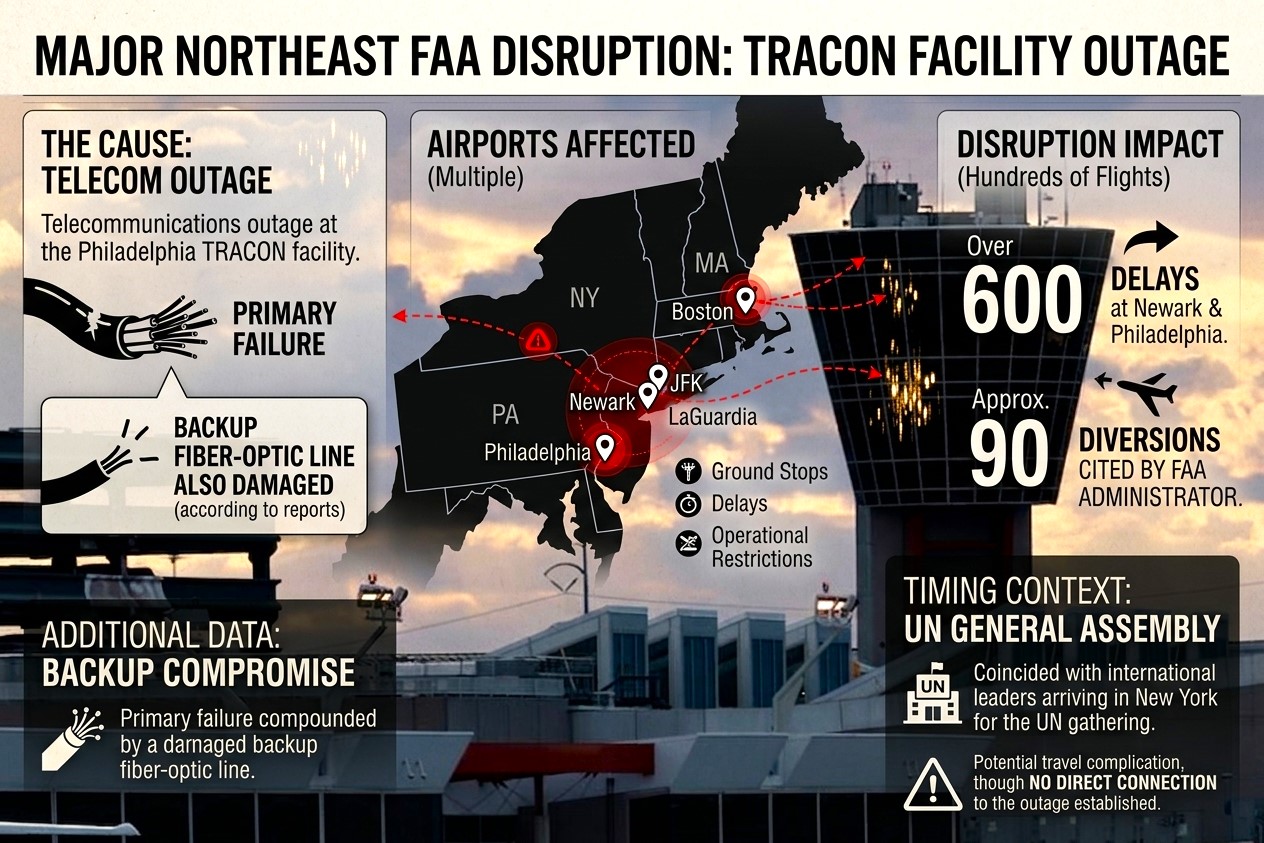
A major telecommunications failure at a Federal Aviation Administration (FAA) air traffic control facility in Philadelphia disrupted air travel across the northeastern United States on Monday, prompting ground stops, flight delays and diversions at several major airports.
The disruption affected the New York metropolitan area's three primary commercial airports — John F. Kennedy International (JFK), LaGuardia (LGA) and Newark Liberty International (EWR) — as well as Philadelphia International Airport (PHL), Boston Logan International Airport (BOS) and other regional facilities.
The incident occurred during the United Nations General Assembly's high-level week in New York, when international leaders and diplomatic delegations are gathering in the city.
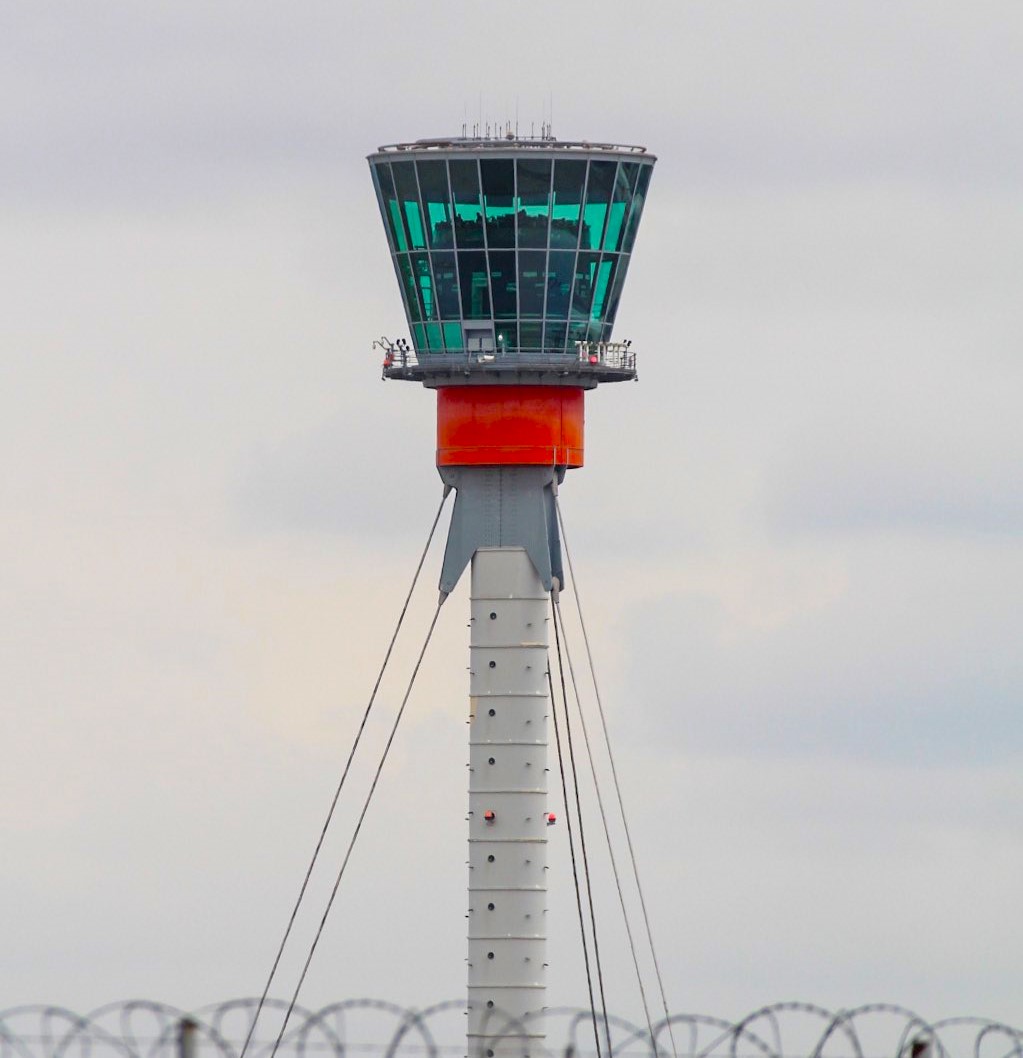
According to reports citing FAA officials, a primary communications circuit at the agency's Philadelphia Terminal Radar Approach Control (TRACON) facility failed.
The situation worsened when controllers attempted to switch to a backup system and discovered that a fiber-optic communications line had also been damaged.
Transportation Secretary Sean Duffy said an Amtrak construction crew had accidentally cut into a fiber line in New Jersey, contributing to the telecommunications outage.
The failure affected communications and radar-related services used to manage aircraft approaching and departing airports in the region. The FAA responded by restricting flight operations to maintain safe traffic separation while technicians worked to restore service.
FAA Administrator Bryan Bedford said the agency was working to install a replacement circuit and repair the damaged backup line. Repairing the fiber-optic connection could take approximately 13 hours, according to his remarks reported by news outlets.
The FAA's restrictions and the resulting disruption extended across a broad area of the Northeast.
The scale of the disruption was substantial. Flight-tracking data cited by Reuters showed more than 600 delayed flights at Newark and Philadelphia, while the FAA administrator reportedly put the number of diversions at approximately 90.
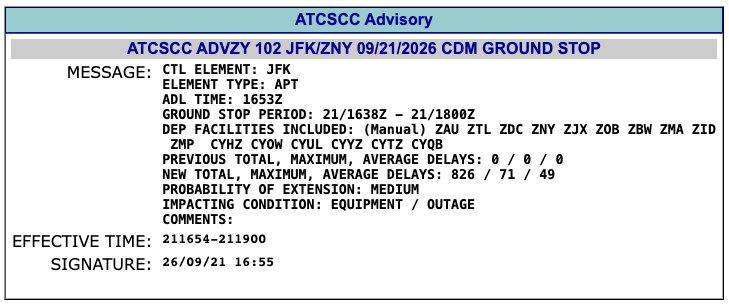
These figures represent different operational impacts; the total number of affected flights across the region may be higher.
The disruption coincided with the arrival of foreign leaders and diplomatic delegations attending the United Nations General Assembly in New York.
The annual gathering generates additional international travel and security-related transportation activity around the city. An air traffic disruption affecting JFK, Newark and LaGuardia therefore creates complications for both ordinary travelers and official delegations.
However, the coincidence in timing does not establish that the outage was connected to the UN event. Available reporting attributes the disruption to a communications failure and damage to backup infrastructure.
The immediate impact on individual delegations, including whether particular leaders experienced delays, requires confirmation from their respective governments or travel representatives.
The September 2026 incident follows several significant air traffic control and aviation technology disruptions in the United States.
A failure in the FAA's NOTAM system led to a nationwide ground stop on January 11, 2023.
The system provides pilots and aviation personnel with notices about hazards, restrictions and other information relevant to flight operations. The outage disrupted departures across the United States while the FAA worked to restore the service.
The incident demonstrated how a failure in an information system can affect flight operations across a national network, even when aircraft and airport infrastructure remain operational.
In spring 2025, Newark Liberty International Airport experienced a series of significant air traffic control communications outages.
The incidents raised concerns about the reliability of systems supporting traffic into and out of one of the country's busiest airports. The disruption also drew attention to staffing pressures and aging air traffic control infrastructure.
The Newark-area problems are particularly relevant to the September 2026 event because Newark's air traffic services had been transferred to the Philadelphia TRACON facility in 2024.
The FAA reported a telecommunications outage affecting communications and radar displays at the Philadelphia TRACON facility in 2025.
The facility supports traffic in the Philadelphia region and Newark area, making its technical reliability important to a large and interconnected airspace.
The September 2026 outage has renewed attention to the risks associated with communications infrastructure serving multiple major airports.
The latest disruption involved a failure of the primary circuit at Philadelphia TRACON, followed by the discovery that its backup fiber-optic line had been damaged during construction work in New Jersey.
The combination of the primary failure and unavailable backup connection caused widespread restrictions and flight disruption across the Northeast.
The event highlights the importance of resilient communications systems, reliable backup infrastructure and rapid restoration procedures.
Modern air traffic control depends on interconnected communications, surveillance, data and operational systems. A failure at one facility can affect multiple airports when those airports share airspace management services.
The September 2026 disruption illustrates several infrastructure challenges:
Congress approved $12.5 billion in 2025 for air traffic control modernization and additional controller hiring, according to Reuters and Associated Press reporting. The latest incident has renewed scrutiny of the reliability of the systems supporting U.S. aviation.
Travelers flying to, from or through the affected airports should:
Even after restrictions are lifted, delays can continue as aircraft and crews are repositioned and schedules recover.
The September 21, 2026, FAA communications outage caused substantial disruption across the northeastern United States, affecting major airports serving New York, New Jersey, Philadelphia and Boston.
Its coincidence with the UN General Assembly added a diplomatic dimension to an already significant aviation disruption. But the reported cause was a failure of air traffic control communications infrastructure, compounded by damage to a backup fiber-optic line.
The incident joins a series of recent U.S. aviation technology disruptions that have renewed attention to the resilience of the nation's air traffic control network.
You may like to read.......