
Zaragoza Airport is set for a major expansion of its commercial network, with the Government of Aragón and Zaragoza City Council linking the planned new routes to a parallel effort to attract a permanent airline base to the airport.
The institutions are preparing a tender covering 31 commercial routes, with the procurement process scheduled to move forward at the end of September. The objective is not only to restore or introduce new city connections, but also to create the conditions for an airline to station aircraft permanently in Zaragoza and use the airport as an operational base.
According to Heraldo de Aragón, the first airline establishing such a base could receive an annual incentive of €453,750. The reported conditions include having more than one aircraft based overnight at Zaragoza, linking the base's activity to the new routes and creating employment.
The incentive is intended to make a permanent operation more attractive to carriers while increasing the airport's year-round activity.
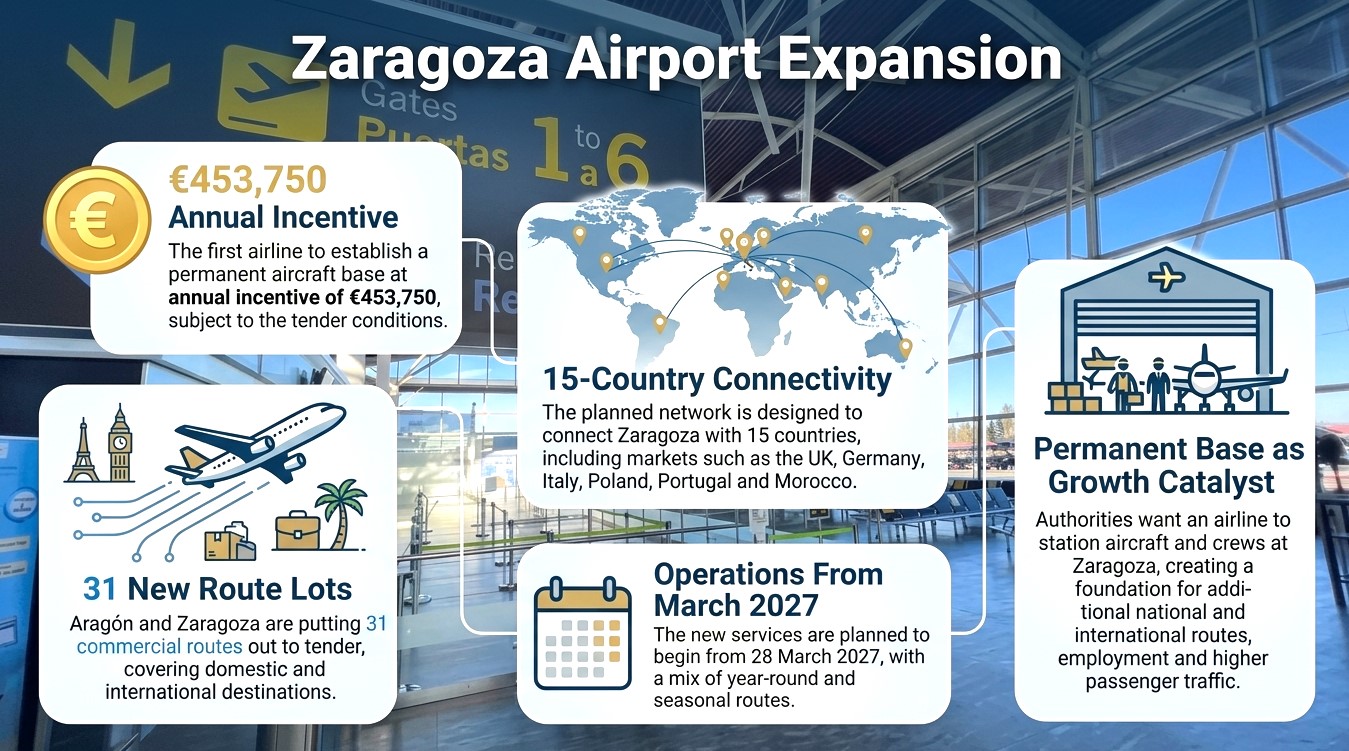
The wider connectivity programme represents an institutional investment of approximately €8.8 million. The tender is structured into 29 lots covering 31 routes, comprising seven domestic and 24 international connections. The programme is designed to expand Zaragoza's direct connectivity to 15 countries.
Among the international destinations planned are Manchester, Düsseldorf, Prague, Bratislava, Budapest, Warsaw, Kraków, Sofia, Pisa, Naples, Palermo, Porto and Tangier, together with a Swiss connection that could serve Basel, Zurich or Geneva.
Several domestic routes are also being introduced or restored, including Ibiza, Málaga, Alicante and Santiago de Compostela. Paris, Düsseldorf and Venice are among the previously served markets being recovered or strengthened.
The programme will not operate every route year-round. According to the published details, 13 of the 20 new services are planned to operate throughout the year, while others will be seasonal, primarily during the summer schedule. Operations are scheduled to begin on 28 March 2027, with ticket sales expected to start in late 2026 or early 2027.
A permanent base could have a different operational impact from simply adding individual routes. An airline stationing aircraft and crews at Zaragoza could support a larger schedule, earlier departures and later arrivals, improved aircraft utilisation and additional route development. It could also generate direct and indirect employment associated with flight operations, ground handling, maintenance, crew and airport services.
The strategy therefore seeks to use the initial network expansion as a platform for further growth. Zaragoza's authorities have explicitly linked the attraction of an airline base with the possibility of adding more national and international routes in the future.
The airport already has a significant aviation footprint beyond passenger traffic. Aena reports 707,000 passengers and 182.9 million kilograms of cargo in 2025, with Zaragoza ranking as the second-largest cargo airport in the Aena network by freight volume. Its location between Madrid, Barcelona and southern France also gives it strategic importance for logistics and aviation-related activity.
The authorities are targeting a substantial increase in passenger traffic as the new routes mature. Recent reporting indicates an ambition to reach around 1.3 million passengers annually, compared with roughly 707,000 passengers recorded by Aena in 2025.
For Zaragoza, the strategy is therefore broader than simply adding destinations. The combination of a significantly expanded route network, financial support for new services and an incentive for an airline base is intended to establish a more sustainable year-round commercial operation.
The next key milestone will be the publication of the tender documents and subsequent award of the route lots. The successful airlines are expected to begin operating the new services from March 2027, while the search for a carrier willing to establish a permanent base could determine whether Zaragoza's passenger network expands beyond the 31 routes included in the programme.