
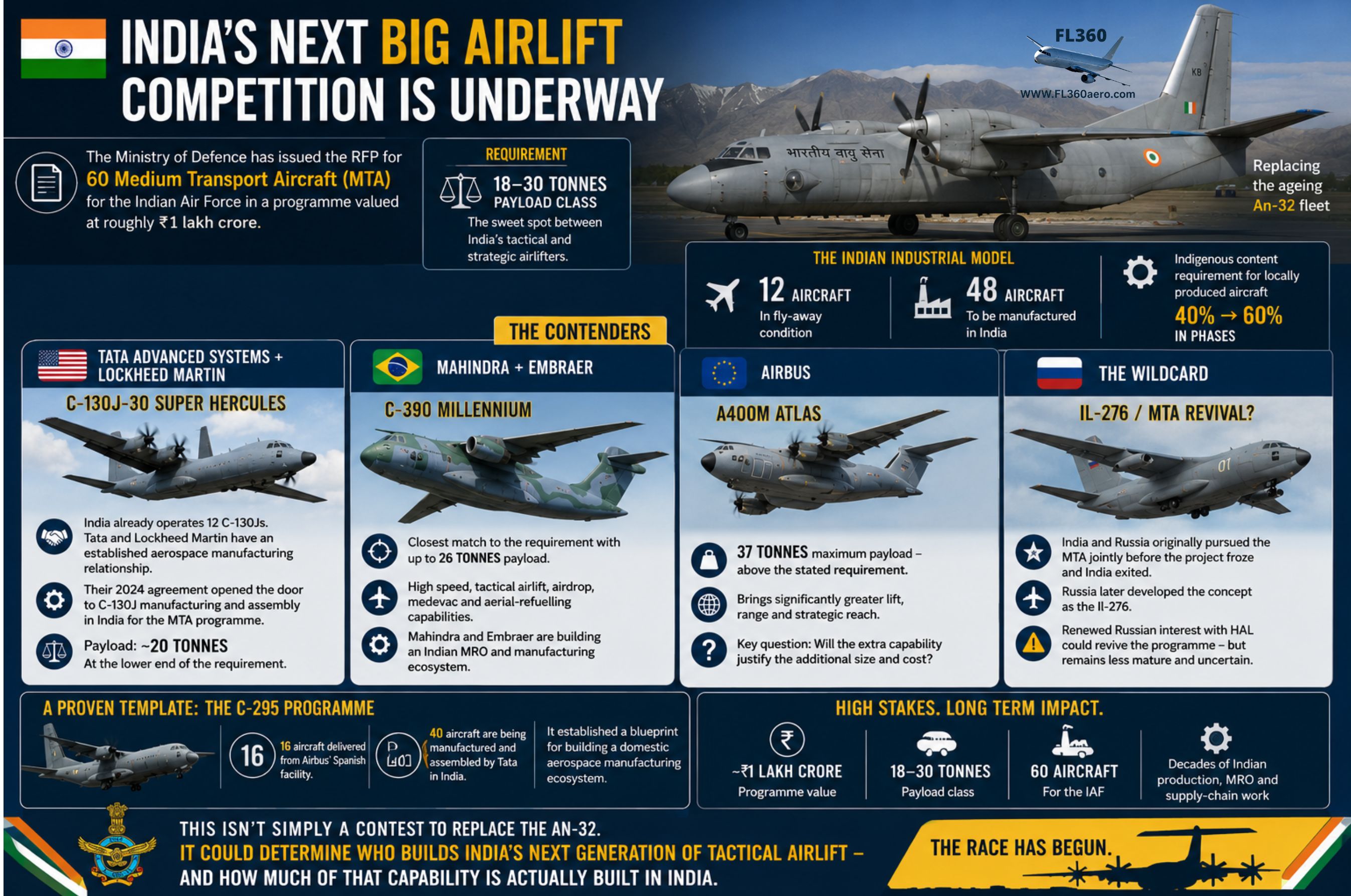
Major Procurement tender Launched: The Indian Ministry of Defence has formally issued a Request for Proposal (RFP) for 60 Medium Transport Aircraft (MTA) valued at roughly ₹1 lakh crore (~$11–12 billion) to replace the Indian Air Force’s aging Soviet-era An-32 fleet.
Bridging Strategic & Tactical Airlift Gaps: The program targets aircraft in the 18–30 tonne payload class, placing it directly between India’s light tactical transports (like the C-295) and heavy strategic airlifters (like the C-17 Globemaster).
Indigenization & Local Manufacturing Model: The acquisition follows a "Buy and Make" model where 12 aircraft will be delivered in fly-away condition, while the remaining 48 will be manufactured in India with domestic content planned to scale up to 60%.
Established Strategic Partnerships: Major contenders have established local joint ventures—including Tata Advanced Systems with Lockheed Martin offering the C-130J-30 Super Hercules (~20-tonne payload), and Mahindra with Embraer offering the C-390 Millennium (up to 26-tonne payload).
Heavier Competitors & Unfunded Alternatives: The competition also involves the 37-tonne Airbus A400M (which exceeds the core payload bracket), while a potential HAL/Il-276 Indo-Russian joint revival remains an unconfirmed, less mature option compared to the private-sector teams.
Building on the C-295 Template: Building on the precedent set by the Airbus-Tata C-295 manufacturing model, the ₹1 lakh crore MTA program serves as a foundational effort to permanently establish a domestic aerospace production, MRO, and supply-chain ecosystem in India.
India has finally moved from years of discussion to procurement on one of the Indian Air Force’s most important — and longest-delayed — transport programmes.
On 12 August 2026, the Ministry of Defence issued a Request for Proposal for 60 Medium Transport Aircraft (MTA) in a programme estimated at around ₹1 lakh crore (roughly US$10 billion). The principal objective is to replace the IAF’s ageing Soviet-origin An-32 fleet, while potentially taking over some missions currently performed by the much older Il-76s.
The programme is considerably more significant than the headline number suggests. It is simultaneously a fleet-replacement project, a tactical-airlift modernisation effort and potentially one of India's largest opportunities yet to establish sustained domestic production of a complex military aircraft.
And unlike many Indian defence competitions, the decisive question may not simply be which aircraft is best?
It may be which aircraft can best combine operational performance, industrialisation, technology transfer, lifecycle support and geopolitical reliability over several decades?
The An-32 has been one of the IAF's great workhorses.
India began receiving the type in 1984, and the aircraft became particularly valuable because of its ability to operate in India's demanding environment, including high-altitude areas and remote airfields in the Himalayas and Northeast. More than 100 remain associated with the IAF's transport fleet, according to recent reporting.
The aircraft has earned that reputation honestly. It is rugged, relatively simple and well suited to tactical logistics.
But the same fleet is now approaching the limits of what can reasonably be expected from a Cold War-era design.
India has already invested in extending the An-32's life. A major upgrade programme involving Ukraine included structural life extension, engine work, new avionics and other modifications. Even as recently as 2024, the IAF was looking at industrial support for the overhaul and potential life extension of dozens of aircraft.
That illustrates the central problem: life extension can buy time, but it cannot permanently solve an ageing fleet's structural, logistical and supply-chain challenges.
The new MTA is therefore not simply about buying a newer An-32.
It is about moving the IAF into a different generation of tactical airlift.
The MTA requirement occupies an interesting space in the IAF's transport fleet.
At one end are lighter tactical aircraft such as the C-295. At the other are heavy airlifters such as the C-17 and ageing Il-76 fleet.
The proposed MTA sits between them.
The requirement calls for an aircraft in the 18–30-tonne payload category, capable of operating from high-altitude and relatively austere locations, including unprepared or semi-prepared runways.
That combination is important for India.
A strategic airlifter is extremely capable, but expensive to operate and not always the optimum tool for moving smaller loads into forward locations.
A smaller tactical transporter is cheaper and more flexible, but eventually runs out of payload and cargo-volume capability.
The MTA is intended to be the workhorse in between.
That means missions could include:
The aircraft will therefore have to perform much more than a simple "cargo plane" role.
The MoD's model is particularly significant.
Of the 60 aircraft, 12 are planned to be supplied in fly-away condition, while 48 are to be manufactured in India. The programme falls under the broader "Buy and Make" approach.
The RFP also reportedly requires minimum indigenous content of 40% initially, rising to 60% in phases.
That changes the nature of the competition.
An overseas OEM cannot simply offer India an aircraft and expect to win on price and performance.
It has to explain:
For India, that could ultimately be worth more than the initial 60-aircraft order.
The most obvious advantage of the C-130J Super Hercules is that India already knows the aircraft.
The IAF operates 12 C-130Js, giving it an established training, maintenance, operational and logistical ecosystem.
Lockheed Martin and Tata Advanced Systems strengthened their relationship in September 2024 with an agreement covering potential C-130J manufacturing and assembly in India specifically for the MTA programme, as well as an Indian MRO facility supporting the existing Indian fleet and potentially other global C-130J operators.
That is a major advantage.
The C-130J is a known quantity to Indian crews.
The IAF already understands its:
And the aircraft has an important Indian pedigree beyond simple procurement: C-130Js have been used for demanding operations, including high-altitude tactical missions.
The C-130J sits close to the lower edge of the new requirement, with a payload around 19–21 tonnes depending on configuration and source.
That means the aircraft offers maturity and commonality — but potentially less growth margin than larger competitors.
The IAF must decide whether the value of an existing ecosystem outweighs the benefits of moving to a newer, larger platform.
The C-390 Millennium presents perhaps the most direct response to the upper end of the MTA requirement.
Embraer quotes a 26-tonne payload, a maximum speed of approximately 470 knots, and a broad mission set encompassing troop and cargo transport, airdrop, medevac, search and rescue, firefighting and humanitarian operations. It can also be configured for aerial refuelling.
That gives the C-390 a significant capability proposition.
It is a jet rather than a turboprop.
That matters.
Higher cruise speed can reduce transit time across India's enormous geography, while the aircraft's payload gives it greater flexibility for moving heavy loads.
And the C-390 has moved well beyond the prototype stage.
The type has entered operational service with Brazil and Portugal and has subsequently attracted orders from multiple air forces. Embraer says the operational fleet has accumulated substantial flight hours and achieved mission-completion rates above 99%, although such manufacturer figures should naturally be assessed alongside independent operational data.
More importantly for India, Mahindra and Embraer have progressively deepened their industrial relationship.
Their February 2024 MoU established cooperation around the MTA competition. In October 2025, the companies signed a Strategic Cooperation Agreement covering industrialisation, local manufacturing, assembly and supply-chain development.
Then, in February 2026, they announced plans to work toward establishing C-390 MRO capability in India if the aircraft is selected.
That is exactly the kind of industrial proposition the new procurement model appears designed to encourage.
The C-390's biggest advantage is also its challenge.
India would be introducing a new transport type.
There would be no existing IAF C-390 fleet to provide commonality.
That means new:
However, the industrial partnership with Mahindra is designed to address precisely this issue.
If India eventually manufactures a substantial portion of the aircraft locally, the C-390 could evolve from a foreign acquisition into an Indian-supported platform.
The question is how much of the promised industrial ecosystem is contractually guaranteed.
That distinction is crucial.
A promise to localise is not the same thing as a legally enforceable production and technology-transfer commitment.
The third major possibility is the Airbus A400M Atlas.
It is an extraordinary aircraft — but perhaps an awkward fit for this particular competition.
The A400M has a payload capability of roughly 37 tonnes, substantially above the 18–30-tonne requirement. That mismatch is reportedly one reason Airbus may not participate in the final competition.
The A400M's extra capacity is obviously valuable.
It can carry loads that neither the C-130J nor C-390 can comfortably match.
But more capability isn't automatically better.
A larger aircraft can mean:
The IAF already has heavy airlift capability through its C-17 fleet and Il-76s.
The question is therefore whether India needs more heavy-medium capability or a genuinely optimised medium transporter.
If the requirement remains tightly focused on 18–30 tonnes, the C-390 appears conceptually closer to the target than the A400M.
The most fascinating possibility is not a mature aircraft currently in widespread production.
It is an old programme that never reached production.
The Indo-Russian Multi-role Transport Aircraft (MTA) project dates back to the late 2000s. India and Russia had planned to jointly develop a medium transport aircraft, but the programme eventually stalled and India withdrew around 2015–16.
Russia subsequently continued development under the Il-276 concept.
Now, reports indicate that HAL and Russia have revived discussions around the concept, potentially bringing it back into the MTA conversation. ThePrint reports that HAL has tied up with Russia following efforts to revive the earlier collaboration.
This deserves attention — but also caution.
The Il-276 should not be presented as equivalent in programme maturity to the C-130J or C-390.
It isn't.
The C-130J is a mature production aircraft with an established global fleet.
The C-390 is a modern aircraft already in operational service with multiple air forces.
The Il-276/MTA represents a revived development path.
That creates potentially enormous upside for HAL — but also enormous risk.
Conceptually, yes.
If India were to revive the programme as a genuinely joint development effort, it could offer something no imported aircraft can provide:
the opportunity to shape the aircraft around Indian requirements from the beginning.
India could potentially influence:
And HAL would gain experience in an area where India still lacks an indigenous production aircraft: the medium military transport category.
But there is a fundamental problem.
Aircraft development takes time.
India does not need a transport aircraft merely because it is desirable on paper. It needs an aircraft that can actually enter squadron service on a predictable schedule.
A revived Il-276 programme would therefore have to answer the hardest question:
Can Russia and HAL deliver a production-ready aircraft faster, cheaper and with lower risk than an already-operational Western or Brazilian platform?
That is a very high bar.
The Russian option also comes with a strategic complication.
India has decades of experience operating Russian aircraft, and the IAF possesses an enormous Russian-origin support ecosystem.
But today's Russia is not the same procurement environment as the Soviet Union of the 1980s and 1990s.
Sanctions, export controls, supply-chain disruption and wartime industrial priorities have changed the risk equation.
For a programme expected to remain in service for 30–40 years, India would have to consider not merely whether the aircraft can be delivered, but whether:
engines, avionics, spares, upgrades and technical support can reliably be supplied throughout its life.
That makes lifecycle sovereignty potentially more important than the initial acquisition price.
Perhaps the most important development preceding the MTA competition is not the C-130J or C-390.
It is the C-295 programme.
In 2021, India ordered 56 C-295s from Airbus.
The arrangement was deliberately structured around industrialisation:
The project has since moved into physical production infrastructure.
Airbus and Tata inaugurated the C-295 final assembly line at Vadodara in October 2024. Airbus says the programme involves manufacturing detail parts, subassemblies and major components in India, with more than 13,000 detail parts and a growing Indian supplier network.
This is strategically significant.
India is effectively learning how to manufacture a complete modern transport aircraft domestically with a foreign OEM.
The MTA programme could take that model to the next level.
The C-295 is smaller than the proposed MTA, but it has established the industrial precedent.
Tata is now involved in two different transport-aircraft propositions.
First, it is already building the C-295 with Airbus.
Second, it has a C-130J industrial relationship with Lockheed Martin.
That gives Tata something its competitors cannot easily reproduce overnight:
existing aircraft manufacturing infrastructure and experience inside India's private aerospace sector.
For the MTA programme, that could translate into a shorter industrialisation learning curve.
But it also creates an interesting strategic question:
Would India want to concentrate multiple transport aircraft programmes with one private industrial group?
Or would the government deliberately distribute major aerospace programmes among Tata, Mahindra, HAL and potentially Adani to create multiple competing industrial centres?
The answer will have consequences far beyond this tender.
Looking only at maximum payload would be a mistake.
The aircraft should be evaluated across at least eight dimensions.
The C-390's 26 tonnes gives it a comfortable position inside the requirement.
The C-130J sits closer to the lower boundary.
The A400M offers considerably more capacity than required.
A revived Il-276 would have to demonstrate its actual production configuration rather than rely on historical specifications.
This could be one of the most important differentiators.
India's transport fleet has to operate in places where aircraft performance deteriorates dramatically with altitude, temperature and runway limitations.
The aircraft that performs best with meaningful payload at high-altitude airfields may be more valuable to the IAF than the aircraft with the best brochure range.
This is another area where the competition becomes interesting.
India's Advanced Landing Grounds and forward operating locations impose requirements that are not necessarily central to every foreign operator's mission profile.
The MTA is expected to support operations from difficult locations, including in Ladakh and the Northeast.
Payload isn't everything.
An aircraft capable of carrying 26 tonnes may still be less useful than another aircraft if its cargo compartment cannot accommodate the required vehicles, pallets or equipment.
The IAF should therefore evaluate volume, floor dimensions, ramp geometry and loading equipment as carefully as maximum payload.
This is where the C-390 has a strong proposition.
A jet transporter can move troops and supplies rapidly over India's enormous distances.
In a crisis, reducing transit time can be operationally valuable.
The C-130J has an enormous advantage here because India already operates the type.
But commonality also has a cost: buying a platform simply because you already operate it may lock the IAF into a capability ceiling that a newer design could exceed.
The best aircraft is not the one that looks best in the brochure.
It is the aircraft that is available when the IAF needs it.
India should therefore place enormous emphasis on:
The MTA selected today may still be flying in the 2050s and 2060s.
That makes growth capacity essential.
Future versions could potentially perform:
An aircraft that is near its structural and payload limits on day one may become a constraint later.
The MTA programme could become one of India's first truly large-scale attempts to establish sustained production of a complex military transport aircraft.
That distinction matters.
Producing 48 aircraft under licence is one thing.
Building a domestic ecosystem capable of producing thousands of complex aerospace components repeatedly to aviation standards is something else.
The C-295 programme has already demonstrated part of this model. Airbus says the Indian project involves more than 13,000 detail parts and a network of Indian suppliers, alongside the Vadodara final assembly line.
The MTA programme could expand that ecosystem.
The winning bid should therefore be judged on how much of the following can realistically move to India:
structures → composites → wiring → avionics integration → landing gear components → hydraulic systems → flight-control components → software → testing → MRO → engine support.
That is how a procurement programme becomes an aerospace industry.
India has been here before.
The MTA itself is an example of how a promising programme can remain frozen for years.
The 2022 RFI reportedly sought responses for up to 80 aircraft, with Airbus, Lockheed Martin and Embraer responding. The eventual programme has now settled at 60 aircraft.
The danger is that the procurement becomes trapped in another cycle of:
RFI → RFP → technical evaluation → trials → commercial negotiations → revised requirements → approvals → rebid.
Every additional year of delay means another year of operating an ageing fleet.
The MoD therefore needs to maintain a disciplined acquisition schedule.
There is no obvious winner.
But the competitors have different strengths.
| Candidate | Major advantage | Major question |
|---|---|---|
| C-130J + Tata | Existing IAF fleet, mature platform, established Indian partnership | Is its payload/growth margin enough? |
| C-390 + Mahindra | 26-tonne payload, modern jet, strong multirole capability | New IAF ecosystem and transition costs |
| A400M | Exceptional payload and range | Potentially oversized for the requirement |
| Il-276 + HAL/Russia | Potentially highest sovereignty/development opportunity | Programme maturity, schedule and geopolitical risk |
On pure capability-to-requirement fit, the C-390 is particularly compelling.
On risk reduction and commonality, the C-130J has an obvious advantage.
On maximum capability, the A400M is in another league — but perhaps beyond what the requirement actually demands.
And on long-term indigenous development, the Il-276 could theoretically offer the biggest prize, while simultaneously presenting the biggest programme risk.
There is a temptation to view the competition as simply:
Tata vs Mahindra vs HAL.
That misses the bigger picture.
India is attempting to move from being primarily an aircraft operator and assembler toward becoming an aircraft manufacturer and lifecycle-support nation.
The progression is already visible:
C-17 / C-130J → C-295 → MTA → future indigenous aircraft.
The C-295 programme has shown that a foreign-designed aircraft can anchor a domestic final-assembly and component ecosystem.
The MTA programme could now demonstrate whether India can sustain production of a substantially larger and more complex military transport aircraft.
And that experience could eventually feed India's own indigenous transport ambitions.
The ₹1 lakh-crore MTA competition is arguably one of the most consequential Indian military-aircraft competitions of the decade.
The IAF needs a replacement for a fleet that entered service in the 1980s.
But the government is simultaneously trying to create something that did not exist at this scale before: a competitive Indian industrial base capable of producing and sustaining modern military transports.
But the final decision should not be driven by headline specifications alone.
The winning aircraft should be the one that can carry the required load from India's most difficult airfields, remain available in wartime, be sustained domestically, grow technologically over decades and generate genuine Indian aerospace capability rather than merely Indian assembly.
If India gets that formula right, the MTA programme could become much more than an An-32 replacement.
It could become the industrial foundation for India's next generation of military airlift.
And for a country that must simultaneously sustain forces across the Himalayas, the Indian Ocean and two very different strategic fronts, that may ultimately be the most important capability delivered by this ₹1 lakh-crore programme.

.jpg)