
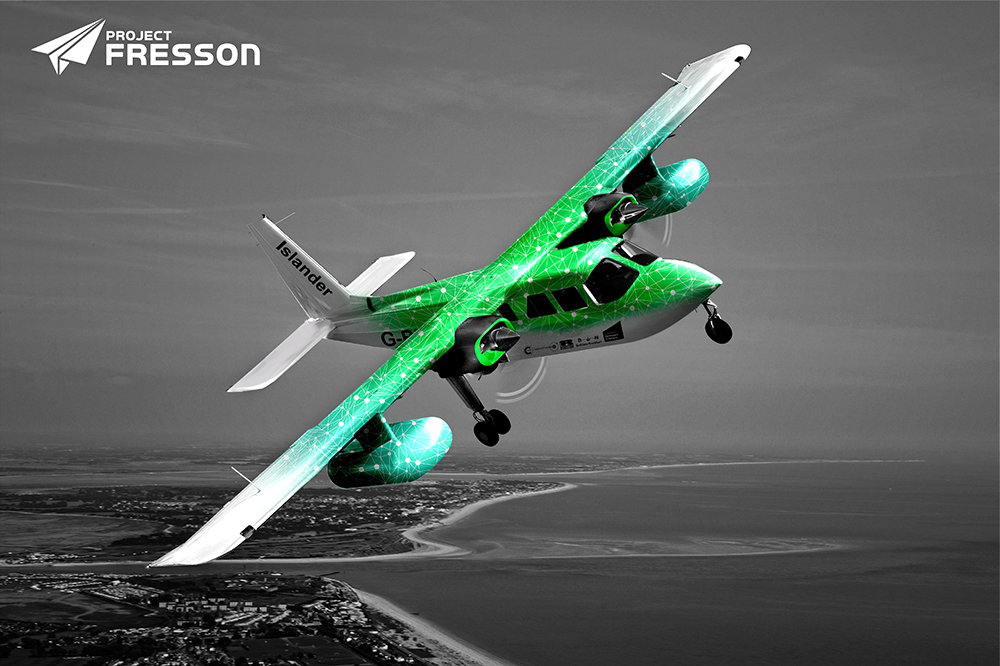
UK aerospace company Cranfield Aerospace Solutions has abandoned its ambition to develop a zero-emission passenger aircraft through Project FRESSON, ending plans to convert a nine-passenger Britten-Norman Islander into a hydrogen-electric aircraft. The company is redirecting its hydrogen propulsion expertise towards STINGRAY, a family of unmanned aerial vehicles (UAVs) targeting commercial and defence markets.
Cranfield Aerospace Solutions has formally shifted its strategic direction away from hydrogen-electric passenger aviation, according to its latest financial accounts filed with the UK's Companies House on November 11, 2026.
In its directors' report covering the financial year ended September 29, 2025, the company explicitly confirmed that it had been "pivoting the strategy away from Project FRESSON and the zero emission passenger flight objective."
The decision represents a significant change for one of the UK's prominent hydrogen-electric aviation development programmes, which had sought to demonstrate the feasibility of hydrogen fuel-cell propulsion in regional passenger operations.
Project FRESSON was established to develop a hydrogen-electric propulsion system for the nine-passenger Britten-Norman Islander, a twin-engine aircraft widely used for regional transport, island connectivity and short-distance operations.
The programme aimed to replace the aircraft's conventional propulsion system with an electric propulsion architecture powered by hydrogen fuel cells.
The concept was intended to demonstrate how hydrogen could support zero-emission regional passenger flights, particularly on shorter routes where smaller aircraft play an important role in maintaining connectivity.
However, the latest corporate accounts make clear that the company is no longer pursuing the original zero-emission passenger flight objective.
Consequently, the planned hydrogen-electric conversion of the nine-passenger Britten-Norman Islander will no longer form part of Cranfield Aerospace's development strategy.
Instead of continuing with passenger aircraft development, Cranfield Aerospace is concentrating its efforts on STINGRAY, a family of hydrogen-electric unmanned aerial vehicles designed for commercial and defence applications.
The programme reflects a strategic move towards aircraft applications where hydrogen propulsion could offer operational advantages through extended endurance, increased range and reduced dependence on conventional aviation fuels.
The company intends to leverage its experience in hydrogen fuel-cell systems, electric propulsion and aircraft integration to develop platforms capable of addressing emerging requirements in the unmanned aviation sector.
This transition also allows Cranfield to pursue potential commercial opportunities beyond conventional passenger aviation, including specialist aerial operations and defence-related applications.
Although Project FRESSON's passenger aircraft objective has been abandoned, Cranfield is not withdrawing from hydrogen-electric propulsion development.
The engineering knowledge and technology developed through the programme, including its GENESIS modular hydrogen-electric powertrain, remain relevant to the company's revised strategy.
The decision therefore represents a change in the intended application of the technology rather than a complete abandonment of hydrogen aviation research.
The company's latest accounts also provide insight into its financial position during the strategic transition.
For the financial year ended September 29, 2025, Cranfield Aerospace reported:
|
Financial indicator |
2025 |
2024 |
|---|---|---|
|
Revenue |
£6.926 million |
£1.934 million |
|
Net loss |
£4.547 million |
£4.341 million |
The company also disclosed receiving £3.5 million through convertible loan notes to support research and development, restructuring and business expansion.
The increase in revenue should be considered in the context of the company's wider business activities, including its AXSIM motorsport simulator operations, rather than being interpreted as evidence of commercial success for Project FRESSON.
Cranfield Aerospace's strategic reversal highlights the considerable challenges involved in bringing hydrogen-electric passenger aircraft into commercial service.
Hydrogen propulsion has attracted significant attention as a potential pathway towards reducing aviation emissions. However, the technology faces substantial engineering and commercial obstacles, including fuel storage, aircraft integration, infrastructure requirements, certification and the economics of operating hydrogen-powered aircraft.
For smaller regional aircraft, these challenges are particularly important because available payload, range and operating economics directly influence commercial viability.
Cranfield's decision does not mean hydrogen-powered passenger aviation is no longer achievable. Rather, it demonstrates that translating promising propulsion technology into a commercially viable passenger aircraft remains a difficult undertaking.
The broader significance is that Cranfield Aerospace is changing where it believes hydrogen propulsion can deliver commercial value first: moving away from a nine-passenger hydrogen-electric Islander towards a new generation of unmanned aircraft.
For the UK aerospace industry, the end of Project FRESSON's passenger aircraft ambitions marks a notable setback. However, the company's continued investment in hydrogen-electric UAV development means its work on alternative aviation propulsion is far from over.
Sources
UK Companies House – Cranfield Aerospace Solutions filing history
Cranfield Aerospace Solutions – Project FRESSON, STINGRAY and GENESIS programme information.
UK Civil Aviation Authority – Hydrogen aviation research and demonstration activities.
FL360aero note: The strategic withdrawal from Project FRESSON is confirmed by the directors' statement. It should not be interpreted as the cancellation of all Cranfield hydrogen-electric development activities or as proof that the STINGRAY programme has already entered commercial service.
Visuals Credit: Cranfield Aerospace

.jpeg)