
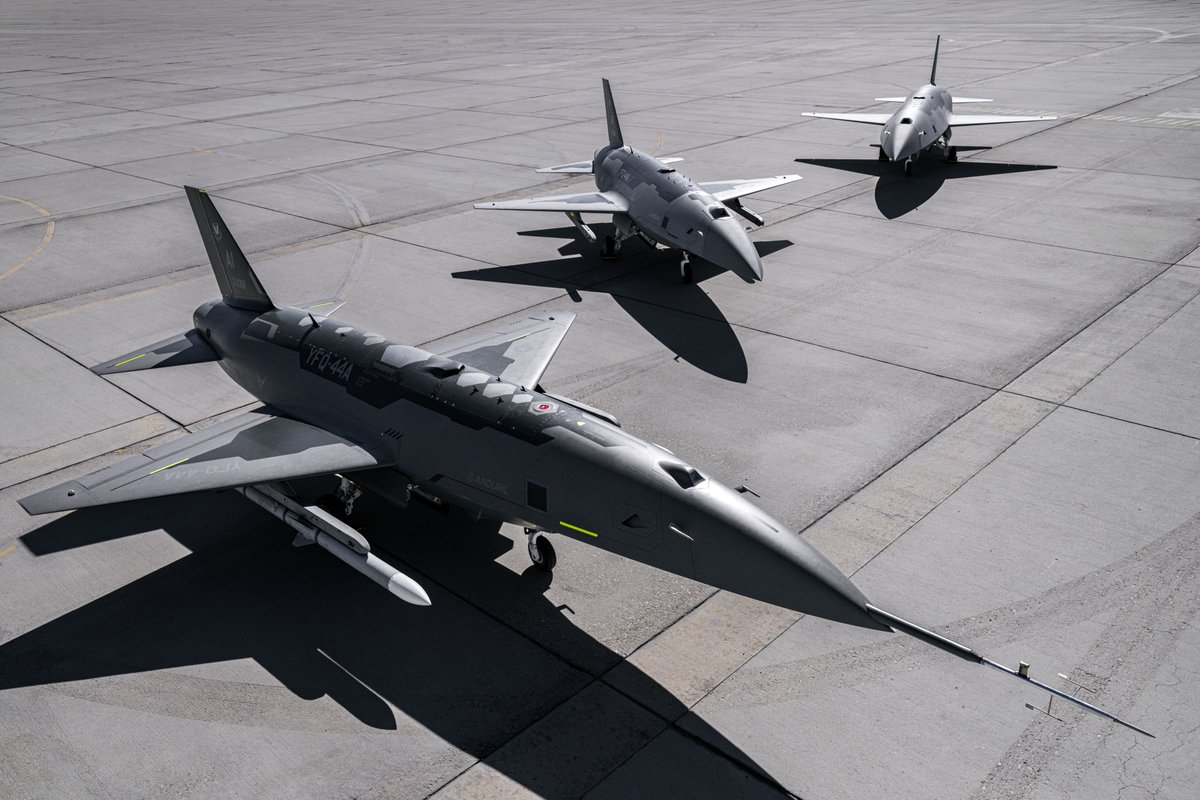
Anduril won a U.S. Air Force production-related contract for its FQ-44 autonomous fighter jet on June 17, putting the Costa Mesa defense company inside one of the Pentagon's most consequential airpower programs and forcing its venture-backed manufacturing thesis into a federal procurement test.
A new era of airpower focused on autonomy and affordable mass is moving into mass production: today, the Air Force selected Anduril for the production phase of the Collaborative Combat Aircraft (CCA) program.
Under the contract, Anduril will deliver an initial set of production FQ-44 semi-autonomous fighter aircraft to support continued testing, validation, and, ultimately, operational fielding.
The contract also establishes a structure for the U.S. Air Force to buy additional lots of production FQ-44 aircraft across the next several years, providing a clear path for the Air Force to rapidly and affordably expand fighter capacity.
The award is part of the Air Force's Collaborative Combat Aircraft Increment 1 downselect. In the Air Force announcement, General Atomics' FQ-42 and Anduril's FQ-44 received engineering and manufacturing development and production contracts.
The Air Force’s decision marks the first time that a new company has won a fighter aircraft program since the 1970s. The same announcement put Anduril into the mission-autonomy software pool, alongside General Atomics, Lockheed Martin, Northrop Grumman, RTX Collins Aerospace and Shield AI.
That second award matters because the Air Force is not buying these aircraft like a conventional fighter program. It is separating the airframe from the autonomy software, treating mission autonomy as a layer that is competed and fielded separately from the vehicle.
The U.S. Air Force's most important procurement decision may not be picking Anduril and General Atomics. It may be refusing to let either company own the entire CCA stack.
For Anduril, the result is a two-front opening: FQ-44 is one of two aircraft selected for Increment 1 production, while Anduril's software team remains in the competition to provide the brains that will fly the broader CCA fleet.
The CCA program is America’s answer to that intractable problem: by rapidly designing, developing, testing, and fielding large numbers of affordable, mass-producible semi-autonomous fighter aircraft, the program will enable America to rapidly regain airborne combat mass on an operationally relevant timeline.
The CCA award is the Pentagon asking whether the same software-first, autonomy-heavy approach can move from border towers and tactical systems into combat aircraft production.
In its current configuration, FQ-44 has the ferry range necessary to deploy anywhere in the world. It can takeoff and land on a short field. It has a combat radius that significantly exceeds the combat radius for current crewed fighters, and the speed to keep up.
It has the payload capacity required to make a real impact on the battlefield. And, across hundreds of hours with Air Force experts and thousands of simulations, we have demonstrated that FQ-44 will do more than just survive the high-end fight: it will excel.
Anduril's founders built the company against the idea that defense innovation had to move at prime-contractor speed. Schimpf, Luckey, Stephens, Matt Grimm and Joseph Chen started Anduril in 2017 with a thesis that software, autonomy and faster hardware iteration could win inside national-security procurement.

.jpg)