
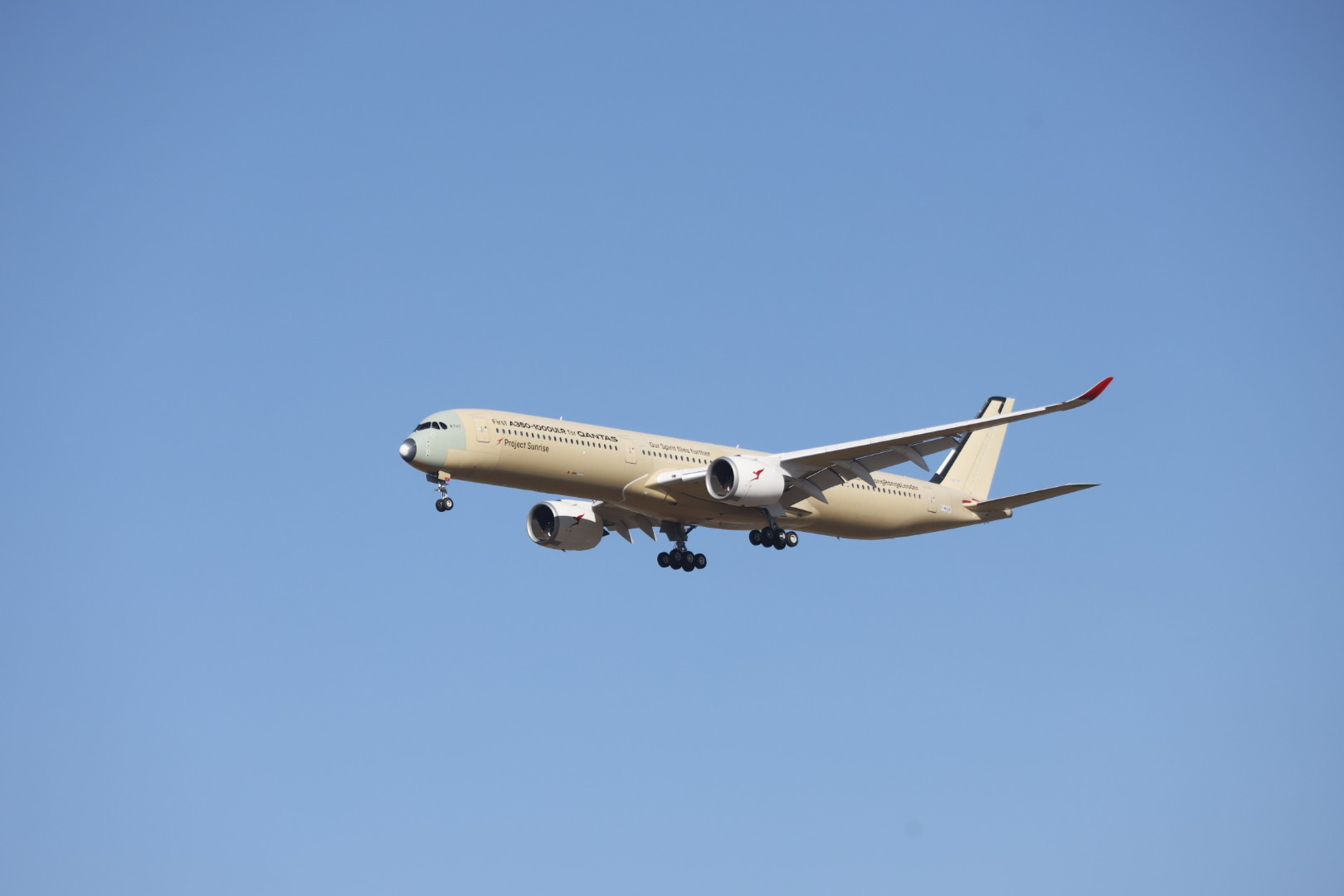
Aviation history was made when the Airbus A350-1000ULR, developed for Qantas' ambitious Project Sunrise, landed in Toulouse after completing a remarkable 24-hour and 24-minute nonstop flight from Melbourne, Australia.
Covering an impressive 23,075 kilometers (14,338 miles), the flight demonstrated the aircraft's capability to redefine long-haul travel and move the airline industry closer to a future where passengers can fly between distant continents without a single stop.
More than just a record-breaking journey, the mission served as a critical certification and endurance test for one of the world's most advanced commercial aircraft.
Spending 24 hours and 24 minutes continuously in the air is an extraordinary feat. The aircraft remained airborne for longer than an entire day while crossing multiple time zones and continents, maintaining an average ground speed of approximately 946 km/h (588 mph).
Although Project Sunrise's commercial routes are expected to last between 19 and 22 hours, Airbus deliberately pushed the aircraft beyond its planned operational profile to validate its systems under extreme conditions.
At the heart of this achievement is the specially modified Airbus A350-1000ULR (Ultra Long Range). Unlike the standard A350-1000, the Project Sunrise variant incorporates significant engineering enhancements designed specifically for ultra-long-haul operations.
Among its most notable modifications is an additional 20,000-liter rear center fuel tank, increasing the aircraft's total fuel capacity to approximately 189,000 liters. Combined with optimized fuel management systems and aerodynamic refinements, these upgrades extend the aircraft's range by nearly 1,850 kilometers (1,000 nautical miles) beyond the standard model.
Powered by Rolls-Royce Trent XWB-97 engines—already recognized among the world's most fuel-efficient large turbofan engines—the aircraft demonstrates how modern engineering can achieve greater range without compromising efficiency.
| Metric | Value |
|---|---|
| Route | Melbourne → Toulouse |
| Flight time | 24 hours 24 minutes |
| Distance flown | 23,075 km (14,338 miles) |
| Aircraft | Airbus A350-1000ULR (Ultra Long Range) |
| Purpose | Flight certification and endurance testing |
| Status | Successful landing in Toulouse, France |
The flight exceeded the endurance of most commercial airline operations and was longer than the planned commercial Project Sunrise routes, which are expected to last 19–22 hours.
Using the published distance:
Average ground speed: ≈ 946 km/h (588 mph)
This is typical for a modern wide-body jet cruising between Mach 0.84–0.86, with winds affecting the ground speed.
Flying more than 23,000 kilometers naturally requires enormous quantities of fuel. While Airbus has not released official fuel consumption figures for this certification flight, industry estimates suggest the aircraft burned between 141 and 159 metric tonnes of Jet A-1 fuel, equivalent to approximately 176,000 to 199,000 liters over the course of the journey.
This translates to an average fuel burn of roughly 5.8 to 6.5 tonnes per hour, an impressive figure considering the aircraft's size and payload.
Perhaps more striking is the aircraft's passenger efficiency. In its planned 238-seat Project Sunrise configuration, fuel consumption works out to approximately 0.8 to 1.0 liters per passenger per 100 kilometers—comparable to, and in some cases better than, the fuel efficiency of many modern passenger cars carrying a single occupant.
The Project Sunrise A350-1000ULR includes:
This extra fuel extends the aircraft's range by about 1,000 nautical miles (≈1,850 km) over the standard A350-1000.
Airbus has not released the actual fuel burn for this certification flight.
Using typical A350-1000 cruise performance:
Average cruise burn: 5.8–6.5 tonnes/hour
For 24.4 hours: ≈141–159 tonnes of Jet A-1
Since Jet A-1 weighs roughly 0.8 kg/L, that corresponds to approximately: ≈176,000–199,000 liters consumed.
This aligns with the aircraft's enlarged fuel capacity and the need to retain reserve fuel.
Despite the huge fuel load, the A350 remains remarkably efficient.
Estimated:
That is comparable to—or better than—many modern family cars carrying a single occupant.
Every ultra-long-haul flight raises questions about environmental impact. Based on estimated fuel usage, the aircraft likely produced between 445 and 500 metric tonnes of carbon dioxide during the flight, with jet fuel generating approximately 3.16 kilograms of CO₂ for every kilogram burned.
While the total emissions are significant, aviation experts point out that nonstop flights can eliminate an entire takeoff and landing cycle associated with connecting flights, reducing fuel burn and emissions compared with equivalent one-stop itineraries. Future adoption of Sustainable Aviation Fuel (SAF) is also expected to further lower the environmental footprint of Project Sunrise operations.
Burning 1 kg of jet fuel produces approximately 3.16 kg of CO₂.
Estimated emissions:
Fuel burned: ≈150 tonnes
CO₂ produced: ≈475 tonnes
Per passenger (238-seat layout): ≈2 tonnes of CO₂ for the full journey.
Actual test-flight emissions differ because the aircraft carried flight-test equipment rather than a normal passenger load.
Project Sunrise aims to eliminate stopovers on routes that historically required one or two connections.
Examples include:
Benefits include:
Flying for more than twenty hours is not solely an engineering challenge; it is equally a human one.
To ensure passenger wellbeing, the Project Sunrise cabin introduces several innovations specifically designed for ultra-long journeys. These include:
These enhancements are supported by years of medical and operational research conducted jointly by Qantas, aviation specialists, and sleep scientists.
For flight crews, such missions require carefully planned rotations, multiple pilots operating in shifts, augmented cabin crews, and continuous fatigue management throughout the journey.
A 20+ hour flight is as much a human-factors challenge as an engineering one. Planned features include:
Flights of this duration require:
During the historic flight, engineers monitored thousands of aircraft parameters in real time. The aircraft is equipped with more than 1,000 sensors, collecting detailed information on engine performance, structural loads, fuel systems, cabin conditions, and avionics.
The data gathered during this mission will support certification efforts and help optimize future commercial operations.
The A350-1000ULR incorporates several changes over the standard A350-1000:
| Metric | Approximate value |
|---|---|
| Flight duration | 24 h 24 min |
| Distance | 23,075 km |
| Average speed | 946 km/h |
| Fuel capacity | 189,000 L |
| Estimated fuel burned | 176,000–199,000 L |
| Estimated fuel mass | 141–159 tonnes |
| Estimated CO₂ emitted | 445–500 tonnes |
| Planned commercial endurance | Up to 22 hours |
| Target routes | Sydney–London, Sydney–New York |
The Airbus A350-1000ULR's successful 24-hour and 24-minute nonstop flight is more than a demonstration of endurance—it is proof of how far commercial aviation has evolved.
Advancements in aerodynamics, lightweight composite materials, fuel-efficient engines, intelligent flight management systems, and passenger-focused cabin design have enabled an aircraft to remain airborne for an entire day while maintaining exceptional levels of safety and efficiency.
As Project Sunrise moves closer to commercial service, this historic mission represents not just another aviation milestone but the beginning of a new era in global connectivity. For passengers, it promises shorter journeys and unprecedented convenience. For the aviation industry, it showcases what is possible when engineering innovation, operational excellence, and ambitious vision come together.
The age of true nonstop global travel is no longer a distant dream—it is preparing for takeoff.
Picture Courtesy: Airbus.
You may like to read.........

.jpg)