
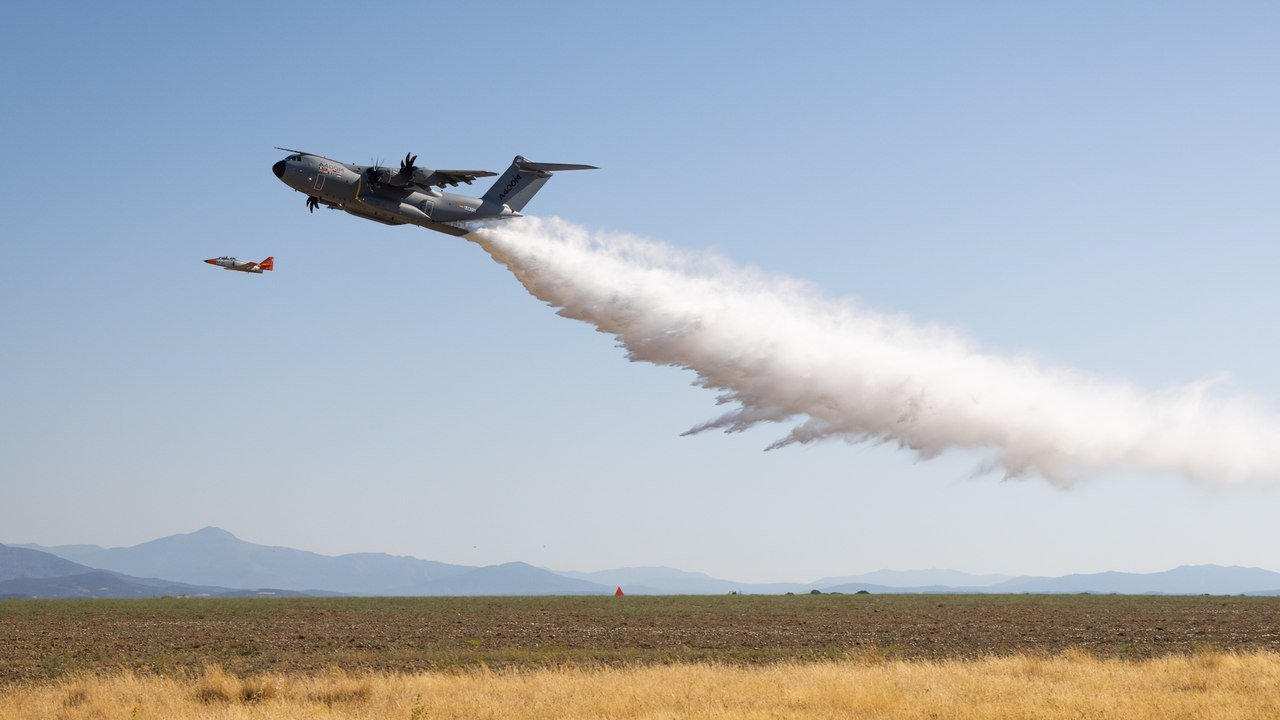
As France battles one of its most challenging wildfire seasons in recent years, the government is introducing an innovative aerial firefighting capability.
Beginning July 29, an Airbus A400M Atlas military transport aircraft equipped with a high-capacity firefighting kit will join operations, providing a significant boost to the country's existing fleet of aerial firefighting assets.
The decision comes as 32 major wildfires continue to burn across France, with nearly 50,000 hectares of land already destroyed amid prolonged heatwaves and severe drought conditions.
Interior Minister Laurent Nuñez announced that the French Armed Forces' A400M Atlas has been converted into an aerial firefighting platform to help address the growing demand for firefighting aircraft.
Government spokesperson Maud Bregeon confirmed that the aircraft and its firefighting equipment will become operational on July 29, following the completion of aircraft modifications and pilot training.
Rather than replacing France's dedicated firefighting fleet, the A400M will serve as a complementary asset, particularly for preventive fire-retardant operations aimed at slowing the spread of rapidly advancing wildfires.
Originally introduced into military service in 2013, the Airbus A400M is a four-engine tactical and strategic airlifter capable of transporting troops, helicopters, armored vehicles, and heavy cargo over long distances.
For firefighting operations, Airbus has developed a roll-on/roll-off Firefighter Kit that can be installed directly inside the aircraft's cargo hold without requiring permanent structural modifications.
The system carries:
Unlike purpose-built water bombers that scoop water directly from lakes or the sea, the A400M's tanks are filled on the ground using standard pumping equipment. Airbus says the aircraft can be refilled in less than 10 minutes, allowing for rapid turnaround during sustained firefighting operations.
One of the A400M's greatest advantages is its operational flexibility. According to Airbus, the aircraft can:
Since the firefighting kit requires no permanent aircraft modifications, any A400M within a military fleet can potentially be adapted for emergency wildfire response.
French officials emphasize that the A400M is not intended to replace Canadair water bombers.
Instead, it will work alongside existing firefighting aircraft by performing long-line retardant drops ahead of advancing fire fronts.
Jean-Brice Dumont, Airbus' Head of Military Air Systems, explained that while Canadairs remain the preferred aircraft for direct attacks on active flames—thanks to their amphibious scooping capability—the A400M excels at creating protective fire-retardant barriers around vulnerable communities and infrastructure.
Because the aircraft releases its payload in a long trailing pattern rather than a concentrated drop, it is particularly effective across wide, relatively flat terrain.
Flying an aircraft as large as the A400M at very low altitude over wildfire zones presents significant challenges.
General Jérôme Bellanger, Chief of Staff of the French Air and Space Force, acknowledged that these missions require highly specialized pilot training.
Low-level flying through smoke, turbulence, mountainous terrain, and changing wind conditions demands skills that only a limited number of military crews possess.
As a result, pilot qualification has become one of the final steps before the aircraft enters operational service.
France currently operates 12 Canadair water bombers, many of which have an average service age approaching 30 years. At the same time, climate change has expanded both the frequency and geographic extent of major wildfires across southern Europe, placing increasing pressure on existing aerial firefighting resources.
The deployment of the A400M represents an important step toward strengthening national firefighting capacity while longer-term fleet modernization continues.
The decision follows several months of testing conducted jointly by the French Ministries of the Interior and Armed Forces in partnership with Airbus.
After successful evaluation of the modular firefighting kit, France signed an agreement with Airbus on July 17 to move the system toward operational use.
Government officials have confirmed that the first operational deployment will begin on July 29, with the aircraft joining firefighting efforts wherever additional aerial support is required.
France is not the first country to explore the A400M's firefighting potential. Spain has already demonstrated similar capabilities as Mediterranean nations search for new ways to combat increasingly destructive wildfire seasons.
As climate-driven extreme weather continues to intensify across Europe, the Airbus A400M could become a valuable force multiplier—combining military versatility with civilian emergency response. While it cannot replace specialized water bombers like the Canadair, its massive payload, rapid conversion capability, and ability to establish extensive fire-retardant barriers make it a powerful new addition to France's aerial firefighting arsenal.
With a 20-tonne drop capacity—equivalent to three Canadair aircraft—the A400M represents a significant enhancement to France's wildfire response strategy, providing critical support during one of the country's most severe fire seasons in recent memory.
Related article.......

.jpg)