
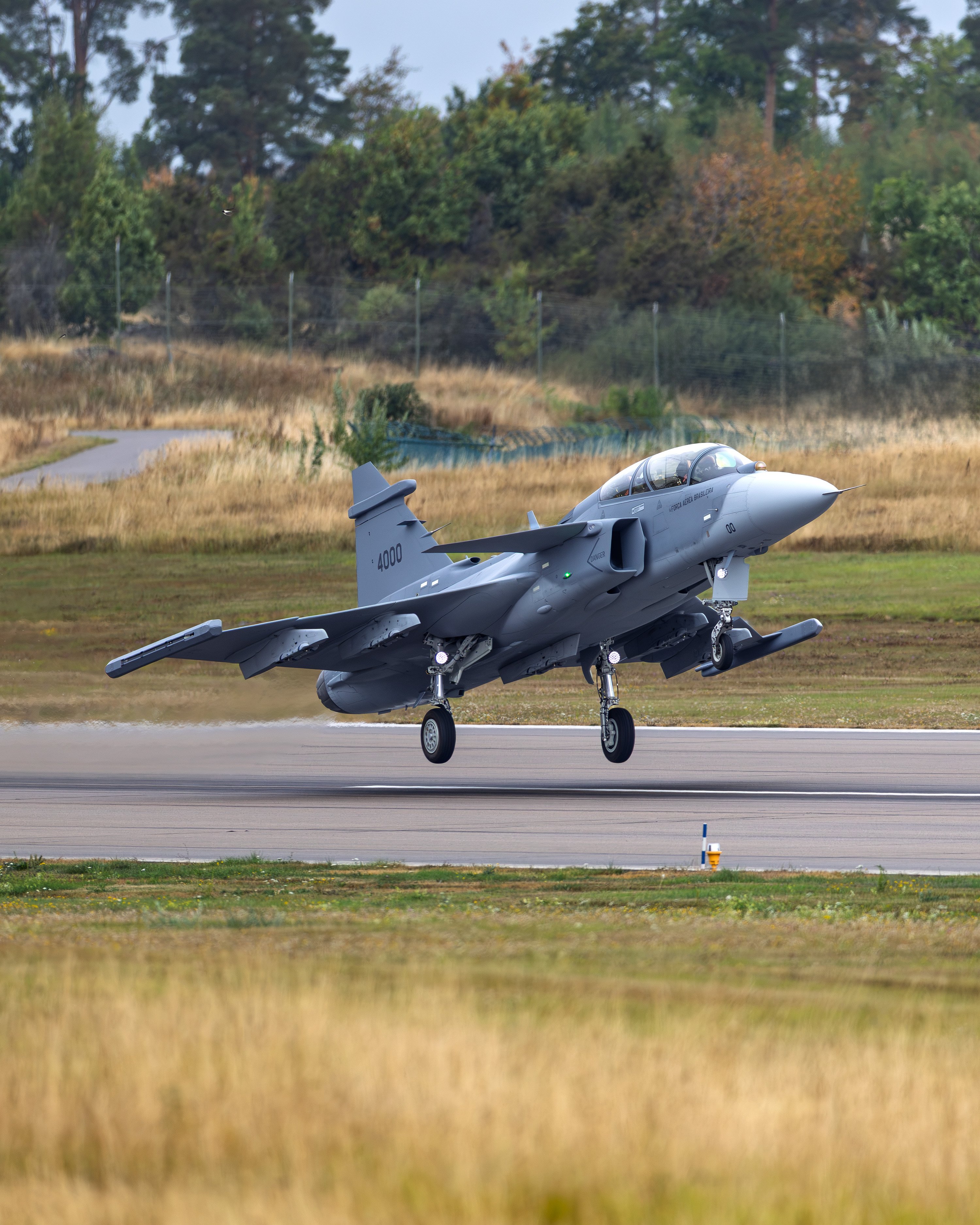
Saab has successfully completed the first flight of the Gripen F, the two-seat variant of the Gripen E developed through the long-running industrial partnership between Sweden and Brazil. The milestone took place on 28 August 2026 at Saab’s airfield in Linköping, Sweden, marking the beginning of the aircraft’s airborne test campaign.
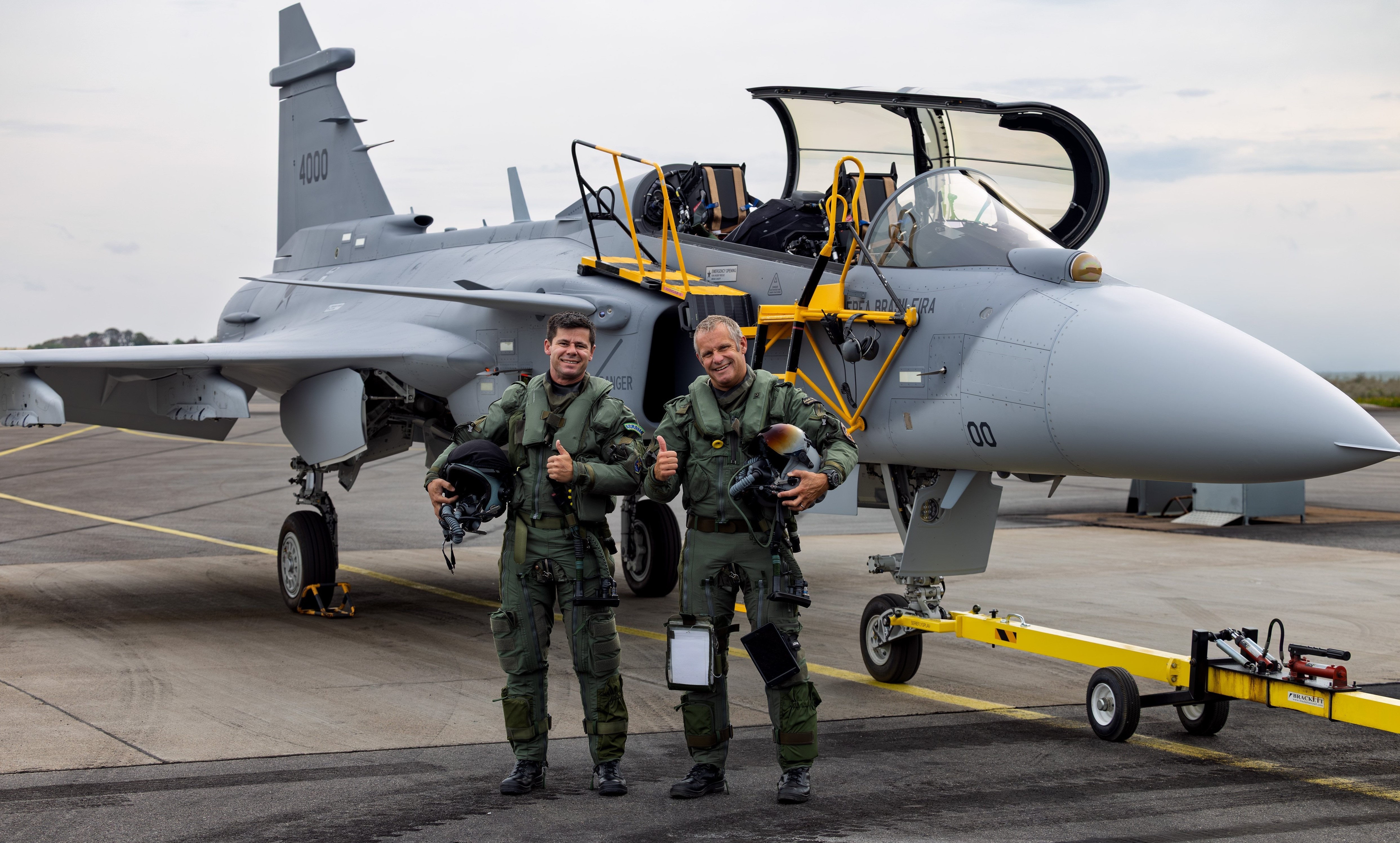
The aircraft took off at 09:40 local time and remained airborne for approximately 40 minutes. The inaugural sortie was flown by Saab Chief Test Pilot Jakob Högberg and Brazilian Air Force test pilot Lieutenant Colonel Aviator Abdon de Rezende Vasconcelos.
According to Saab, the flight was intended to verify the functionality of the Gripen F’s core flight systems and initial flight performance. The aircraft will now progress through a structured flight-test programme, including expansion of its operating envelope and evaluation of the systems and functions unique to the two-seat configuration.
The Gripen F first flight is the latest milestone in a programme that dates back more than a decade.
Brazil selected Saab's Gripen NG in December 2013 under the F-X2 fighter competition. In October 2014, Brazil and Saab signed a contract worth approximately SEK 39.3 billion covering 36 aircraft: 28 single-seat Gripen E and eight two-seat Gripen F aircraft, together with associated systems, equipment and industrial cooperation.
The agreement was particularly significant because Brazil was not simply acquiring an off-the-shelf fighter. The programme incorporated extensive technology transfer and Brazilian industrial participation, with Embraer taking a leading role in the development and production effort. The contract became effective in September 2015.
The Gripen F is the twin-seat iteration of Saab’s next-generation Gripen E fighter, co-developed with Brazilian industry. Designed for both dual-pilot combat operations and operational training, it retains the complete performance, sensor, and weapons capabilities of the single-seat variant.
Key Roles & Features
Dual-Cockpit Versatility: Accommodates an instructor for training or a Weapon Systems Officer (WSO) to manage complex tactical workloads.
Full Combat Capability: Shares identical avionics, sensor suites, and weapons inventories—including BVR missiles—with the Gripen E.
Command Node: Functions as a forward hub for electronic warfare and drone orchestration.
Program Status
First Rollout: Saab unveiled the first completed Gripen F at its Linköping site in Sweden.
Launch Client: The Brazilian Air Force (designated F-39F) ordered eight twin-seat models as part of its broader 36-aircraft program.
Testing Phase: Currently undergoing ground and systems validation prior to flight testing and deployment.
The single-seat Gripen E prototype completed its maiden flight on 15 June 2017 from Linköping. Saab reported that the aircraft flew for 40 minutes, during which the test team evaluated several initial flight-test criteria, including landing-gear operation.
For Brazil, the programme subsequently moved into an important local phase. The first Brazilian Gripen E was presented in Sweden in September 2019 to begin its flight-test programme. In September 2020, that aircraft conducted its first flight in Brazil, flying from Navegantes to Gavião Peixoto, where Embraer’s Gripen Flight Test Center became part of the integrated test campaign.
Brazilian testing included flight-control and environmental-control systems, tropical-condition testing, weapons integration and the Brazilian Link BR2 encrypted communications system.
The Gripen E subsequently entered operational service with the Brazilian Air Force in December 2022, when the FAB's 1st Air Defense Group at Anápolis began operational activities with the aircraft, designated F-39 Gripen in Brazil.
The Gripen F is not merely a Gripen E with an additional cockpit position. Saab says the Brazilian programme involved substantial engineering work to accommodate the second crew station.
Brazilian engineers participated in modifications involving the pilot seats, cockpit displays and controls, electrical and environmental-control systems, oxygen and anti-G systems, and structural/fuselage changes.
The two-seat configuration is intended to provide a platform for pilot conversion and advanced training, while retaining combat capability. Saab describes Gripen F as combining training capability with operational functionality, allowing pilots to develop experience on the same basic aircraft configuration used for advanced combat missions.
One of the defining characteristics of the Brazilian Gripen programme has been its industrial dimension. Saab says more than 350 Brazilian engineers, technicians and pilots have participated in training connected with Gripen development, production, flight testing and maintenance.
Brazilian companies including Embraer, Akaer, Atech and AEL Sistemas, alongside Saab's Brazilian operations, have participated in different areas of the programme. Saab's technology-transfer programme was designed to establish capabilities in Brazil that extend beyond final assembly and support indigenous engineering and manufacturing expertise.
The industrial relationship has also progressed to local aircraft production. In 2023, Saab and Embraer inaugurated the Gripen production line in Brazil, with 15 of the 36 aircraft in the original Brazilian order planned for production locally.
In March 2026, the first Gripen E fighter produced in Brazil was officially unveiled at Embraer's Gavião Peixoto complex, another major milestone for the programme.
The Gripen F's first flight is only the beginning of its flight-test campaign.
Following initial production acceptance flights, Saab plans a progressive flight-envelope expansion, progressively clearing higher levels of speed, altitude, G-loading and angle of attack. At the same time, engineers and test pilots will assess the aircraft's tactical capabilities and the functions associated specifically with the rear cockpit.
The test campaign will be conducted through Saab's Flight Test Centre in Sweden. After completion of the planned test and aircraft-acceptance activities, the Gripen F is scheduled to be prepared for delivery to the Brazilian Air Force.
The Gripen F represents the culmination of a particularly deep Brazil–Sweden aerospace partnership. Brazil began as the customer for 36 next-generation fighters but subsequently became an active participant in development, systems integration, testing and manufacturing.
The aircraft's first flight therefore represents more than another fighter prototype taking to the air. It demonstrates the progression of the Brazilian Gripen programme from fighter selection in 2013, contract signature in 2014, Gripen E first flight in 2017, Brazilian flight testing from 2020, operational service from 2022, local production in 2023 and the first Brazilian-built Gripen E in 2026 — culminating now in the Gripen F entering flight testing.

.jpg)