
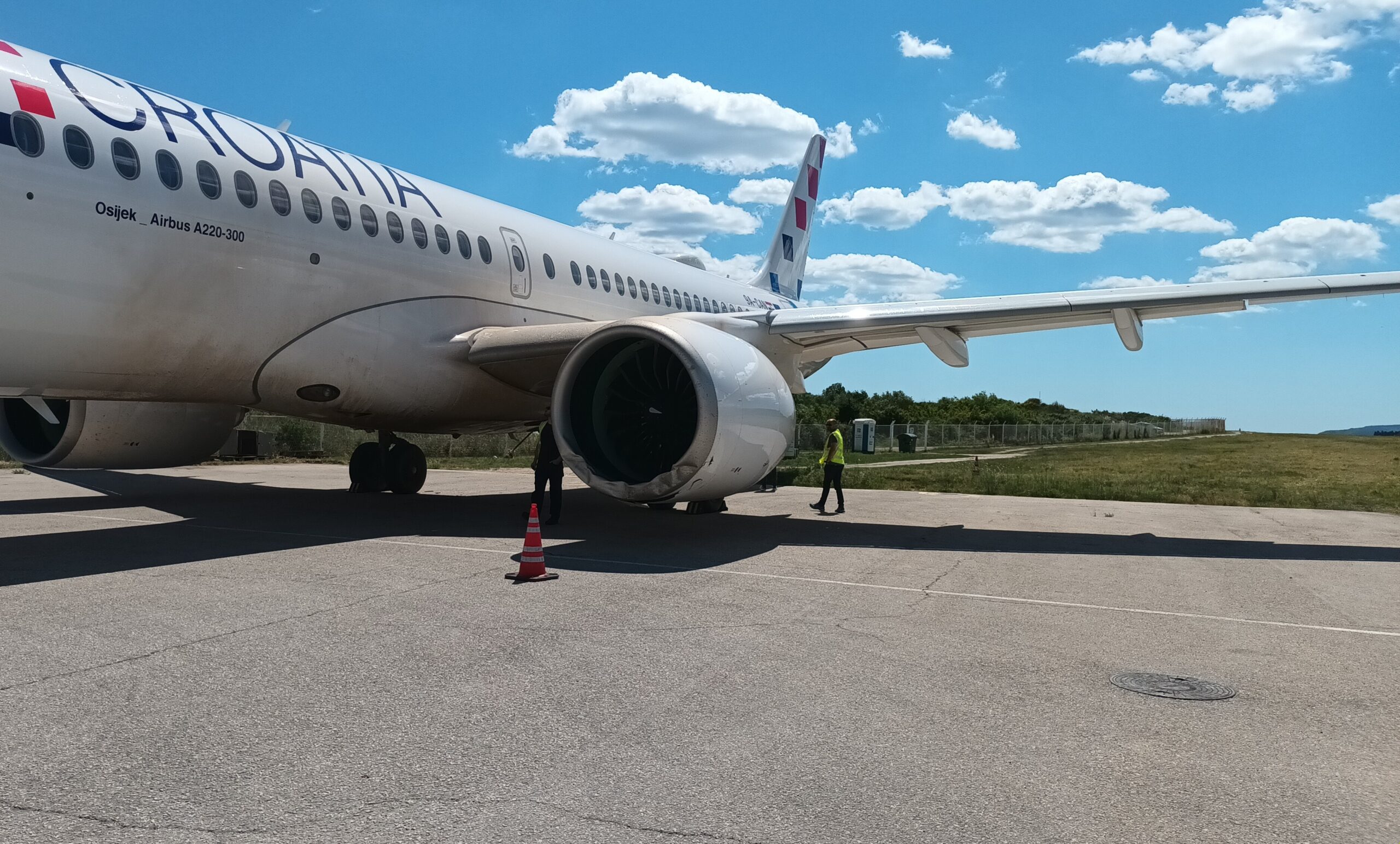
In its preliminary report (Investigation ID343-08/26-03/03) into the serious incident involving Croatia Airlines A220-300 aircraft (9A-CAN) during an attempted take-off from Split to Frankfurt, the Croatian Agency for Investigation of Accidents in Air, Maritime and Rail Transport (AIN) determined that adverse weather and runway conditions "were not factors" in the runway excursion.
On May 16, 2026, the Croatia Airlines Airbus A220-300 aircraft (9A-CAN) experienced a runway excursion at Split Airport (SPU) in Croatia. Operating as Flight OU412 bound for Frankfurt, the crew initiated a high-speed rejected take-off.
"During the taxiing, the pilots monitored the wind data and requested a change of runway, given the direction and strength of the wind, which in the case of using runway 05 would have a tail component."
"They received clearance to take off from runway 23. The wind direction at that time was 290° and a strength of 15 kt with gusts up to 23 kt. The lateral wind component during takeoff from runway 23 was to the right of the aircraft, with a strength of 13 kt with gusts up to 20 kt."
"For this type of aircraft, the maximum permitted lateral wind component during takeoff is 32 kt. Therefore, the impact of the wind was not negligible, but it was below the permitted limit."
" The condition of the runway was correct and could not have been a factor that would have jeopardized takeoff. Visibility on the runway and in the Split Airport area was good."
The pilots managed to align the plane's movement parallel to the runway line and aborted takeoff. After intensive deceleration, the plane successfully stopped.
Upon stopping, the left leg of the main landing gear was on the dirt surface off the runway, the right leg was on the runway, and the nose leg was in a shallow drain along the edge of the runway.
The pilots turned off the engines and, in contact with the controller at the Split Airport tower, established that there was no smoke or fire on the plane and that there was no need for urgent evacuation, and the passengers left the plane in the usual way.
During that time, emergency services at the airport were ready to intervene, should the need arise. Damages All damages to the aircraft are repairable and are therefore considered minor damages.
The left engine and nose leg were damaged. All tires were damaged due to skidding, and the left tire of the nose leg broke.
As a result of braking with the 'trust reversers', particles were raised from the dirt next to the track, which damaged the plating and some elements on the lower part of the plane's fuselage and the left wing. Also, some damage to the left engine was caused by the engine hitting the signal markings located along the track.
Split Airport (LDSP) With its full name 'St. Jeronim Airport', it is located in the Resnik area, about 25 km from Split. In terms of traffic, this is the second airport in Croatia.
It is equipped to provide services and receive large aircraft on international flights, as well as to receive general aviation aircraft. The asphalt runway is 2550 m long and oriented 05-23.
The aircraft in question flew from Dusseldorf, Germany, as planned, and landed at Split Airport at around 12:30 LT (12:30 local time).
About 20 minutes before landing, a passing shower that affected the Split area ended. The runway was wet, and the wind had a slightly more pronounced lateral component, but all parameters were within the permitted limits and traffic at Split Airport proceeded normally.



.jpg)
.jpg)