
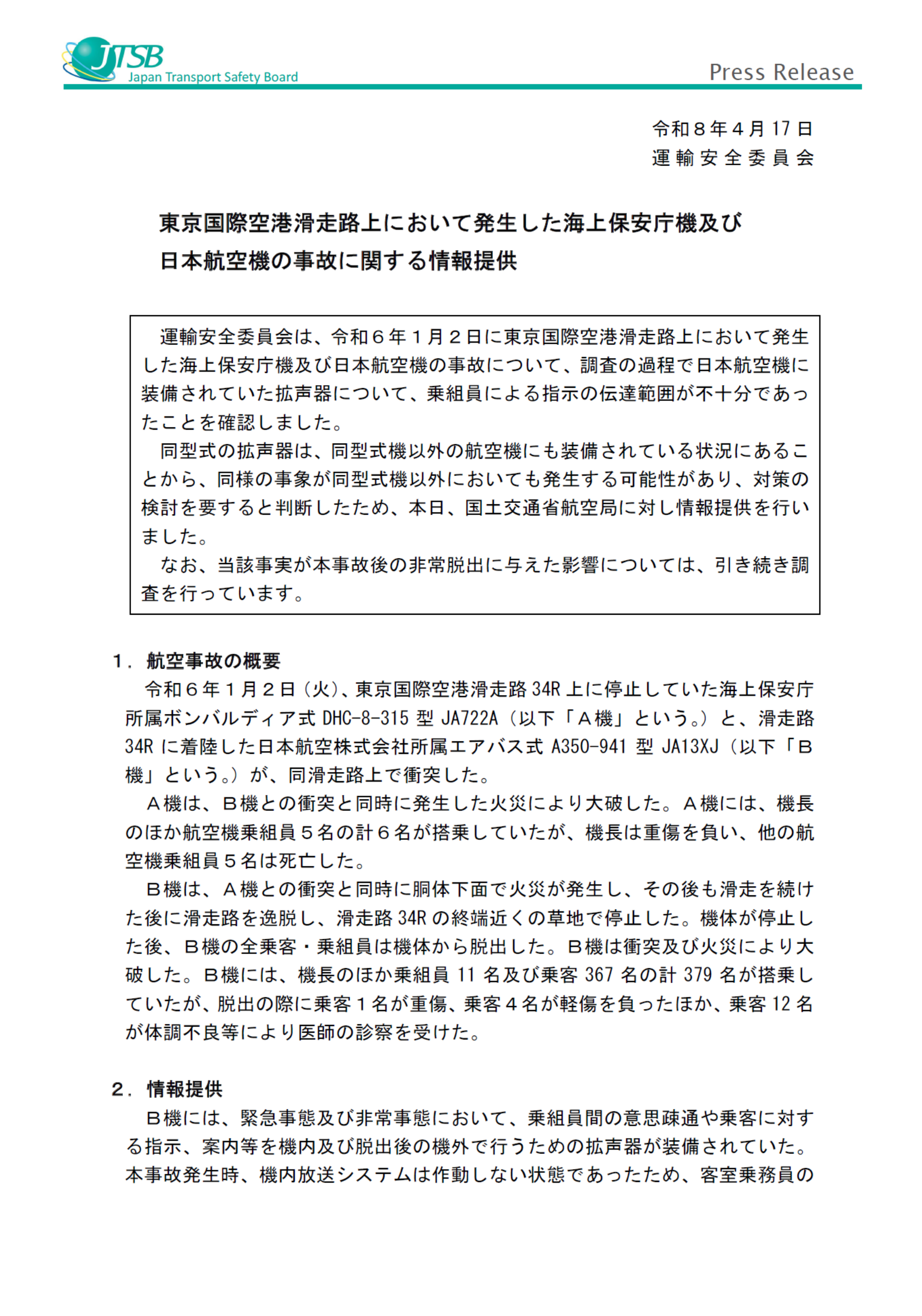
Today, the Japan Transport Safety Board has provided information to the Japanese Civil Aviation Bureau of the Ministry of Land, Infrastructure, Transport and Tourism that the transmission range of instructions by the crew was insufficient regarding the public address system equipped on the Japan Airlines aircraft in connection with the accident involving the Japan Coast Guard aircraft and the Japan Airlines aircraft that occurred at Tokyo International Airport on January 2, 2024.
In the accident two years ago at Haneda Airport, where a Japan Airlines aircraft collided with a Japan Coast Guard aircraft, killing five people on the Coast Guard plane, the Japan Transport Safety Board has released the results of its investigation into the Megaphones (loudspeakers) used for evacuation guidance on the Japan Airlines aircraft, concluding that the instructions were not clearly audible.
In this accident, the Japan Airlines aircraft's in-flight announcement system was not functioning, and the cabin crew used loudspeakers to call for evacuation. However, the sound from the loudspeakers was difficult to hear, and some passengers evacuated by observing the movements of other passengers.
Following the tragic accident in 2024, in May of last year, the Japan Transport Safety Board conducted a verification experiment using the same type of aircraft as the Japan Airlines aircraft to investigate how the sound of the same type of loudspeaker was heard in a noisy environment.
The experiment revealed that the output of this loudspeaker was insufficient in some areas. The Japan Transport Safety Board conveyed the results to the Ministry of Land, Infrastructure, Transport and Tourism, which today requested that each airline take safety measures, such as providing loudspeakers with higher output, as the same type of loudspeaker may be used by other airlines as well.
To be noted here, on December 25, the Japan Transport Safety Board (JTSB) released its second progress report on the collision accident that occurred at Haneda Airport on January 2, 2024, between a Japan Coast Guard MA722 (Bombardier DHC-8-Q300, registration number JA722A) and Japan Airlines (JAL/JL, 9201) flight JL516 (A350-900, JA13XJ) from Sapporo to Haneda.
The latest report draws attention to the fact that when the JCG aircraft entered the runway, the "Runway Occupancy Monitoring Support Function," a system that detects erroneous runway incursions, was activated and a warning message was displayed on the screen, but the controllers did not pay attention to it, which led to the accident not being prevented.
In its second report from December 2025, the JTSB revealed that, since the first progress report, they have been conducting analyses on a total of 12 items across three areas: the Japan Coast Guard aircraft, the JAL aircraft, and air traffic control.
On Tuesday, January 2, 2024, a Japan Coast Guard Bombardier DHC-8-315 aircraft, Regd. JA722A (hereinafter referred to as "Aircraft A"), which had stopped on Runway 34R (Runway C) at Tokyo International Airport, collided with a Japan Airlines Airbus A350-941 aircraft, Regd. JA13XJ (hereinafter referred to as "Aircraft B"), which had landed on Runway 34R.
Aircraft A was destroyed by the collision with Aircraft B and a fire that broke out immediately after the collision. Aircraft A had six people on board, including the captain and five crew members. The captain was seriously injured, and the other five crew members were killed.
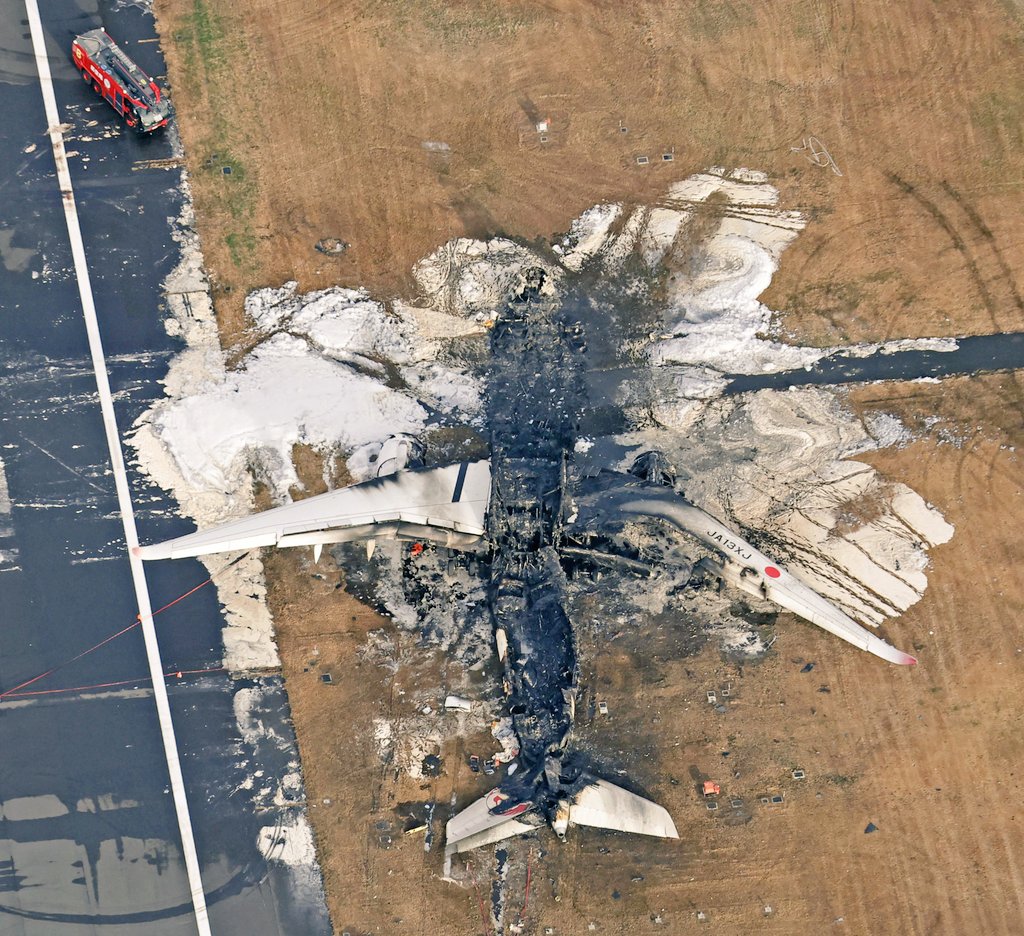
Aircraft B, on impact with Aircraft A, broke out on its underside and continued to taxi, then deviated from the runway and came to a stop in a grassy area near the end of Runway 34R.
After the aircraft came to a stop, all passengers and crew members of Aircraft B evacuated. Aircraft B was destroyed by the collision and fire. There were 379 people on board Aircraft B, including the pilot, 11 crew members, and 367 passengers.
During the evacuation, one passenger was seriously injured and four passengers were slightly injured, and 12 passengers were examined by a doctor due to poor health.
Related news....


.jpg)
.jpg)