
The Japan Transport Safety Board released a progress report on the investigation into the January 2024 collision at Haneda Airport between a Japan Airlines plane and a Japan Coast Guard (JCG) plane on the morning of the 25th.
The report pointed out a commonality with past aviation accidents in that the system that detects and notifies air traffic controllers of erroneous runway incursions was not effectively utilized. Based on the analysis of causes to date, the board will compile measures to prevent recurrence and mitigate damage.
This is the first time that the Japan Transport Safety Board has released two progress reports before issuing a final investigation report. The progress report released in December last year pointed out that the accident was caused by a combination of three factors:
The latest report draws attention to the fact that when the JCG aircraft entered the runway, the "Runway Occupancy Monitoring Support Function," a system that detects erroneous runway incursions, was activated and a warning message was displayed on the screen, but the controllers did not pay attention to it, which led to the accident not being prevented.
Investigations to date have revealed that there were no regulations or full-scale training on how to handle situations when a warning message was activated, and that the controllers did not pay attention to the system on a daily basis.
The report cited an example of "similarities" between the response at the time of the accident and the causes of past aviation accidents, such as the 2001 near miss between two Japan Airlines planes over Yaizu City, Shizuoka Prefecture, in which 57 passengers and others were injured.
In this accident, a system that predicted close encounters between aircraft was activated and displayed an alarm to air traffic controllers, but it was pointed out that there were no regulations for how to respond when the alarm was activated, and appropriate action was not taken.
The Japan Transport Safety Board will also investigate whether lessons learned from past accidents have been applied to subsequent accident prevention systems.
Meanwhile, it was revealed that one of the focal points of the investigation is that the JAL plane did not notice the JCG plane on the runway until just before the collision, and that analysis is being carried out through re-enactment experiments and other means.
It has been revealed that at the time of the accident, the runway lights around the area where the JCG plane was stopped and the JCG plane's anti-collision lights visible from behind were all white.
In March of this year, a re-enactment experiment was conducted using the same type of JCG plane and a helicopter at Chubu Centrair International Airport (Aichi), which has a similar runway light arrangement to Haneda Airport. Based on the results of this experiment, a detailed analysis of the situation at the time will be conducted.
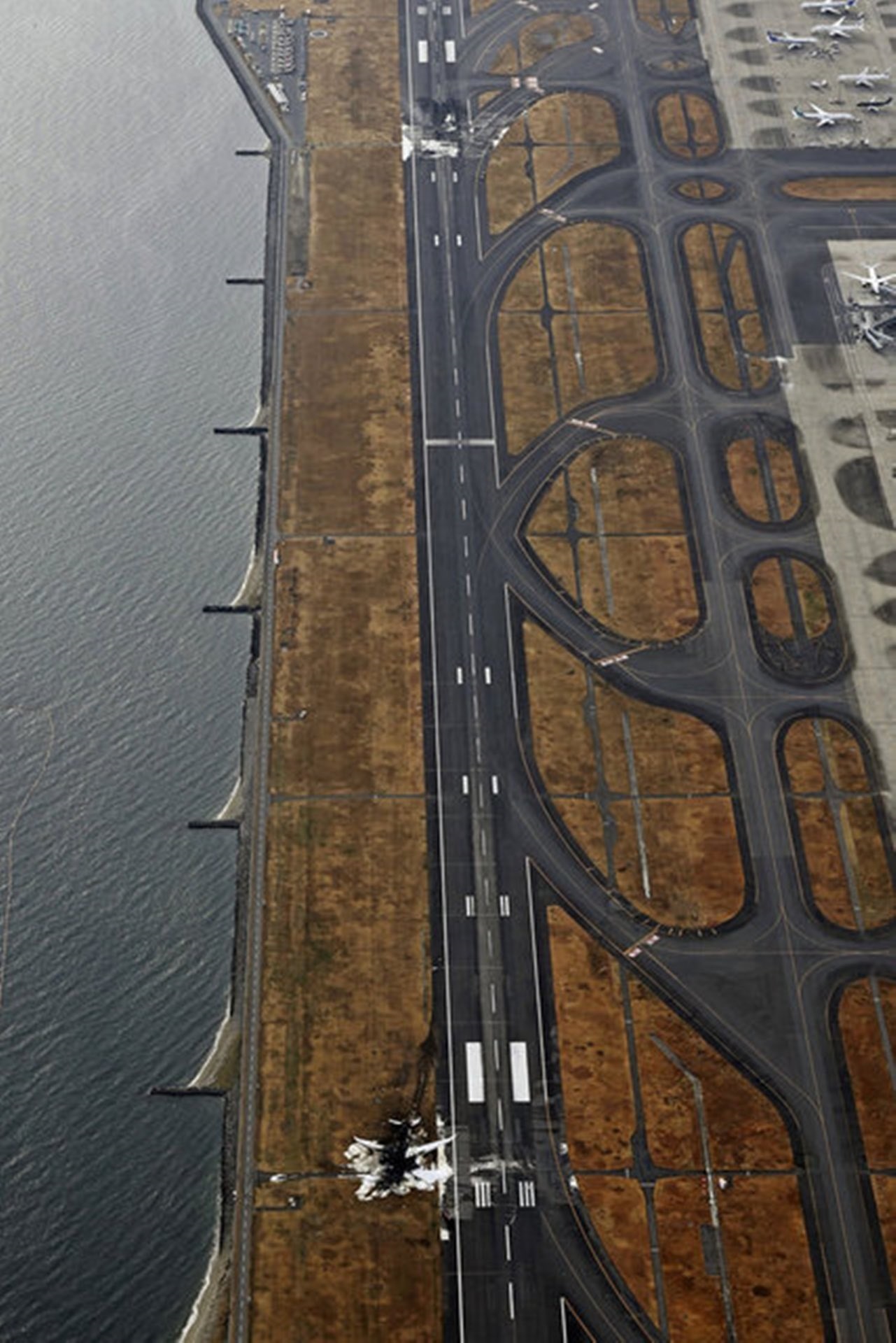
On Tuesday, January 2, 2024, a Japan Coast Guard Bombardier DHC-8-315 aircraft, Regd. JA722A (hereinafter referred to as "Aircraft A"), which had stopped on Runway 34R (Runway C) at Tokyo International Airport, collided with a Japan Airlines Airbus A350-941 aircraft, Regd. JA13XJ (hereinafter referred to as "Aircraft B"), which had landed on Runway 34R.
Aircraft A was destroyed by the collision with Aircraft B and a fire that broke out immediately after the collision. Aircraft A had six people on board, including the captain and five crew members. The captain was seriously injured, and the other five crew members were killed.
Aircraft B, on impact with Aircraft A, broke out on its underside and continued to taxi, then deviated from the runway and came to a stop in a grassy area near the end of Runway 34R.
After the aircraft came to a stop, all passengers and crew members of Aircraft B evacuated. Aircraft B was destroyed by the collision and fire. There were 379 people on board Aircraft B, including the pilot, 11 crew members, and 367 passengers.
During the evacuation, one passenger was seriously injured and four passengers were slightly injured, and 12 passengers were examined by a doctor due to poor health.
At Haneda Airport, two air traffic controllers are in charge of each runway in operation. There are also other staff such as a supervisor and assistants, and the air traffic control center is usually staffed by about 15 people overall.
Seven airports, including Haneda, have runway occupancy monitoring support, which watches for wrongful entry into runways.
Under the system, if another aircraft enters a runway when a plane is approaching to land, the runway is lit up in yellow on a monitor at air traffic control and the airplanes are displayed in red. This system was operating normally at the time of the accident.
You may like to read.......

.jpg)
.jpg)