
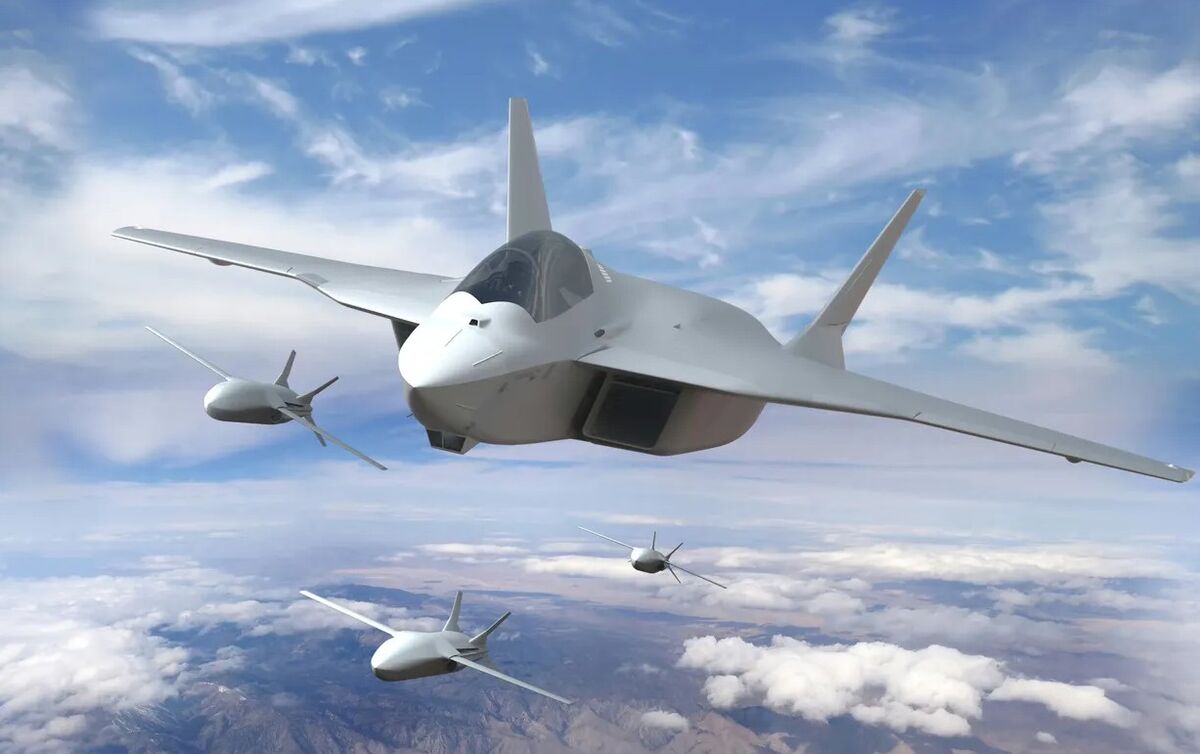
The friction between Airbus and Dassault Aviation over the European FCAS (Future Combat Air System) project seems unstoppable. According to Dassault's CEO, the project could be abandoned, and he believes Airbus no longer wants to work with them.
Building two separate fighter jets to address the problems surrounding the FCAS is not an option for France, according to Dassault Aviation CEO Éric Trappier.
"Airbus no longer wants to work with Dassault" to develop the European fighter jet of the Scaf project and if this attitude persists, "the project is dead," said Dassault CEO Eric Trappier on Wednesday.
Eric Trappier said during a press conference on the occasion of the presentation of the annual results,
"If Airbus maintains the probability of not working with Dassault, the project is dead,"
"It is Airbus that is not respecting the initial equation."
Brought to life in 2017 between France and Germany, the project, now including Spain, is based on a next-generation stealth fighter jet, accompanied by autonomous drones and a digital combat cloud.
The conflict is taking place between the two aviation giants in charge of the project’s development, Dassault and Germany’s Airbus Defence and Space. However, the German and French governments also appear unable to agree on the project’s direction.
Now, the German aerospace industry, together with its workers’ union, has called for protests against the delayed decision on the Future Combat Air System (FCAS) fighter jet project, in which Germany’s Airbus Defence and Space is a lead partner.
An ongoing dispute between France and Germany about how to proceed with FCAS has raised doubts about the project’s future.
The workers hope their demonstration can push Berlin to take more decisive action to move the project forward. Both associations are calling for an end to the standstill and argue that “the FCAS programme must be continued as soon as possible.”
Progress on the €100 billion project, which is envisioned to encompass a next-generation fighter jet interlinked with a system of autonomous drones and an AI cloud, has been stuck for over a year. Germany’s leading contractor, Airbus Defence and Space, and France’s Dassault have publicly aired their disagreements about the envisioned work.
“We are strictly adhering to our commitments,” continued Eric Trappier. “It is Airbus that is not respecting the initial equation,” he declared.
"While the idea of a two-aircraft solution is gradually gaining traction, having been mentioned in February by the head of Airbus, who represents Germany and Spain in the FCAS program , “France cannot support the idea of having two aircraft,” said Eric Trappier.
Europeans "have an interest in having a common model," President Emmanuel Macron maintained during a visit to India on February 19. Dassault and Airbus have been at odds for months over the industrial management of the project, to the point of threatening the very future of the Future Combat Air System (FCAS) program launched in 2017.
"That's business," Macron replied.
Berlin and Paris are now also debating which requirements the jet should fulfill. France’s nuclear deterrence and its need to operate from an aircraft carrier require different specifications than Germany would prefer.
German Chancellor Friedrich Merz has already publicly questioned the relevance of the project .
"The French need (...) an aircraft capable of carrying nuclear weapons and operating from an aircraft carrier. That is not what we currently need in the German army," the chancellor said on the German podcast Machtwechsel.
"The question now is this: do we have the strength and the will to build two aircraft for these two different sets of requirements, or just one?" he asked. " There are frictions between companies. That's business.
Should that dictate the strategy of nations? The answer is no," replied Emmanuel Macron. "Is building several aircraft the best use of our money? We need a European standard," he insisted.
A decision by the three partner nations, France, Germany and Spain, was planned for the end of last year – but ultimately postponed. A new deadline was floated when Germany announced that it expected a proposal from France by the end of February. So far, no decision has been made.
Dassault Aviation indicated on Wednesday that it expects an increase in its deliveries and revenue in 2026, after the aircraft manufacturer published results slightly above expectations for the past fiscal year.
" The forecast for 2026 is for revenue up compared to that of 2025, in the class of 8.5 billion euros, including the delivery of 40 Falcon and 28 Rafale ," said Eric Trappier, the group's chairman and CEO, in a statement.
The group delivered 26 Rafale and 37 Falcon in 2025 and had an order book of 220 Rafale and 73 Falcon as of December 31.
Related article......