
Two years after Singapore Airlines flight SQ321 was struck by severe turbulence over Myanmar, the widow of the British passenger who died in the incident has launched legal proceedings against the airline in the United Kingdom, seeking damages for serious spinal injuries and answers over her husband's death.
Linda Kitchen, 74, has begun High Court proceedings against Singapore Airlines after suffering a broken back during the May 21, 2024, turbulence event. Her husband, Geoffrey “Geoff” Kitchen, 73, died during the incident.
According to reports citing High Court documents, two claims have been filed by the Kitchen family. One is brought by Linda Kitchen in her own right, while another is being pursued by her on behalf of her late husband's estate.
Several other passengers have also launched legal action against Singapore Airlines, according to British media reports.
Singapore Airlines said it was unable to comment on matters currently before the courts.
Geoff and Linda Kitchen were beginning a planned six-week holiday to Singapore, Indonesia and Australia when SQ321 encountered severe turbulence while operating from London Heathrow to Singapore.
The Boeing 777-300ER was carrying 211 passengers and 18 crew members when the aircraft encountered the turbulence over Myanmar.
The turbulence was so violent that Linda Kitchen believed the aircraft was going down. During the sudden aircraft movements, her husband was thrown onto her, pinning her against a seat armrest. Other passengers eventually helped move him, after which a doctor performed CPR.
The aircraft diverted to Bangkok's Suvarnabhumi International Airport, where it made an emergency landing so injured passengers could receive medical treatment.
Kitchen was transported to hospital and remained in Bangkok for approximately 10 days before being flown back to Bristol. She subsequently spent about another week in hospital in Britain and required substantial assistance following her discharge.
She learned of her husband's death two days after the incident.
“Nothing prepared me for hearing he had died. It was absolutely devastating.”
Kitchen has also said that she wants answers about what happened aboard the aircraft.
“I feel I owe it to him to at least get some answers.”
Her legal representative, aviation lawyer Anthe Korelidou, said the family continues to have questions about the circumstances of the incident and whether more could have been done to prevent the injuries.
The family is also awaiting a coroner's inquest into Geoff Kitchen's death.
The latest development follows the publication of the Singapore Transport Safety Investigation Bureau's (TSIB) final report in May 2026, which provided a detailed account of the turbulence encounter.
Investigators determined that the turbulence was convectively induced, most likely associated with a rapidly developing cloud capable of producing powerful updrafts and downdrafts.
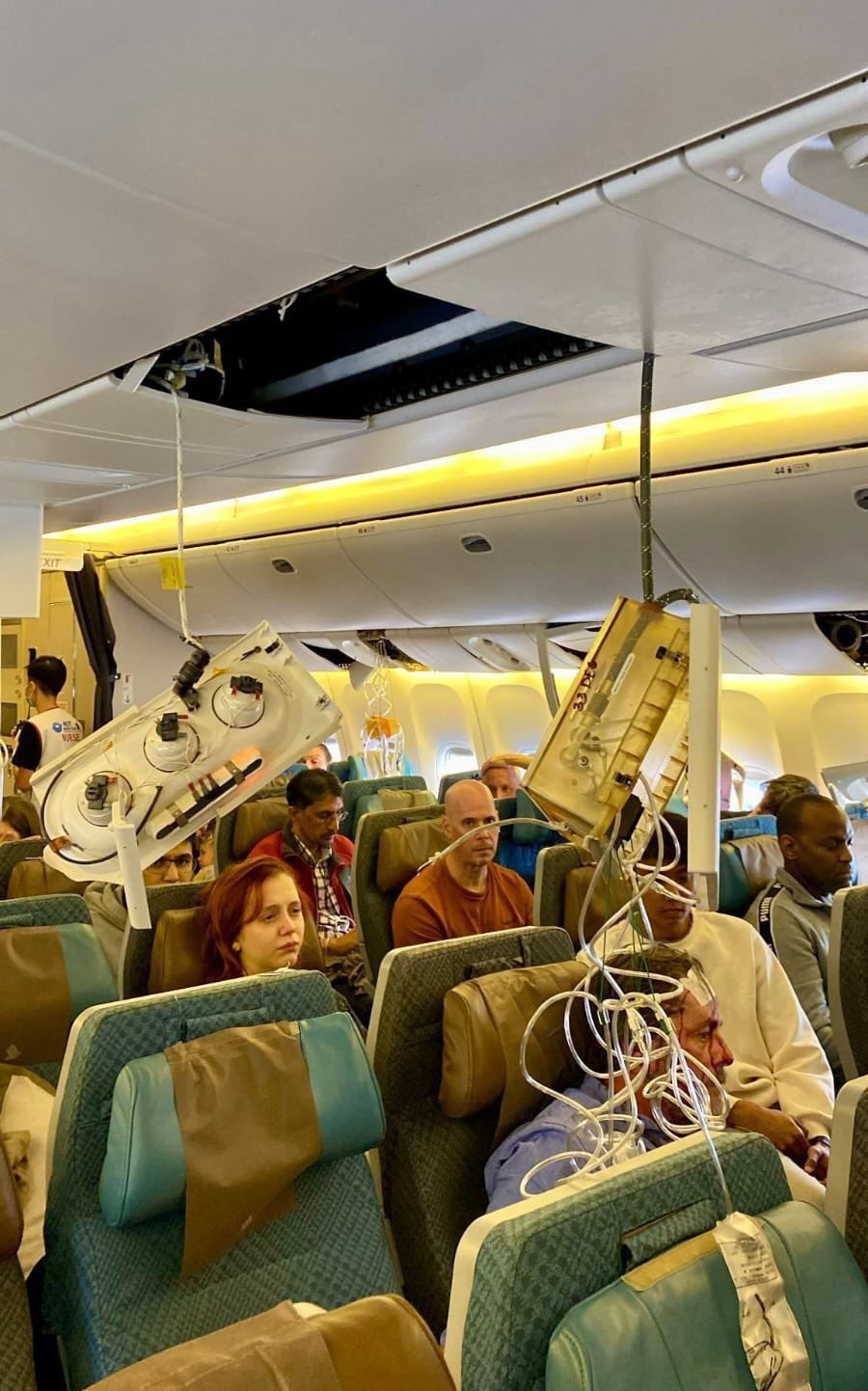
The aircraft experienced extremely rapid changes in gravitational acceleration. Passengers who were not wearing seat belts were thrown into the air before falling back onto the cabin floor, seats and other structures.
TSIB concluded that the aircraft experienced a rapid change in altitude of approximately 54 metres (177 feet) within about five seconds during the most severe part of the encounter.
The investigation found that the flight crew had not observed significant weather on the aircraft's navigational displays in the minutes immediately before the event. Visual checks also indicated what appeared to be a clear flight path.
Investigators subsequently concluded that it was likely the aircraft's weather radar did not detect the developing weather before the turbulence encounter.
However, the weather-radar manufacturer found no evidence that the system had malfunctioned or failed to detect and display weather during the flight.
One of the most significant findings concerned the extremely short time available to the crew.
The seat-belt sign had been switched on after the aircraft began experiencing turbulence. However, severe turbulence struck approximately 17 seconds later.
That left insufficient time for the flight crew to make a cabin announcement warning passengers to immediately return to their seats and fasten their belts.
The resulting rapid vertical movements generated large changes in gravitational force, causing unsecured passengers to become airborne.
The consequences were severe.
Of the 229 people aboard, including passengers and crew:
Geoff Kitchen was subsequently determined to have suffered heart failure and pulmonary oedema, a condition involving fluid accumulation in the lungs.
Following the accident, Singapore Airlines announced an initial compensation framework for affected passengers.
In June 2024, the airline offered US$10,000 to passengers who suffered minor injuries.
Passengers who sustained more serious injuries were invited to discuss compensation based on their individual circumstances. The airline also offered those passengers an advance payment of US$25,000 to address immediate financial needs.
Singapore Airlines apologised for the incident and said it would cooperate with affected passengers and their families.
The current High Court proceedings indicate that some passengers and relatives remain dissatisfied with the compensation process or are seeking further damages through the courts.
The SQ321 incident also prompted Singapore Airlines to review and strengthen its approach to turbulence management.
Among the measures subsequently introduced were:
The changes reflect a broader aviation-industry challenge: modern aircraft can detect and avoid much severe weather, but convectively induced turbulence can develop rapidly and may not always be accurately identified far enough in advance to provide a meaningful warning to cabin occupants.
For Linda Kitchen, the case is not simply about financial damages.
The legal proceedings come as the family continues to seek an explanation of exactly what happened to Geoff Kitchen and whether additional measures could have reduced the consequences of the turbulence encounter.
The forthcoming coroner's inquest is expected to provide another opportunity to examine the circumstances surrounding his death.
The SQ321 accident remains one of the most consequential recent examples of the dangers posed by severe turbulence to airline passengers. It has also highlighted the importance of seat-belt use, rapid turbulence detection, weather-radar interpretation and the ability of flight crews to provide timely warnings.
For the Kitchen family, however, the technical findings are inseparable from a deeply personal loss.
Two years after the flight that was supposed to begin a six-week holiday, Linda Kitchen is still seeking answers about the final moments of her husband's life.
As she put it: “I feel I owe it to him to at least get some answers.”
Related article.........

.jpg)