
A hydraulic system malfunction aboard a Philippine Airlines Airbus A320 forced the aircraft to return to Manila on November 29, 2026, triggering a major operational disruption at Ninoy Aquino International Airport (NAIA) after multiple landing-gear tires burst during landing.
The incident involved flight PR2923, operated by Airbus A320-214 registration RP-C8609, which was scheduled to operate from Manila to Daraga, Albay, in the Philippines.
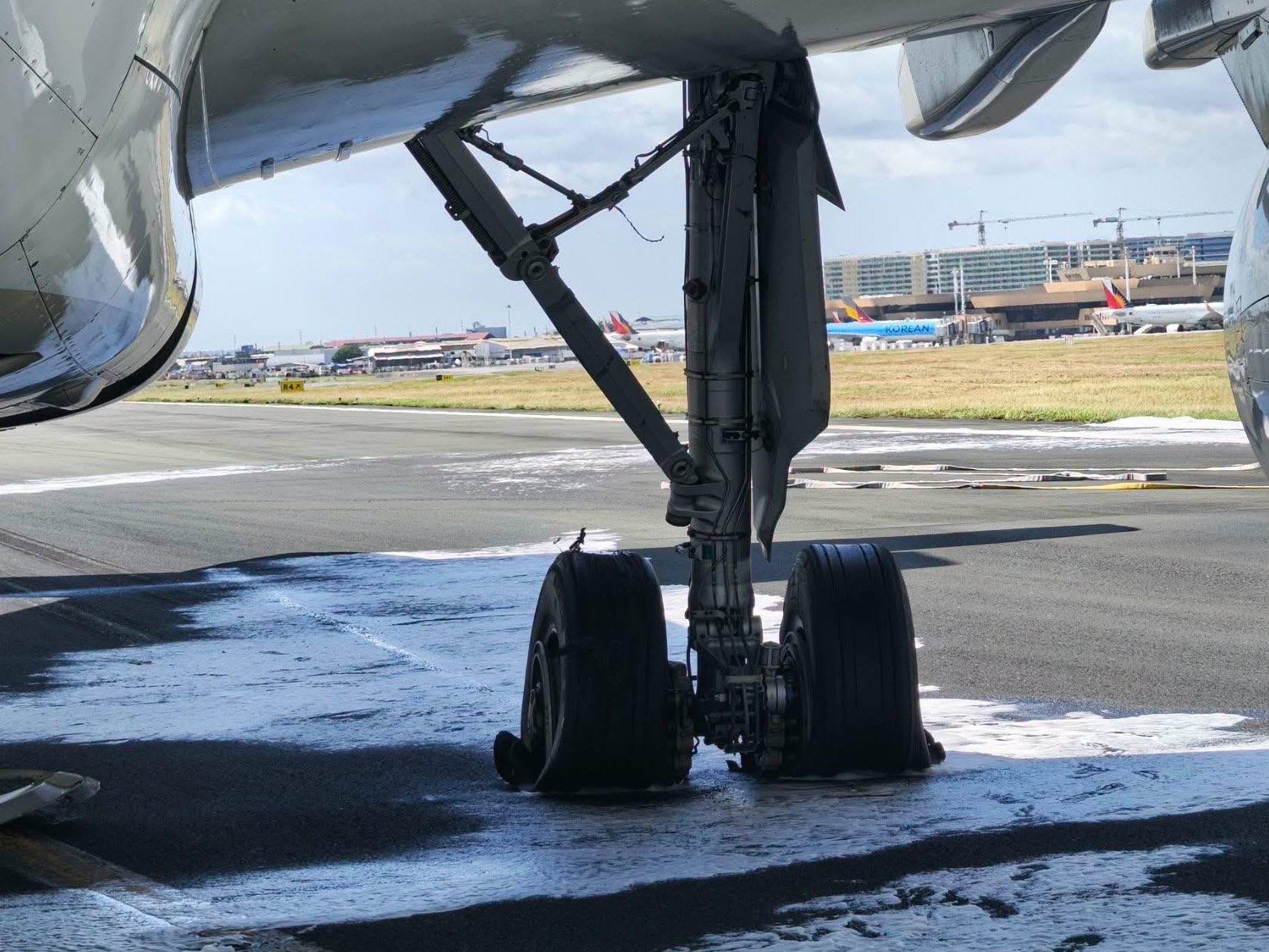
The aircraft returned to Manila approximately 95 minutes after departure, landing on Runway 06 at around 11:45 a.m. local time. Following touchdown, all the main landing gear tires reportedly burst, leaving the aircraft disabled on the runway and preventing its immediate removal.
Although the aircraft suffered a significant operational problem, all passengers safely disembarked, and no injuries were reported.
According to the Civil Aviation Authority of the Philippines (CAAP) and Philippine Airlines, the aircraft encountered a hydraulic system problem during its flight to Daraga, forcing the crew to discontinue the journey and return to its departure airport.
The precise hydraulic system involved, the nature of the malfunction and the extent of its impact on the aircraft's landing capability have not yet been established publicly.
The aircraft subsequently landed at NAIA at approximately 11:45 a.m. However, multiple tire failures during the landing left the A320 immobilised on the main runway.
Airport fire and medical response teams were placed on standby as a precaution. All passengers were safely disembarked, while the airline coordinated with airport authorities and government agencies to arrange the aircraft's recovery.
The disabled aircraft forced airport authorities to temporarily close Runway 06/24, NAIA's primary runway, creating significant challenges for flight operations at one of Southeast Asia's busiest airports.
The CAAP confirmed that operations were temporarily shifted to the shorter crossing runway, Runway 13, while Runway 06/24 remained unavailable.
At approximately 12:50 p.m., ground crews began replacing the damaged tires to prepare the aircraft for towing. The operation required the aircraft to be made safe and the affected runway to be cleared before normal operations could resume.
The main runway finally reopened at approximately 5:48 p.m., according to airport operator New NAIA Infra Corp. (NNIC). CAAP subsequently confirmed that normal runway operations had resumed at approximately 5:55 p.m.
The runway closure significantly affected arriving international and domestic flights. With the primary runway unavailable, several widebody aircraft approaching Manila were diverted to alternative airports.
CAAP initially identified four flights diverted to Clark International Airport:
|
Flight |
Aircraft |
Route |
|---|---|---|
|
PAL891 |
Boeing 777-300ER |
Taipei–Manila |
|
CEB313 |
Airbus A330-900 |
Taipei–Manila |
|
PAL659 |
Airbus A330-300 |
Dubai–Manila |
|
PAL1454 |
Airbus A350-900 |
General Santos–Manila |
The disruption subsequently affected additional services from Singapore, Tokyo, Riyadh, Dubai, Bahrain and Doha.
According to an updated CAAP flight-disruption list, 13 incoming flights were diverted and two Philippine Airlines flights were cancelled as of the afternoon of November 29.
The diversions included:
Flights from Los Angeles and Doha, rerouted to Guam and Bangkok, respectively.
Melbourne-bound? No — Melbourne–Manila services were diverted to Cebu.
Sydney–Manila services were diverted to Davao.
A Bangkok–Manila service was diverted to Cebu.
The disruption also resulted in cancellations and schedule adjustments extending beyond the initial runway closure.
While the hydraulic malfunction prompted the return to Manila, the precise technical relationship between the hydraulic problem and the multiple tire failures has not been established.
An aircraft's hydraulic systems operate several important functions, including flight controls, landing gear, braking and nosewheel steering, depending on the system architecture.
A hydraulic malfunction does not automatically mean that an aircraft loses all braking capability, as transport-category aircraft generally have multiple hydraulic systems and alternative operating provisions.
Similarly, tire bursts during landing can result from several factors, including excessive braking loads, wheel-locking conditions, tire damage or other mechanical abnormalities.
In this case, the available reports confirm the hydraulic problem and subsequent tire failures, but do not establish the precise mechanism responsible for the damage.
The aircraft's engineering inspection and any subsequent technical investigation will be important in determining whether the two events were related.
The incident demonstrates how an aircraft becoming immobilised on a primary runway can create widespread disruption, particularly at airports with intersecting runways and limited operational flexibility.
Although NAIA's secondary runway allowed some operations to continue, its shorter length and operational constraints limited the airport's ability to accommodate the full traffic demand, particularly involving widebody aircraft.
The six-hour closure affected international arrivals, domestic services and airline schedules, while requiring coordination between Philippine Airlines, CAAP, NNIC and airport ground teams.
The investigation into the hydraulic malfunction and the circumstances surrounding the tire failures will be important in establishing the technical sequence of events.
At the time of reporting, the precise hydraulic failure mechanism and the reason for the multiple tire bursts remained undetermined.