
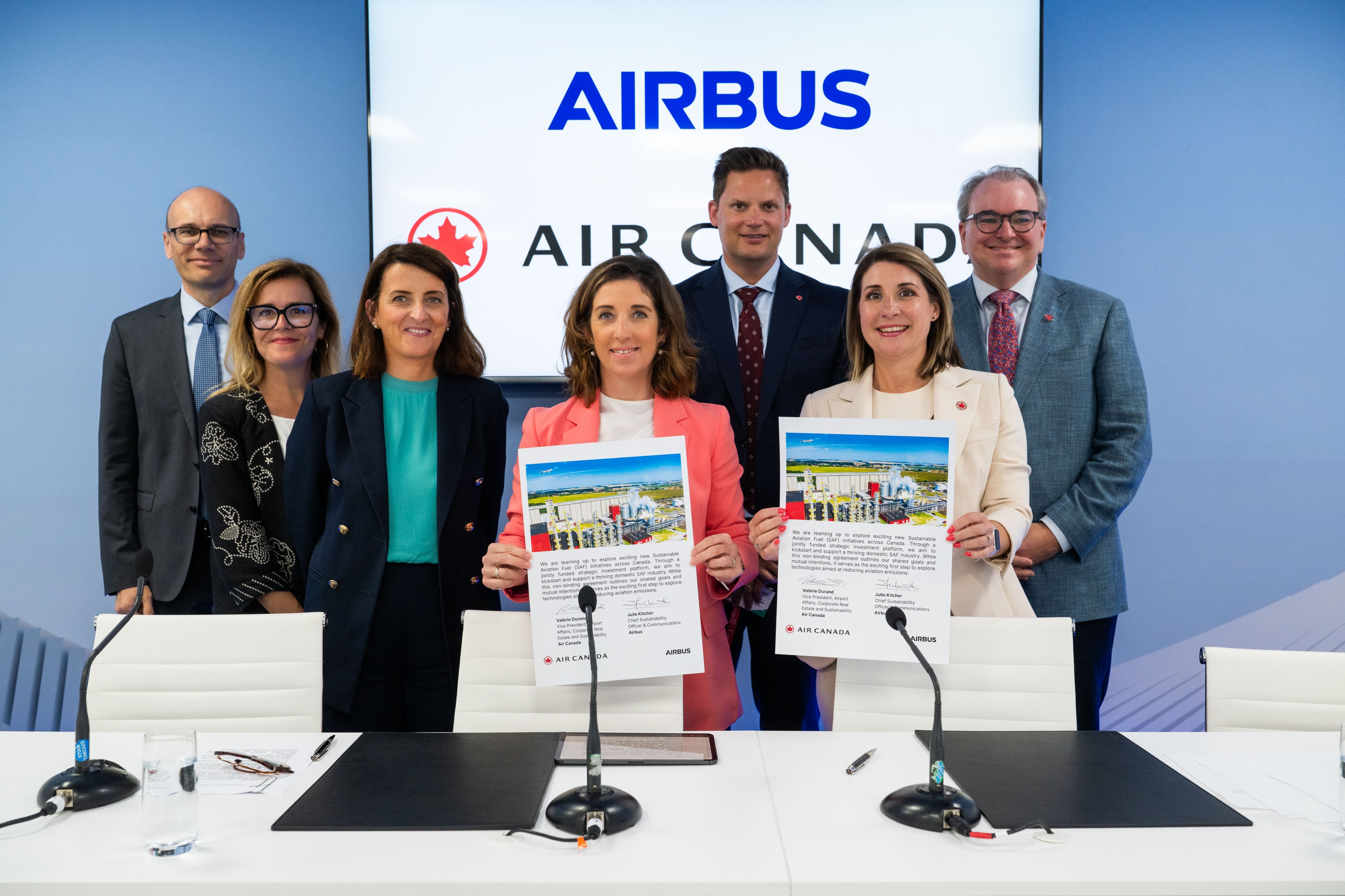
Air Canada and Airbus have announced a major collaboration to accelerate the decarbonization of aviation by establishing a jointly funded Sustainability Co-Investment Platform aimed at expanding Canada's sustainable aviation fuel (SAF) industry.
The two companies intend to invest up to C$13.7 million (approximately US$10 million or €8.7 million) through the platform to support the development of commercial-scale SAF production in Canada. The initiative is designed to help advance a jointly selected Canadian SAF project toward a Final Investment Decision (FID) while strengthening the country's renewable aviation fuel ecosystem.
According to a joint announcement released on July 20, the investment represents a significant step toward increasing both the production and adoption of SAF in Canada. However, Air Canada and Airbus emphasized that the success of the initiative will depend on supportive public policies at both the federal and provincial levels to encourage large-scale investment and accelerate domestic SAF production.
The companies are working alongside the Canadian Sustainable Aviation Fuel Coalition (C-SAF) to engage governments in creating structural frameworks that will enable a competitive and commercially viable SAF industry. Their shared objective is to make renewable aviation fuels more widely available for Canada's aerospace sector while preserving the affordability of air travel.
As part of the initiative:
SAF is produced from renewable or waste-based feedstocks rather than conventional petroleum. Compared with traditional jet fuel, it can significantly reduce lifecycle greenhouse gas emissions while being compatible with existing aircraft and airport fueling infrastructure. However, its adoption has been limited by higher costs and relatively low production volumes.
"Air Canada is proud to help advance aviation's energy transition in Canada. Through this joint initiative with Airbus, we are taking meaningful steps toward supporting domestic SAF production, helping corporate customers address the emissions associated with business travel, and contributing to a lower-carbon path for the industry."
" With continued industry collaboration and a supportive policy environment, we are confident this momentum can accelerate," said Valerie Durand, Vice President, Airport Affairs, Corporate Real Estate and Sustainability at Air Canada.
Echoing the importance of industry-wide collaboration, Julie Kitcher, Airbus Chief Sustainability Officer and Communications, highlighted Canada's potential to become a leading producer of sustainable aviation fuel.
"I want to thank Air Canada for this very important joint sustainability initiative. Decarbonising aviation will require deep industry collaboration and decades of investment in new sources of renewable energy. By launching this co-investment platform and making a long-term commitment to Air Canada's Leave Less Travel Programme, we will help to stimulate the production of, and demand for, SAF in Canada. The country has a vast feedstock potential. When combined with a supportive policy framework, it can contribute to the sector's decarbonisation ambitions and create significant economic growth and job creation," Kitcher said.
As part of the broader partnership, Airbus has signed a five-year agreement under Air Canada's Leave Less Travel Program. Through the agreement, Airbus will purchase sustainable aviation fuel environmental attributes associated with more than 60,000 litres of SAF for its initial allocation.
Under the programme, Air Canada will monitor Airbus' greenhouse gas (GHG) emissions generated through corporate travel and retire verified SAF environmental attributes on the company's behalf, enabling Airbus to reduce the emissions associated with its business travel.
This initiative could:
Sustainable aviation fuel is considered one of the aviation industry's most promising tools for reducing lifecycle carbon emissions. Produced from renewable and waste-derived feedstocks, SAF can significantly lower greenhouse gas emissions compared with conventional jet fuel while remaining compatible with existing aircraft and airport infrastructure.
Despite its environmental benefits, widespread adoption has been constrained by limited production capacity and higher costs, making initiatives such as the Air Canada-Airbus partnership increasingly important for scaling the industry.
The investment also reflects growing momentum within the aviation sector to accelerate progress toward net-zero emissions. By supporting commercial-scale SAF production and fostering collaboration between industry and government, Air Canada and Airbus aim to strengthen Canada's position in the global sustainable aviation market while creating new economic opportunities and supporting long-term environmental goals.