
Investigators are examining whether a late touchdown, high residual speed, adverse winds and the aircraft’s landing performance contributed to a fatal runway excursion at Miami International Airport (MIA) that killed at least five people and injured five others.
A Boeing 767-300 freighter operating 21 Air Flight 7598 for Amazon Prime Air overran the runway while landing at Miami International Airport on Sunday, September 6, 2026. The aircraft had departed Luis Muñoz Marín International Airport in San Juan, Puerto Rico, and touched down at approximately 1:53 p.m. local time, according to flight-tracking data.
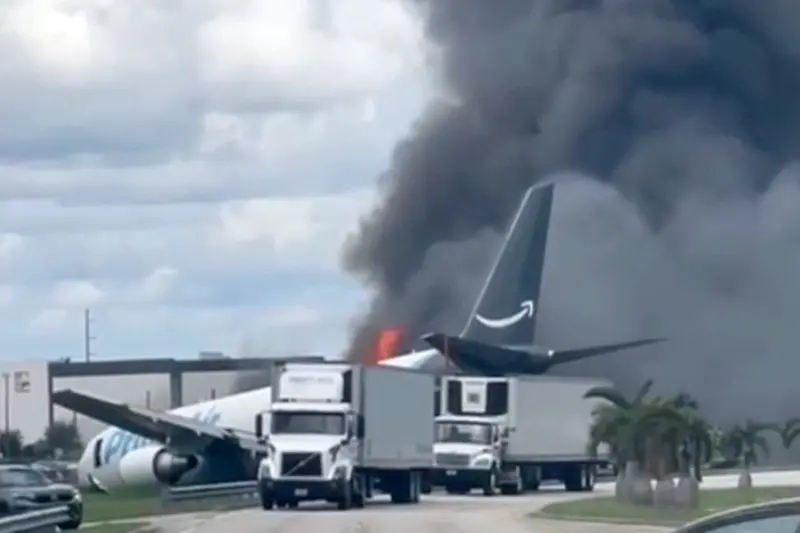
The aircraft subsequently departed the paved runway surface, crossed an airport-adjacent roadway and struck multiple vehicles before coming to rest in the airport vicinity. A major fire broke out, producing heavy black smoke and requiring a large-scale emergency response.
At least five people were killed and five others injured, including three reported to be in critical condition. Authorities have not yet established whether the fatalities were occupants of the aircraft, people on the ground, or a combination of both.
The aircraft was a Boeing 767-33A(ER)(BDSF), registration N1997A, operated by North Carolina-based 21 Air on behalf of Amazon Prime Air. Flightradar24 identifies the aircraft as approximately 32 years old. It was originally manufactured as a passenger aircraft and operated in passenger service before being converted to a freighter in 2015.
The aircraft is powered by two General Electric CF6-80C2B6F turbofan engines.
This is important from an engineering perspective because the investigation will have to distinguish between a problem with the aircraft's systems and a runway-performance event. A 767 landing involves several independent but interrelated sources of deceleration:
A failure or degradation in any one element does not automatically make a runway overrun inevitable, but the combined performance of these systems will be central to the investigation.
One of the most important investigative questions will be the aircraft's actual touchdown point.
Video circulating from the accident appears to show the 767 remaining airborne for an unusually long distance before touchdown. Investigators will therefore reconstruct the approach and determine precisely where the main landing gear contacted the runway.
Flightradar24's analysis indicates that the aircraft exited the usable runway area at approximately 112 knots, with the last received speed around 69 knots. The aircraft ultimately came to rest roughly 1,500 feet (460 meters) beyond the runway end, according to preliminary accident information.
Those figures will be important, but they do not by themselves establish the cause.
Investigators will need to reconstruct the aircraft's speed continuously from flight-data-recorder information, determine the touchdown point, calculate the aircraft's weight and configuration, and establish how rapidly it decelerated once the wheels contacted the runway.
For a large jet, touchdown distance is critical because every additional second spent airborne above the runway consumes valuable pavement without generating the wheel braking forces available after touchdown.
Once the aircraft is on the ground, the crew needs sufficient runway remaining to transition from aerodynamic flight to ground deceleration.
The sequence normally involves:
Touchdown → spoilers deploy → weight transfers onto landing gear → wheel brakes become effective → reverse thrust assists deceleration → aircraft slows to taxi speed.
If touchdown occurs significantly farther down the runway than planned, the aircraft may have insufficient pavement remaining even if all braking systems function normally.
The investigation will therefore examine whether the aircraft crossed a point at which a go-around should have been initiated rather than continuing the landing.
However, it would be premature to conclude that a late touchdown caused this accident. Only the flight-data recorder, cockpit voice recorder, air-traffic-control recordings, weather data, aircraft maintenance records and other evidence can establish what happened.
Weather appears likely to be another important investigative factor.
Flightradar24 reported conditions around the time of landing that included thunderstorms and gusting winds. The reported METAR included winds from approximately 190° at 17 knots, gusting to 26 knots, with thunderstorms and cumulonimbus clouds in the vicinity of the airport. A wind shift was also reported.
For a landing aircraft, wind direction matters greatly.
A headwind generally reduces the aircraft's groundspeed for a given indicated airspeed, while a tailwind increases groundspeed and therefore the distance required to stop.
A sudden wind shift or gust can also affect the approach path and touchdown point. Investigators will examine:
The weather data will ultimately be compared with the aircraft's performance calculations and the crew's operational procedures.
Another major investigative branch will concern the aircraft's deceleration.
Investigators will inspect the brake assemblies, wheels, tires, antiskid system, hydraulic systems, spoilers, thrust reversers and associated control systems.
The 767's braking system uses antiskid technology to regulate brake pressure and prevent wheel lock. If the aircraft's wheels are not rotating at an appropriate rate relative to the runway, the system can reduce brake pressure and subsequently restore it as conditions permit.
Investigators will therefore want to know:
Were the brakes commanded? Did they produce the expected braking forces? Did the antiskid system activate normally? Were the spoilers deployed? Were the thrust reversers selected and operating correctly?
Equally important, investigators will determine whether any mechanical anomaly occurred before the runway excursion or was simply a consequence of the crash.
That distinction is essential. Fire, structural damage and engine damage following an overrun can create numerous apparent failures that were not responsible for the original event.
The accident created an extremely complex rescue environment.
Miami-Dade Fire Rescue deployed more than 60 units and approximately 200 personnel to the scene. Firefighters encountered heavy flames and smoke from the aircraft and conducted search-and-rescue operations involving the cockpit as well as people trapped in vehicles struck by the aircraft.
A fuel leak was also reported at the crash site.
Firefighters reportedly faced additional challenges involving the aircraft's engines. The emergency response included specialized airport firefighting equipment and foam to suppress the aircraft fire.
From an accident-investigation standpoint, the post-impact fire is important but must be separated from the initial runway-excursion sequence.
Investigators will determine whether the engines were operating normally during the landing, whether thrust reversers functioned as expected and whether any engine abnormality preceded the excursion.
Another issue receiving attention is the absence of an Engineered Materials Arresting System (EMAS) at the runway involved.
EMAS is designed for aircraft that overrun a runway. It consists of lightweight, crushable material installed beyond the runway end. As an aircraft enters the bed, its landing gear sinks into the material, generating additional drag and rapidly reducing the aircraft's kinetic energy.
The FAA says a standard EMAS installation is designed to stop the airport's critical aircraft when entering the system at 70 knots or less. The agency says EMAS installations have safely stopped 26 overrunning aircraft carrying 497 passengers and crew.
But the absence of EMAS at Miami should not automatically be interpreted as an airport safety deficiency.
Runway safety areas are designed to provide additional space beyond the runway, and the FAA recognizes that the physical environment around airports can make full standard safety areas difficult to achieve. EMAS is particularly useful where land limitations prevent adequate conventional runway safety areas.
Investigators and airport authorities will therefore examine the runway-end geometry, available safety area, surrounding roads and infrastructure and whether additional mitigation measures could have reduced the consequences of this particular excursion.
The aircraft landed on Runway 30, which is approximately 9,355 feet (2,851 meters) long according to Miami International Airport's published runway information.
That runway length provides substantial stopping distance for appropriately configured aircraft, but runway length alone does not determine whether a landing is safe.
Landing performance depends on a combination of:
Aircraft weight + touchdown speed + runway remaining + wind + runway friction + braking action + spoilers + reverse thrust + runway slope + aircraft configuration.
A relatively small change in touchdown speed can have a disproportionately large effect on kinetic energy because kinetic energy varies with the square of velocity:
KE = ½mv²
Consequently, an aircraft arriving at a higher groundspeed carries substantially more kinetic energy that must be dissipated through aerodynamic drag, wheel braking and reverse thrust.
This is one reason accurate touchdown speed and stopping-performance data will be central to the NTSB investigation.
The National Transportation Safety Board (NTSB) is leading the investigation, with the FAA also involved. NTSB Chairwoman Jennifer Homendy is expected to lead the agency's response in Miami.
Investigators are expected to recover and analyze:
The investigators will also reconstruct the aircraft's trajectory from the approach through touchdown, runway deceleration, runway departure and final impact.
The Miami accident also comes less than two years after another fatal cargo-aircraft accident involving a Boeing 767.
In February 2019, Atlas Air Flight 3591, a Boeing 767-300 freighter, crashed into Trinity Bay, Texas, during a rapid descent while approaching Houston. The NTSB investigation ultimately examined flight-control and human-factors issues surrounding the accident.
The two accidents are technically very different and should not be conflated. Nevertheless, they demonstrate why the 767 freighter fleet continues to receive close attention from operators, regulators and investigators.
The Miami accident is fundamentally a runway-excursion investigation. The central question is not simply why the aircraft failed to stop, but how the aircraft arrived at the point where it could no longer stop within the available runway.
That distinction will be critical.
Investigators must determine whether the initiating factor was a late touchdown, excessive approach or touchdown speed, wind or weather, runway condition, braking performance, aircraft malfunction, crew decision-making, or a combination of several factors.
Until the flight recorders and physical evidence are analyzed, any single-cause explanation remains premature.
What is already clear is that a routine cargo arrival at one of the United States' busiest international freight airports turned into a catastrophic runway excursion, crossing the boundary between aviation operations and the surrounding ground environment.
The NTSB's reconstruction of those final minutes—and particularly the aircraft's approach profile, touchdown point, groundspeed and deceleration after touchdown—will be central to explaining how the Boeing 767 left the runway and why the consequences were so severe.

.jpg)