
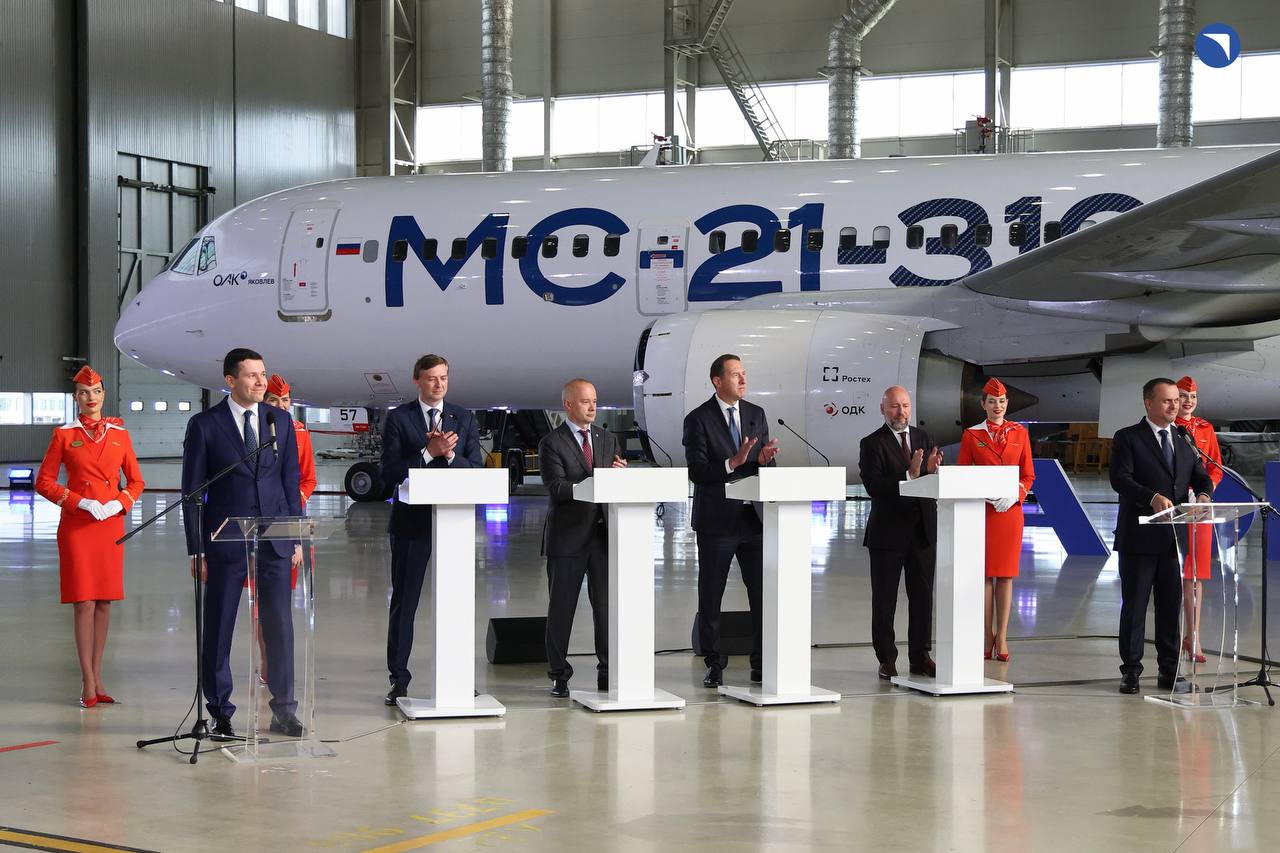
Aeroflot’s order for 90 MC-21-310 aircraft is about far more than adding another aircraft type to its fleet. The agreement gives Russia’s largest airline a long-term plan for introducing a domestically produced narrowbody aircraft, while giving the manufacturer a firm production pipeline and Aeroflot an integrated package covering aircraft, training, simulators and technical support.
Aeroflot signed the contract with three Rostec companies—United Aircraft Corporation (UAC), Aviacapital-Service and United Engine Corporation (UEC)—on September 18, 2026. The 90 aircraft are scheduled for delivery between 2029 and 2032: 14 in 2029, 18 in 2030, 24 in 2031 and 34 in 2032.
The agreement is in addition to Aeroflot’s earlier contract for 18 MC-21 aircraft, bringing its total planned MC-21 fleet to 108 aircraft. The first 18 are scheduled for delivery in 2027 and 2028.
A long-term replacement for foreign narrowbody aircraft
The most important reason for the order is Aeroflot’s need for a long-term source of narrowbody aircraft that can be supported within Russia.
Aeroflot currently operates a large fleet of Airbus and Boeing narrowbody aircraft. According to recent industry data, the airline has around 58 Airbus A320s, 35 A321s and 37 Boeing 737-800s, although some aircraft are parked. Aeroflot has also indicated that many of its Western-built aircraft could remain in service into the 2030–2035 period because they still have useful operating life.
That makes the MC-21 less of an immediate replacement programme and more of a long-term fleet transition.
The delivery schedule reflects that approach. Rather than receiving all 90 aircraft within a few years, Aeroflot will progressively introduce the aircraft from 2029 through 2032. This gives the airline time to establish the MC-21 operational infrastructure while its existing Airbus and Boeing aircraft continue flying.
The MC-21 is intended for Aeroflot's core narrowbody market
The MC-21-310 is designed for the medium-haul, single-aisle segment—the same broad market in which aircraft such as the Airbus A320 family and Boeing 737 family operate.
Yakovlev describes the aircraft as having a capacity of up to 211 passengers. The Russian-powered MC-21-310 uses the Aviadvigatel PD-14 engine and incorporates a substantially localized set of systems and components.
For Aeroflot, that makes the aircraft relevant to the high-volume part of its network rather than a specialist or niche fleet.
Aeroflot has previously said that its first MC-21 aircraft would initially be deployed on relatively short routes, including Moscow–St. Petersburg and Moscow–Nizhny Novgorod. Such routes can provide operational experience while allowing technical support and replacement capacity to be maintained relatively close at hand.
The 22-year support package is particularly significant
One of the most important aspects of the agreement is that Aeroflot did not simply order 90 airframes.
The contract includes flight simulators, crew training, technical-personnel training, maintenance software and post-sale technical support for 22 years. The support arrangement covers the entire planned fleet of 108 MC-21s, including the 18 aircraft from the earlier contract.
This structure addresses one of the biggest challenges of introducing a new aircraft: creating an ecosystem around it.
An airline needs trained pilots, cabin crew, engineers, maintenance procedures, software, spare parts and technical expertise before a new aircraft can become a dependable part of its daily operation.
By putting these elements into the same long-term agreement, Aeroflot and the manufacturers are attempting to reduce the risk associated with the aircraft's entry into service.
Aeroflot CEO Sergey Alexandrovsky has said that the airline is already preparing personnel for the new type, including pilots, cabin crew and engineers.
The order also gives the MC-21 programme production certainty
There is another side to the agreement: the order provides UAC with a substantial and predictable production backlog.
Rostec says manufacturing a passenger aircraft takes roughly 1.5 to two years and that the Aeroflot contract provides a clear production workload for years ahead, creating a foundation for increasing serial production.
That matters because the MC-21 programme is moving from development and certification toward regular series production.
Aeroflot is effectively becoming the aircraft's launch operator at a time when the Russian aviation industry is attempting to establish a sustainable domestic production and support system for the type.
The scale of the order therefore works in both directions: Aeroflot receives a defined future supply of aircraft, while the manufacturer receives a firm customer and a predictable production schedule.
The sanctions-driven shift to domestic technology is another factor
The MC-21 programme originally involved international suppliers. Following the withdrawal of Western partners after sanctions were imposed on Russia in 2022, the aircraft underwent an extensive localization effort.
Rostec says roughly 80 domestic systems and components were developed for the aircraft, including the engine. The MC-21-310 represents the version of the aircraft developed around the Russian PD-14 powerplant and domestically supplied systems.
Consequently, Aeroflot's commitment is also closely connected to the development of Russia's domestic civil-aircraft supply chain.
The airline's order does not by itself guarantee that every production or certification target will be achieved on schedule. The MC-21 has experienced development and certification delays, and the Russian authorities and industry currently expect certification of the localized aircraft and the beginning of serial production in 2027.
That makes the 2029–2032 delivery programme significant: much of Aeroflot's large-scale MC-21 expansion is dependent on the aircraft successfully completing certification and reaching sustained production.
Why 90 aircraft?
The size of the order becomes easier to understand when viewed as a fleet programme rather than a single purchase.
Aeroflot will already have 18 MC-21s arriving in 2027–2028. Adding another 90 creates a planned fleet of 108 aircraft. This is large enough to support a dedicated operational ecosystem, including pilot training, simulators, maintenance capabilities and technical personnel.
It also allows Aeroflot to spread the introduction of the aircraft over several years rather than attempting a rapid fleet conversion.
The annual delivery schedule—14 aircraft in 2029, 18 in 2030, 24 in 2031 and 34 in 2032—also indicates an intended gradual increase in the MC-21's presence within the airline.
It is not simply an immediate Airbus and Boeing replacement
An important point is that the order should not be interpreted as Aeroflot planning to replace its entire Western-built narrowbody fleet immediately.
The airline has indicated that many of its Airbus and Boeing aircraft have sufficient remaining useful life to continue operating into the 2030s.
Instead, the MC-21 order establishes a substantial future domestic narrowbody fleet alongside existing aircraft.
Over time, the 108-aircraft programme could therefore provide Aeroflot with a significant alternative to relying on foreign-built narrowbody aircraft for future fleet renewal.
A strategic partnership rather than a simple aircraft purchase
The structure of the contract is arguably as important as the 90-aircraft figure.
Aeroflot gets aircraft, simulators, training and long-term maintenance support. UAC and its partners get a major launch customer and a long-term production commitment. The Russian aerospace industry gets a large-scale operational customer for its new narrowbody programme.
That explains why the agreement runs for such a long period and why technical support has been built into the package.
Aeroflot has described itself as the launch operator of the MC-21, while UAC has characterized the relationship as a strategic partnership aimed at ensuring an effective entry into service.
The bigger picture
Aeroflot's decision to sign for 90 additional MC-21-310s can therefore be understood through several overlapping objectives:
Fleet renewal: The aircraft provides a future narrowbody option as Aeroflot's existing fleet ages.
Domestic supply: The MC-21 offers an aircraft developed around Russian engines and locally produced systems.
Operational scale: A planned fleet of 108 aircraft is large enough to justify dedicated training and maintenance infrastructure.
Long-term support: The 22-year technical-support arrangement reduces the need for Aeroflot to build the entire support ecosystem independently.
Production planning: The order gives UAC a firm workload extending into 2032.
Launch-operator role: Aeroflot will provide the MC-21 programme with a large-scale commercial operator as the aircraft enters regular service.
Gradual introduction: Deliveries over 2027–2032 allow the airline to introduce the aircraft progressively rather than replace its existing narrowbody fleet at once.
Conclusion
Aeroflot's 90-aircraft MC-21-310 agreement is best viewed as a long-term fleet and industrial programme, rather than simply a large aircraft order.
The airline is committing to a planned fleet of 108 MC-21s while securing the simulators, personnel training and 22 years of technical support needed to operate them. At the same time, the agreement gives Russia's aircraft industry a firm production backlog as it attempts to move the MC-21 from a development programme into sustained series production.
The decisive test, however, will come with entry into service. The MC-21 must complete certification, achieve reliable series production and demonstrate that its support system can deliver the availability and economics required by a major airline. Aeroflot's 2029–2032 delivery schedule therefore represents not only a fleet plan, but also a long-term test of whether the MC-21 can become the backbone of Russia's next generation of domestically supplied narrowbody aviation.


(1).jpg)